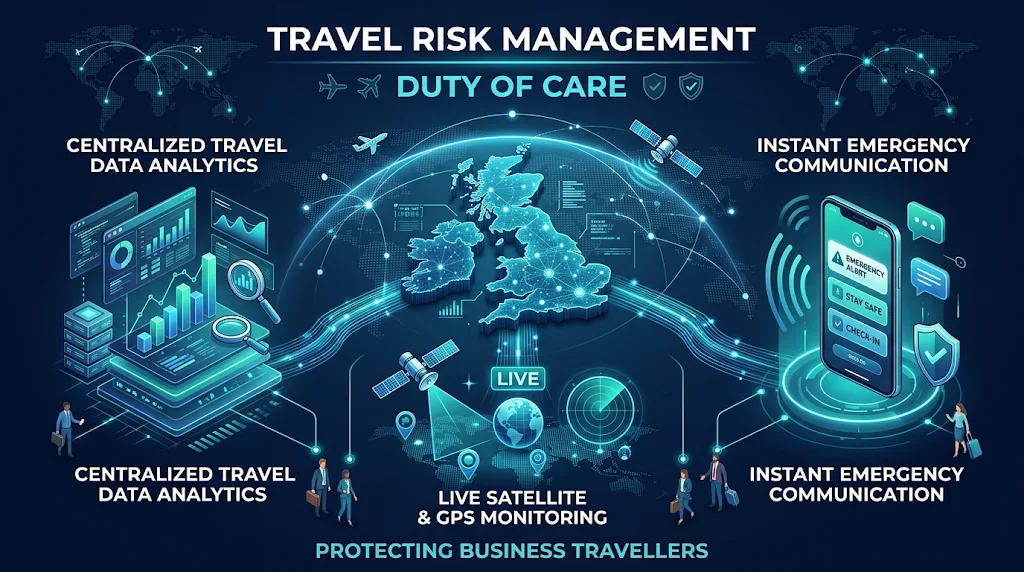
Travel Risk Management Technology UK | Duty of Care for Travel Businesses
Discover how UK travel businesses can improve traveller safety, duty of care, risk monitoring, emergency communication and travel risk management through connected technology.
Travel Risk Management Technology UK
Travel Duty of Care UK, Travel Risk Management Software, Traveller Safety Technology, Corporate Travel Risk Management, Travel Emergency Communication, Travel Risk Monitoring, Travel Management Systems, Business Travel Safety, Travel Data Integration, Travel Security Solutions.
Travel risk management UK, travel duty of care, travel safety technology, corporate travel risk, traveller tracking software, travel emergency management, travel risk monitoring systems, business travel security, travel compliance technology, travel management software UK, traveller communication systems, travel incident reporting, travel risk assessment, travel data management, travel operations technology.
UK travel management companies, corporate travel providers, tour operators, travel agencies, business travel departments and organisations managing employee travel.
Travel Risk Management and Duty of Care Technology for UK Travel Businesses
Travel businesses have a responsibility to manage more than bookings, itineraries and customer payments. They also need to consider traveller safety, unexpected disruptions, emergency communication and the ability to respond when travel plans are affected by changing circumstances.
For UK travel management companies, corporate travel providers and tour operators, managing these responsibilities can become increasingly complicated as the number of travellers, destinations and supplier relationships grows.
A traveller may be visiting another country for a business meeting, attending an international event or travelling as part of an organised tour. During the journey, unexpected situations can arise, including transport disruption, severe weather, medical emergencies, security incidents or sudden changes to local travel conditions.
When traveller information is scattered across booking platforms, spreadsheets, email conversations and separate communication applications, responding to these situations can take valuable time.
This is where travel risk management technology becomes important.
A connected technology environment can help travel businesses maintain organised traveller records, communicate relevant updates, document incidents and support more structured decision-making.
For UK organisations, the objective is not simply to introduce another software platform. It is to build a reliable operational process that connects traveller information, risk assessment, communication and incident management.
1. What Is Travel Risk Management?
Travel risk management is the process of identifying, assessing, monitoring and responding to potential risks that may affect people travelling for business, leisure or organised activities.
It involves understanding the circumstances of a journey, identifying relevant risks and establishing procedures for communication and support.
A travel risk management framework may include:
Traveller identification and contact information.
Destination-specific risk assessments.
Travel itinerary visibility.
Emergency contact procedures.
Travel disruption monitoring.
Incident reporting and escalation.
Communication with travellers.
Internal responsibility and approval processes.
Post-incident documentation.
The level of support required depends on the organisation, destination, travel purpose and nature of the journey.
A corporate travel provider managing international employee travel may require a different approach from a small leisure travel agency organising domestic holidays.
Technology can help both types of businesses organise information and improve operational visibility.
2. Why UK Travel Businesses Need Better Traveller Risk Visibility
Many travel businesses use multiple systems to manage different stages of a journey.
Booking information may exist in one application, customer contact details in a CRM, travel documents in cloud storage and emergency communication records in email or messaging platforms.
This creates an information gap.
When an unexpected event occurs, employees may need to search several applications to establish:
Who is currently travelling?
What destination are they visiting?
What are their scheduled travel dates?
Which accommodation or transport arrangements are confirmed?
How can the traveller be contacted?
Who is responsible for responding?
Has the incident already been reported?
What action has been taken?
A structured information environment can reduce the need to collect these details manually.
For organisations reviewing their wider technology requirements, Nexteck's business technology and software architecture services provide a starting point for assessing how different business systems can work together.
3. Creating a Centralised Traveller Information System
A centralised traveller information system helps authorised employees access relevant journey information from a consistent location.
Depending on the organisation's operating model, the system may contain:
Traveller profiles: Basic contact information, relevant travel preferences and authorised emergency contact details.
Journey information: Destination, departure date, return date, itinerary and booking references.
Supplier information: Relevant hotel, transport provider and local service contact details.
Emergency procedures: Internal escalation contacts, response instructions and approved communication channels.
Incident records: Reported issues, timestamps, assigned personnel, actions taken and resolution status.
The objective is to make important information easier to retrieve without unnecessarily duplicating sensitive personal data.
Businesses should apply appropriate access permissions, data minimisation, retention policies and security controls when designing these systems.
4. Travel Risk Assessment and Destination Monitoring
Travel risks can vary significantly between destinations and can change over time.
A risk assessment process should consider relevant factors before a journey begins and establish how important changes will be reviewed.
Depending on the travel context, relevant considerations may include:
Local security conditions.
Weather-related disruption.
Transport reliability.
Public health information.
Local infrastructure.
Political or civil disruption.
Accessibility requirements.
Availability of local support.
Travel businesses can use authorised information sources and internal assessment procedures to organise relevant information.
A digital workflow can help employees record the assessment, identify the person responsible for reviewing it and document any decisions.
For example, a company arranging international employee travel may require a pre-travel review for destinations where additional planning or approval is appropriate.
The system could record the destination, assessment date, responsible reviewer, identified concerns and required follow-up actions.
Technology should support professional judgement rather than automatically treating every destination as safe or unsafe.
5. Real-Time Traveller Communication and Emergency Notifications
Communication is one of the most important elements of traveller support.
When a flight is cancelled, severe weather affects transport or a local incident changes travel arrangements, travellers may need timely and accurate information.
However, communication becomes difficult when contact details are outdated or employees are unsure which channel should be used.
A connected communication workflow can help organisations:
Maintain verified contact details.
Identify affected travellers.
Send relevant travel updates.
Record when a message was issued.
Track acknowledgement where supported.
Escalate unanswered emergency communications.
Maintain an audit trail of important interactions.
Communication channels may include email, SMS, approved messaging platforms or telephone contact.
The selected channel should reflect the urgency of the situation and the traveller's communication preferences.
Emergency notifications should be reviewed carefully before distribution. Incorrect or unverified information can create confusion and unnecessary concern.
6. Managing Travel Disruptions Through Connected Workflows
Travel disruption is not limited to flight cancellations.
A journey may be affected by:
Rail service interruptions.
Severe weather.
Hotel booking problems.
Supplier cancellations.
Missed connections.
Road closures.
Changes to event schedules.
Local transport availability.
Without a structured process, employees may handle every disruption differently.
A travel disruption management workflow can establish clear steps.
Step 1: Record the disruption
Capture the reported issue, affected journey and time of notification.
Step 2: Identify affected travellers
Use available itinerary and booking records to establish which travellers may be affected.
Step 3: Assess the impact
Determine whether the issue requires a booking change, customer notification, alternative arrangement or escalation.
Step 4: Assign responsibility
Allocate the case to the appropriate employee or support team.
Step 5: Communicate the response
Share verified information and relevant next steps with affected travellers.
Step 6: Record the outcome
Maintain a record of actions, decisions and final resolution.
This approach can help improve consistency and reduce confusion during busy operational periods.
7. Integrating Travel Risk Systems with Existing Business Applications
A travel risk management platform should not operate as an isolated database if relevant information already exists elsewhere.
Potential integration points include:
Travel booking platforms.
Customer relationship management systems.
Human resources applications.
Corporate travel management systems.
Email and communication platforms.
Document management solutions.
Reporting and analytics applications.
For example, a booking platform may contain journey details, while an HR system maintains employee information.
Where authorised integrations are available, relevant information can be exchanged to support a more complete traveller record.
However, integrations must be designed carefully.
Not every supplier offers an API, and not every field should be shared between systems. Businesses should define the purpose, permissions and security requirements of each integration.
Nexteck's industry and sector technology capabilities can help organisations explore technology requirements across different business environments.
8. How AI Can Support Travel Risk Management
Artificial intelligence can assist with selected administrative and information-management tasks.
Potential applications include:
Travel information classification: Organising incoming travel disruption reports by category.
Document information extraction: Extracting relevant journey details from approved travel documents for employee verification.
Internal knowledge search: Helping authorised employees locate approved emergency procedures and internal policies.
Incident summaries: Preparing structured summaries from recorded incident information.
Communication drafting: Helping employees prepare clear updates using verified information.
AI should not independently make high-impact emergency decisions or present unverified information as fact.
For example, an AI assistant should not invent a destination warning, claim that a traveller is safe without evidence or automatically change a confirmed booking without proper authorisation.
Human review, reliable source information and clearly defined escalation procedures remain essential.
9. Data Protection, Privacy and Security Considerations
Traveller information may contain personal and potentially sensitive details.
UK travel businesses should consider their obligations under applicable data protection legislation, including UK GDPR and the Data Protection Act 2018.
A well-designed system should consider:
Data minimisation.
Appropriate lawful processing.
Role-based access permissions.
Secure authentication.
Encryption where appropriate.
Retention and deletion procedures.
Supplier and processor responsibilities.
Incident response procedures.
Audit logging.
Secure information sharing.
Businesses should avoid collecting detailed personal information simply because a system makes it technically possible.
Access should be limited to employees who need the information for legitimate business purposes.
Organisations should also review how third-party travel providers, technology vendors and communication platforms process traveller information.
10. Measuring Travel Risk Management Performance
A travel risk management programme should be reviewed regularly.
Operational indicators can help management understand whether procedures are working effectively.
| KPI | What it helps measure |
|---|---|
| Traveller record completeness | Availability of essential journey information |
| Emergency contact verification | Accuracy of contact records |
| Incident acknowledgement time | Speed of initial response |
| Incident resolution time | Time taken to close reported issues |
| Communication delivery status | Whether messages are successfully delivered |
| Escalation completion | Whether cases reach the responsible team |
| Risk assessment coverage | Proportion of relevant journeys assessed |
| Incident documentation completeness | Quality of recorded information |
These indicators should be interpreted in context. A lower incident count does not automatically mean that a travel risk programme is effective.
The purpose of reporting is to identify operational weaknesses and improve the quality of traveller support.
11. Building a Travel Risk Technology Roadmap
Travel businesses should not begin by purchasing multiple monitoring and communication applications.
A more practical approach is to understand the current process and identify where technology can create measurable operational value.
Phase 1: Review current travel operations
Document how traveller information, destination assessments, disruptions and incidents are currently managed.
Phase 2: Identify information gaps
Review whether essential information is duplicated, difficult to access or stored in disconnected applications.
Phase 3: Define system requirements
Establish the necessary functionality, integrations, permissions and reporting requirements.
Phase 4: Implement priority workflows
Start with important processes such as traveller records, incident reporting and emergency communication.
Phase 5: Test and train
Test realistic travel disruption scenarios and train employees on their responsibilities.
Phase 6: Review performance
Monitor operational indicators and improve the system as the business grows.
Businesses can use the Nexteck SME Strategy & Tracking Toolkit to organise technology priorities, document operational gaps and track improvement actions.
12. The Future of Travel Risk Management Technology in the UK
Travel operations are becoming increasingly connected.
Businesses are using digital booking systems, customer platforms, mobile communication and data analytics to improve the way journeys are organised.
The next stage is to connect these capabilities with more structured risk management processes.
For travel businesses, this means improving the visibility of traveller information, making communication more organised and establishing clear responsibilities when unexpected situations occur.
The most effective technology strategy will depend on the organisation's size, travel destinations, customer requirements and existing systems.
A small travel agency may need a straightforward traveller information and incident reporting process. A corporate travel management provider may require more advanced integrations, access controls and reporting capabilities.
The important principle is to select technology based on operational needs rather than adopting tools without a defined purpose.
Frequently Asked Questions
What is travel risk management technology?
Travel risk management technology includes digital systems used to organise traveller information, assess potential risks, monitor disruptions, communicate updates and document incidents.
Why is duty of care important for UK travel businesses?
Duty of care is an important consideration for organisations arranging or managing travel. Businesses should understand their legal and contractual responsibilities and establish appropriate procedures to support traveller safety.
Can travel risk management software integrate with booking platforms?
Yes. Where suitable APIs or approved integration methods are available, travel risk systems can exchange relevant journey information with booking platforms and other business applications.
Can AI monitor travel risks automatically?
AI can assist with organising information and identifying patterns from approved data sources. Important risk decisions and emergency responses should remain subject to appropriate human review.
What information should a traveller management system contain?
It may include authorised traveller contact information, journey details, relevant booking references, emergency procedures and incident records. Organisations should only collect information necessary for their stated purposes.
How can a travel company improve emergency communication?
A business can establish verified contact records, approved communication channels, clear escalation procedures and documented incident workflows.
Is travel risk management only for corporate travel providers?
No. Corporate travel providers, tour operators, travel agencies and other organisations managing journeys may benefit from structured travel risk management processes.
Improve Your Travel Business Technology and Operational Readiness
Managing travel risk requires more than sending occasional travel updates. Businesses need organised information, clear procedures, reliable communication and technology that supports employees when unexpected situations occur.
Nexteck helps organisations assess business technology, review operational processes and identify suitable software integration opportunities.
If your travel business is managing traveller information across disconnected systems or struggling to maintain visibility during travel disruptions, a structured technology assessment can help identify practical improvements.
Explore Nexteck's technology services, review its industry capabilities and use the SME Strategy & Tracking Toolkit to organise your next steps.
Build a more connected, organised and responsive travel operation with the right technology strategy.