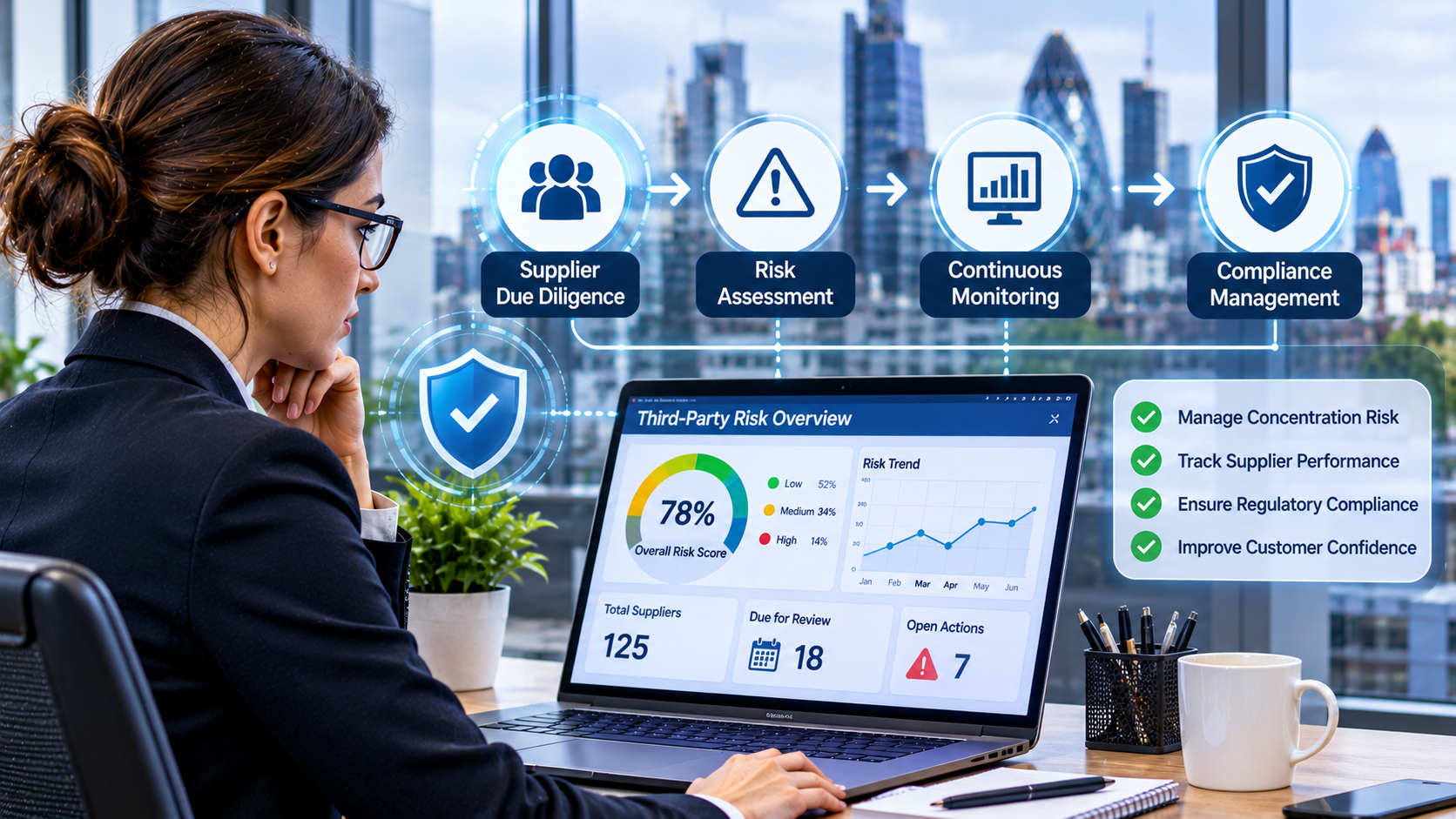
Third-Party Risk Management Automation UK | Financial Services
Discover how UK financial services firms can automate third-party risk management, supplier due diligence, vendor monitoring and concentration risk reporting.
Third-party risk management automation UK
Third-party risk management software, supplier risk management UK, financial services vendor risk, automated supplier due diligence, third-party risk assessment, vendor compliance monitoring, supplier concentration risk, outsourcing risk management, financial services risk automation, continuous supplier monitoring.
UK financial services technology, London financial services consultants, UK banking technology solutions, UK fintech risk management, financial services automation London, UK insurance technology.
Commercial and informational
Introduction: Why Third-Party Risk Has Become a Business-Critical Issue
UK financial services organisations depend on an increasingly complex network of external suppliers. Cloud hosting providers, payment processors, software vendors, data providers, outsourced operations teams, cybersecurity specialists and professional service partners all contribute to daily business activity.
These relationships can improve efficiency, reduce operating costs and give businesses access to specialist capabilities. However, every external relationship can also introduce risks involving information security, service availability, regulatory compliance, financial stability, data protection and operational dependency.
The challenge is not simply identifying risky suppliers during onboarding. The real challenge is maintaining accurate, current and connected information throughout the entire supplier lifecycle.
Many organisations still manage vendor information through disconnected spreadsheets, email approvals, shared folders and manually updated risk registers. As supplier networks expand, this approach becomes difficult to maintain. Important documents expire, review dates are missed, ownership becomes unclear and management teams struggle to identify which supplier relationships create the greatest exposure.
Third-party risk management automation provides a structured way to connect supplier information, due diligence, risk assessments, contractual obligations, monitoring activities and management reporting.
For UK banks, fintech companies, insurers, investment firms and other regulated financial services businesses, a connected approach can support stronger oversight and more informed operational decisions.
Organisations looking to improve their wider technology architecture can explore Nexteck's technology and business solutions to understand how connected systems and automation can support business operations.
1. What Is Third-Party Risk Management?
Third-party risk management, commonly referred to as TPRM, is the process of identifying, assessing, managing and monitoring risks associated with external suppliers and service providers.
It covers the complete supplier lifecycle:
Initial supplier identification and classification.
Due diligence before engagement.
Security and compliance assessments.
Contractual risk reviews.
Approval and onboarding.
Ongoing performance monitoring.
Periodic reassessment.
Incident management.
Contract renewal and termination.
A mature third-party risk management process should provide a clear picture of who the organisation depends on, what services those suppliers deliver, what information they access and what could happen if a supplier fails.
For example, a payment provider may be responsible for processing customer transactions. A cloud hosting supplier may support a business-critical application. A customer verification provider may influence whether new accounts can be opened.
These relationships do not carry identical risks. Their importance depends on the service, data access, operational dependency, substitutability and potential impact of disruption.
This is why supplier risk management should move beyond a basic vendor checklist towards a structured, risk-based operating model.
2. Why Manual Supplier Risk Management Creates Problems
Manual processes can work when an organisation has a small number of suppliers. They become increasingly difficult when supplier relationships span multiple departments, systems and business units.
Fragmented supplier information
Supplier information is frequently distributed across procurement platforms, contract repositories, finance systems, spreadsheets and email conversations.
This fragmentation makes it difficult to establish a reliable supplier record. Different departments may hold different versions of a contract, assessment or supplier contact list.
A centralised supplier data model can bring these records together and provide a consistent view of each relationship.
Missed reassessment dates
Supplier risks change over time. A provider may experience a security incident, undergo an acquisition, change its subcontractors or introduce new technology.
If reassessments depend entirely on calendar reminders and manual follow-ups, important reviews can be delayed.
Automated reminders, escalation rules and review workflows can help teams identify overdue assessments before they become significant control gaps.
Limited visibility of supplier dependencies
A business may depend on several suppliers that ultimately rely on the same cloud infrastructure, data centre, telecommunications provider or subcontractor.
Looking at each supplier independently may conceal concentration risk.
A connected third-party risk platform can help map important dependencies and highlight relationships that deserve further investigation.
Inconsistent risk assessments
Different departments may use different questionnaires, scoring methods and approval criteria.
Without consistent assessment standards, comparing supplier risks becomes difficult.
A standardised framework can introduce common categories, evidence requirements, scoring rules and approval thresholds while still allowing sector-specific requirements.
3. The Core Components of an Automated TPRM Framework
A useful third-party risk management system should connect the following capabilities.
A. Central supplier inventory
The supplier inventory is the foundation of the entire process.
Each supplier record should contain relevant information such as:
Legal entity and trading name.
Service description.
Internal business owner.
Contract start and renewal dates.
Business units using the service.
Data access and information classification.
Criticality and service dependency.
Subcontractor relationships.
Risk assessment status.
Outstanding remediation actions.
The inventory should integrate with procurement, finance, contract management and other relevant systems where appropriate.
This reduces duplicate records and helps organisations maintain a more reliable view of their supplier ecosystem.
B. Automated supplier due diligence
Supplier due diligence should be proportionate to the service being provided.
A low-risk supplier may require a relatively simple assessment. A provider handling sensitive customer information or supporting critical business services may require more detailed reviews.
An automated workflow can:
Send the relevant assessment questionnaire.
Collect supplier responses.
Request supporting documents.
Assign questions to internal reviewers.
Flag missing or inconsistent information.
Route high-risk findings for approval.
Record decisions and supporting evidence.
This creates a repeatable process and reduces the administrative effort involved in chasing information.
C. Risk scoring and classification
Risk scoring should help teams prioritise attention rather than create a misleading impression of mathematical certainty.
A supplier assessment may consider:
Information security risk.
Data protection risk.
Operational dependency.
Financial stability.
Regulatory relevance.
Business continuity arrangements.
Geographic exposure.
Subcontracting complexity.
Service substitutability.
The system can combine these factors into a risk classification, provided the scoring methodology is transparent and subject to appropriate human review.
D. Contract and obligation tracking
Contracts contain important information about service levels, security requirements, audit rights, incident notification, subcontracting and termination arrangements.
A contract management integration can help connect these obligations to supplier records and operational controls.
For example, a supplier contract renewal date can trigger an internal review. A change in service scope can trigger a reassessment. A missing contractual requirement can create an action for the responsible team.
This helps prevent supplier oversight from becoming disconnected from actual contractual commitments.
4. Managing Supplier Concentration and Fourth-Party Risk
One of the most important challenges in third-party risk management is understanding indirect dependencies.
A financial services firm may use multiple technology suppliers, but several of those providers may depend on the same underlying cloud platform or infrastructure company.
This creates concentration risk.
A supplier relationship map can help identify:
Critical services supported by each supplier.
Shared infrastructure dependencies.
Important subcontractors.
Geographic concentration.
Common technology platforms.
Potential single points of failure.
Alternative service providers.
Fourth-party risk refers to risks introduced by a supplier's own suppliers and subcontractors.
For example, a software provider may outsource data hosting to another company. The financial services firm may not have a direct contract with that hosting provider, but its operations could still depend on the provider's availability and security.
Automated dependency mapping can improve visibility, although organisations may need supplier disclosures, contractual information and specialist reviews to establish an accurate picture.
5. Continuous Supplier Monitoring and Early-Warning Indicators
A supplier assessment completed during onboarding can quickly become outdated.
Continuous monitoring provides a way to identify events that may require a reassessment.
Depending on the supplier and available data, monitoring indicators may include:
Security incidents and relevant alerts.
Changes in ownership or financial condition.
Service availability issues.
Significant contractual changes.
Regulatory or legal developments.
Changes to subcontracting arrangements.
Expired certifications or assurance documents.
Repeated service-level failures.
Monitoring should be proportionate and based on reliable sources. Automated alerts should not automatically be treated as confirmed evidence of supplier failure.
Instead, alerts should enter a review workflow where an authorised person can validate the information, assess its relevance and decide whether further action is required.
This approach creates a more responsive supplier oversight process.
6. How Integration Connects TPRM With Existing Business Systems
A third-party risk platform should not become another isolated application.
Its value increases when it can exchange relevant information with the systems already used by the organisation.
| Business system | Potential integration |
|---|---|
| Procurement | Supplier onboarding and purchase approvals |
| Finance and ERP | Supplier payments and financial information |
| Contract management | Contract terms, renewal dates and obligations |
| Identity management | Supplier access and user permissions |
| Security platforms | Relevant security events and incidents |
| Service management | Service disruptions and remediation tickets |
| Governance, Risk and Compliance | Risk registers, controls and audit evidence |
| Business intelligence | Supplier risk dashboards and reporting |
Integration requirements should be defined around business processes, data ownership, security and system capabilities.
For businesses reviewing their wider technology landscape, Nexteck's industry solutions provide a useful starting point for understanding sector-focused technology and systems integration.
7. The Role of AI in Third-Party Risk Management
Artificial intelligence can support supplier risk management by reducing repetitive information-processing work.
Potential applications include:
Document extraction: AI can extract relevant information from supplier questionnaires, assurance reports, contracts and policy documents.
Questionnaire analysis: AI can identify incomplete responses, inconsistent answers and areas that require further review.
Risk summarisation: AI can produce concise summaries of supplier findings for authorised reviewers.
Change detection: AI-assisted monitoring can help identify changes in supplier documentation or relevant information.
Evidence classification: Documents can be categorised according to supplier, control, review period or evidence type.
However, AI-generated risk conclusions should not replace accountable decision-making. Sensitive supplier data must be handled under appropriate access controls, retention policies and security requirements.
Human approval remains important for material risk decisions, exceptions and supplier acceptance.
8. A Practical Implementation Roadmap for UK Financial Services Firms
A phased implementation can help organisations improve supplier oversight without creating unnecessary operational disruption.
Phase 1: Assess the existing supplier landscape
Start by identifying current supplier records, business owners, systems, contracts and assessment processes.
Determine where information is stored, which departments own supplier relationships and where the largest visibility gaps exist.
Deliverable: Supplier inventory and current-state process assessment.
Phase 2: Define supplier criticality and risk categories
Create a consistent classification model based on service importance, data access, operational dependency and potential business impact.
Define which suppliers require enhanced due diligence and more frequent review.
Deliverable: Supplier segmentation and risk assessment framework.
Phase 3: Design workflows and integrations
Map the required processes for onboarding, assessments, approvals, renewals, incident reviews and remediation.
Identify the systems that should exchange information and establish data ownership.
Deliverable: TPRM workflow and integration architecture.
Phase 4: Automate evidence and monitoring
Introduce automated questionnaires, document collection, review reminders, action tracking and relevant monitoring alerts.
Ensure that all material decisions have traceable approval records.
Deliverable: Automated supplier review and monitoring workflows.
Phase 5: Introduce management reporting
Develop dashboards that show supplier risk, overdue reviews, outstanding actions, critical dependencies and emerging issues.
Use the information to support management decisions and continuous improvement.
Deliverable: Supplier risk dashboard and governance reporting.
Organisations can use the Nexteck SME Strategy & Tracking Toolkit as a reference point for structured diagnostics, prioritisation, action ownership and KPI governance.
9. KPIs for Measuring Third-Party Risk Management Performance
A successful TPRM programme should measure both process efficiency and the quality of supplier oversight.
| KPI | What it measures |
|---|---|
| Supplier inventory completeness | Whether relevant supplier records are captured |
| Due diligence completion rate | Percentage of required assessments completed |
| Overdue reassessments | Reviews that have passed their target date |
| Critical supplier coverage | Visibility of high-impact supplier relationships |
| Open remediation actions | Outstanding supplier risk issues |
| Average assessment turnaround | Time taken to complete assessments |
| Evidence expiry rate | Documents requiring renewal |
| Concentration risk visibility | Coverage of important supplier dependencies |
| Incident response time | Time taken to review supplier-related incidents |
Targets should be based on the organisation's size, risk appetite, supplier population and regulatory obligations rather than adopting arbitrary industry-wide numbers.
10. Common Mistakes to Avoid
Organisations should avoid treating third-party risk management as a one-time procurement exercise.
Other common mistakes include:
Using the same questionnaire for every supplier.
Relying on incomplete supplier inventories.
Ignoring subcontractor dependencies.
Treating risk scores as definitive decisions.
Automating workflows without defining ownership.
Collecting evidence without checking its relevance.
Failing to connect supplier risks with business services.
Creating dashboards that do not support action.
Introducing AI without suitable data governance.
Automation should strengthen the existing risk management framework, not simply digitise inefficient processes.
11. How Nexteck Can Support Connected Risk and Technology Operations
Third-party risk management is not only a compliance challenge. It is also a technology architecture and operational data challenge.
Supplier information often sits across multiple platforms, while procurement, finance, security and compliance teams follow different processes.
Nexteck works across business technology strategy, bespoke software architecture, systems integration and automation. A structured technology assessment can help organisations identify fragmented processes, prioritise integration opportunities and define a practical implementation roadmap.
For UK financial services firms, the starting point should be understanding the current supplier lifecycle, the systems supporting it and the operational information management teams need.
Explore Nexteck's business technology services or review its industry-focused capabilities to understand how connected technology solutions can support complex business environments.
A structured assessment can also help establish priorities through the Nexteck Strategy & Tracking Toolkit.
If your organisation is managing supplier risk through spreadsheets, disconnected platforms or manual review processes, Nexteck can help assess the technology gaps and identify practical opportunities for improvement.
Frequently Asked Questions
What is third-party risk management automation?
Third-party risk management automation uses software, integrations and structured workflows to manage supplier onboarding, due diligence, risk assessments, evidence collection, monitoring and remediation activities.
Why is third-party risk management important for UK financial services firms?
Financial services organisations rely on external providers for technology, data, payments and operational services. Weak supplier oversight can create security, compliance, service continuity and concentration risks.
What is the difference between vendor risk management and third-party risk management?
Vendor risk management commonly focuses on suppliers and vendors. Third-party risk management is a broader term that can include suppliers, outsourced service providers, partners, subcontractors and other external dependencies.
How does automation improve supplier due diligence?
Automation can distribute questionnaires, collect documents, assign reviews, identify missing information, track approvals and remind stakeholders about outstanding actions.
What is fourth-party risk?
Fourth-party risk relates to risks introduced by a direct supplier's own service providers or subcontractors. These indirect relationships may affect the organisation even when no direct contract exists.
Can AI be used for supplier risk assessments?
AI can assist with document extraction, evidence classification, questionnaire analysis and risk summaries. Material risk decisions should remain subject to suitable human review and governance.
What should a third-party risk management dashboard include?
A useful dashboard may include supplier criticality, assessment status, overdue reviews, outstanding remediation actions, evidence expiry, incidents and important supplier dependencies.
How long does TPRM automation implementation take?
Implementation time depends on supplier numbers, data quality, existing platforms, integration complexity and governance requirements. A phased approach can help organisations begin with the highest-priority supplier relationships.
How can Nexteck help with third-party risk management automation?
Nexteck can help businesses assess technology architecture, identify fragmented workflows, plan systems integration and develop practical automation roadmaps aligned with operational requirements.
Final Thoughts
Third-party risk management is most effective when supplier information, due diligence, contracts, monitoring and remediation are connected through a consistent operating model.
For UK financial services firms, automation can improve visibility, reduce repetitive administration and help teams identify supplier issues that require attention.
The objective is not simply to automate more tasks. It is to create a reliable, traceable and risk-based approach to managing the external relationships on which the organisation depends.
Planning to modernise supplier risk management? Speak with Nexteck about technology architecture, systems integration and practical business automation opportunities.