Technology Vendor Lock-In for UK SMEs: How to Protect Your Business from Costly Software Dependencies
Software Vendor Lock-In: A Guide for UK SMEs
Learn how UK SMEs can reduce software vendor lock-in, protect business data, plan system migration and maintain flexibility as technology needs change.
Software vendor lock-in UK SMEs
software vendor dependency, business software migration UK, SaaS exit strategy, data portability for SMEs, software contract review, technology risk management, cloud software dependency, IT strategy for UK businesses.
software vendor lock-in UK, SaaS exit strategy, data portability, business software migration, technology risk management, UK SME software strategy.
UK SMEs, London businesses, growing companies across England, technology planning for small businesses.
Introduction: Is Your Business Too Dependent on One Software Provider?
Business software can help a company manage customers, process transactions, organise employees and deliver services more efficiently. However, when a business becomes heavily dependent on a single platform, moving to another solution can become difficult, expensive or disruptive.
This situation is commonly called software vendor lock-in. It can occur when business data is difficult to export, important workflows rely on proprietary features, integrations cannot easily be replaced or contracts make switching providers complicated.
For a growing UK SME, these dependencies may not be obvious at the beginning. A software product may initially solve a pressing problem, but over time the company may build more processes around it. Eventually, changing the platform could require data migration, staff retraining, integration redevelopment and operational downtime.
The goal is not to avoid every long-term software relationship. A dependable provider can be valuable. The goal is to maintain enough visibility, contractual clarity and technical flexibility to make informed decisions.
Businesses reviewing their wider technology strategy can explore the Nexteck homepage as a starting point for understanding its approach to IT planning, systems integration and business technology.
1. Understand How Software Vendor Lock-In Happens
Vendor lock-in develops when switching providers becomes difficult because of technical, financial, operational or contractual dependencies.
Common examples include:
Business data stored in formats that are difficult to export.
Essential workflows built around proprietary platform features.
Integrations that depend on a provider's private APIs.
High charges for data extraction or migration.
Contracts with restrictive renewal or termination terms.
Employees trained around one platform with no documented alternative process.
Customisations that cannot easily be transferred to another system.
A company might use a CRM platform to manage sales, customer communications and reporting. If all business processes depend on that platform's proprietary features, replacing it may require more than importing customer records into a new CRM.
The business may need to rebuild automations, reporting rules, permissions and connections to other applications.
The Nexteck Industries page covers a range of technology environments, including manufacturing, e-commerce, education, financial services and professional services. These different sectors illustrate why software dependency should be evaluated in the context of actual business operations.
2. Identify Your Most Critical Software Dependencies
Start by creating an inventory of the applications the business relies on.
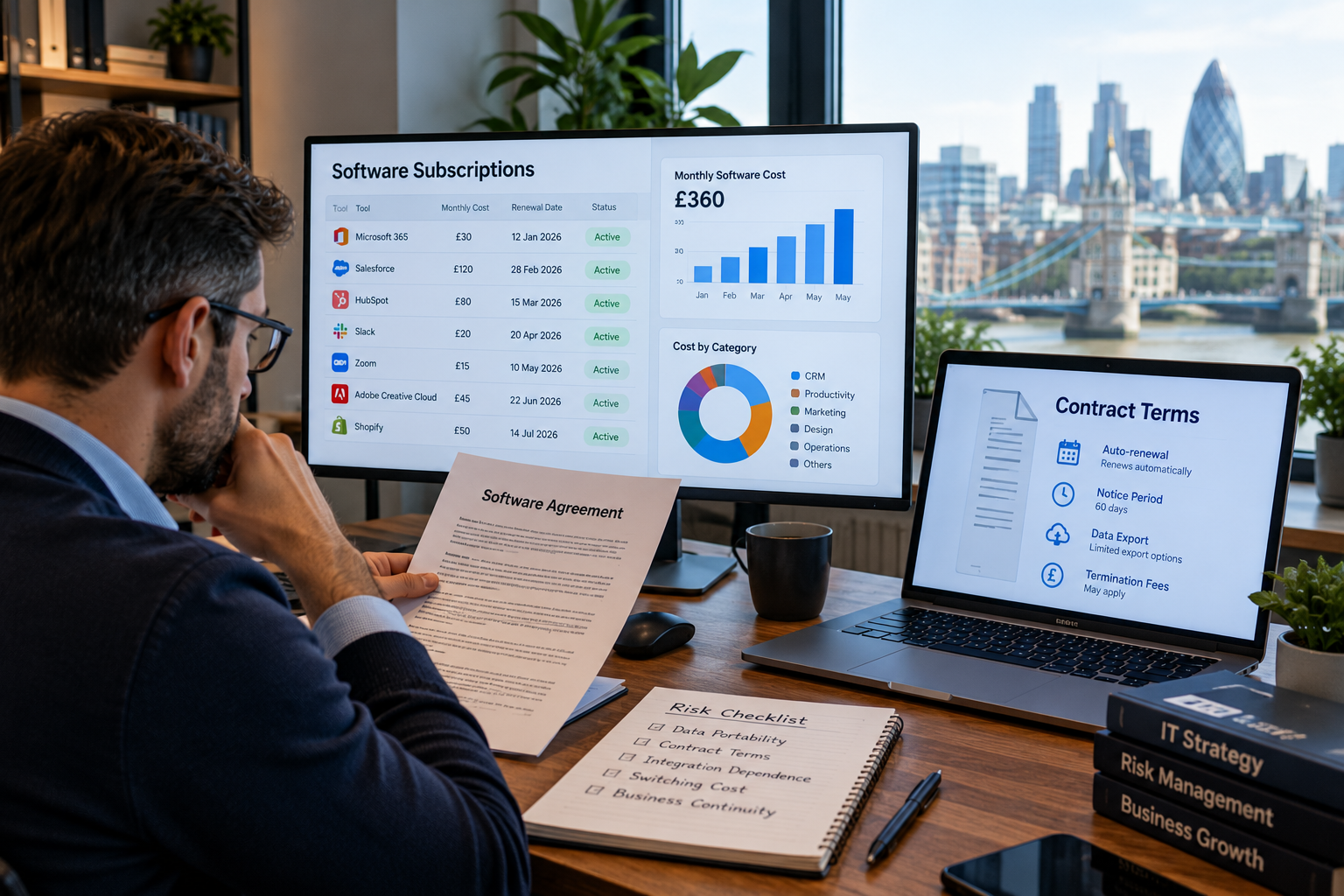
For each application, record its purpose, owner, cost, data stored, connected systems and impact if it becomes unavailable.
Pay particular attention to systems that support essential activities, such as customer management, order processing, invoicing, inventory, scheduling or regulated recordkeeping.
Ask:
Can the business export its important data?
Are the export formats documented and usable?
Can the application be replaced without rebuilding every workflow?
Does the business control the relevant domain names, credentials and records?
Are integrations dependent on features available only from one provider?
Is there a documented procedure for changing platforms?
What would happen if the provider changed its pricing or discontinued a feature?
This review should distinguish ordinary software usage from genuine dependency risk. A business may use a specialised platform successfully without being excessively locked in, provided it understands the consequences of switching and has a reasonable exit plan.
The Nexteck SME Strategy & Tracking Toolkit describes a structured approach to reviewing technology opportunities, operational pain points and tool-stack choices. These activities can help organise a software dependency assessment.
3. Review Contracts, Renewal Dates and Exit Conditions
Technical flexibility is only part of the picture. Contract terms can also affect a business's ability to change providers.
Review renewal dates, notice periods, termination conditions, price adjustment clauses, service levels, data export terms and any charges associated with leaving the service.
Where relevant, clarify what happens to business data at the end of the contract and how long the provider retains it after termination.
For important systems, establish who is responsible for managing the contract and when the next review should take place. Avoid discovering renewal deadlines only after the available cancellation window has passed.
For complex or high-value agreements, seek appropriate legal advice before committing to material changes.
4. Protect Data Portability and Ownership
Data portability is the ability to retrieve and transfer business information in a usable form.
Before adopting a platform, identify the information the business must be able to recover. This could include customer records, transaction histories, documents, product information, workflow configurations and audit logs, depending on the service.
Do not assume that downloading a spreadsheet is sufficient. Some systems store important relationships, attachments, permissions or automation rules that may not be preserved in a basic export.
Test the export process where practical. Check whether the exported data is complete, readable and suitable for the intended purpose.
Maintain appropriate backups and ensure the organisation knows who can access them. A backup should be protected from unauthorised access and tested periodically rather than treated as a theoretical safeguard.
5. Design Integrations to Reduce Unnecessary Dependency
Integrations can make business software more useful, but they can also increase switching complexity.
Map how information moves between applications and identify which connections are essential. Document APIs, data fields, authentication methods, scheduled transfers and failure-handling procedures.
Where practical, use documented interfaces and maintain clear integration specifications. Avoid building undocumented dependencies that only one developer or provider understands.
A modular architecture can help isolate components so that changing one application does not require rebuilding the entire business environment. However, modularity also introduces design and maintenance work, so it should be proportionate to the business's needs.
The Nexteck homepage is a relevant starting point for exploring its focus on technology strategy and systems integration when evaluating how applications fit together.
6. Compare the True Cost of Staying Versus Switching
A provider's subscription fee is only one part of the total cost.
Staying may involve rising licence charges, additional modules, manual workarounds or increasing integration costs. Switching may involve migration, implementation, staff training, temporary parallel operation and potential disruption.
Create a realistic comparison that includes both immediate and ongoing expenses.
Consider the cost of:
Current licences and future price changes.
Additional users, storage or premium features.
Integration maintenance.
Data extraction and migration.
Staff training and productivity during transition.
Temporary operation of two systems.
Support, hosting and maintenance of the replacement.
Potential downtime and recovery arrangements.
Do not assume switching is always cheaper. The purpose of the comparison is to understand the trade-offs and identify the point at which a different solution may become worthwhile.
The Nexteck Toolkit includes technology opportunity planning and tool-stack considerations in its described framework, which can support structured evaluation of these choices.
7. Create a Practical Exit Plan Before You Need One
An exit plan does not mean the business intends to leave its current provider. It means the company has considered how it would respond if the relationship no longer met its needs.
A basic plan should identify:
The business owner responsible for the application.
The data and configurations that must be preserved.
The export and backup procedures.
Potential replacement products or approaches.
Integration and migration dependencies.
Contract notice periods and termination conditions.
Testing and rollback arrangements.
Communication and training requirements.
For critical systems, consider how the business would continue operating during an outage or transition. The level of planning should reflect the consequences of losing access to the system.
8. Review Your Software Portfolio Regularly
A software dependency assessment should be repeated as the business changes.
New departments may introduce additional applications. Acquisitions, expansion into new markets or new compliance requirements may change what the company needs from its systems.
Review the software inventory periodically and whenever a critical provider changes its pricing, service terms or technical capabilities.
Remove unused subscriptions, document important workflows and make sure that ownership of critical accounts does not rest with a single employee without appropriate recovery arrangements.
The Nexteck SME Toolkit describes tools for business diagnostics, technology opportunity tracking and KPI governance that can help teams organise ongoing reviews and assign responsibilities.
Conclusion
Software vendor lock-in can limit flexibility when a business cannot easily retrieve its data, replace integrations or change platforms without significant disruption. UK SMEs can reduce this risk by documenting dependencies, reviewing contracts, testing data exports and creating proportionate exit plans.
The objective is not to switch providers unnecessarily. It is to understand the risks, retain control over critical business information and make technology decisions based on long-term operational requirements.
Explore the Nexteck homepage, its industry and sector information, and the Nexteck SME Strategy & Tracking Toolkit for further information about technology planning and operational improvement.
Frequently Asked Questions
What is software vendor lock-in?
Software vendor lock-in occurs when changing providers becomes difficult or costly because of technical dependencies, contract terms, proprietary features, data portability limitations or operational reliance on a particular system.
How can a UK SME reduce vendor lock-in?
Document dependencies, review contracts, test data exports, maintain suitable backups, understand integration requirements and create an exit plan for critical applications.
Does using cloud software automatically create vendor lock-in?
No. Cloud software can provide flexibility, but the risk depends on the service's data export options, proprietary features, integrations, contract terms and the business's reliance on the platform.
What is data portability?
Data portability is the ability to retrieve and transfer information in a usable format. Businesses should confirm which records, attachments, relationships and configurations can be exported before adopting a system.
Should a small business switch providers to avoid lock-in?
Not necessarily. Switching has costs and risks of its own. The business should compare the benefits, total cost, operational impact and available alternatives before making a decision.