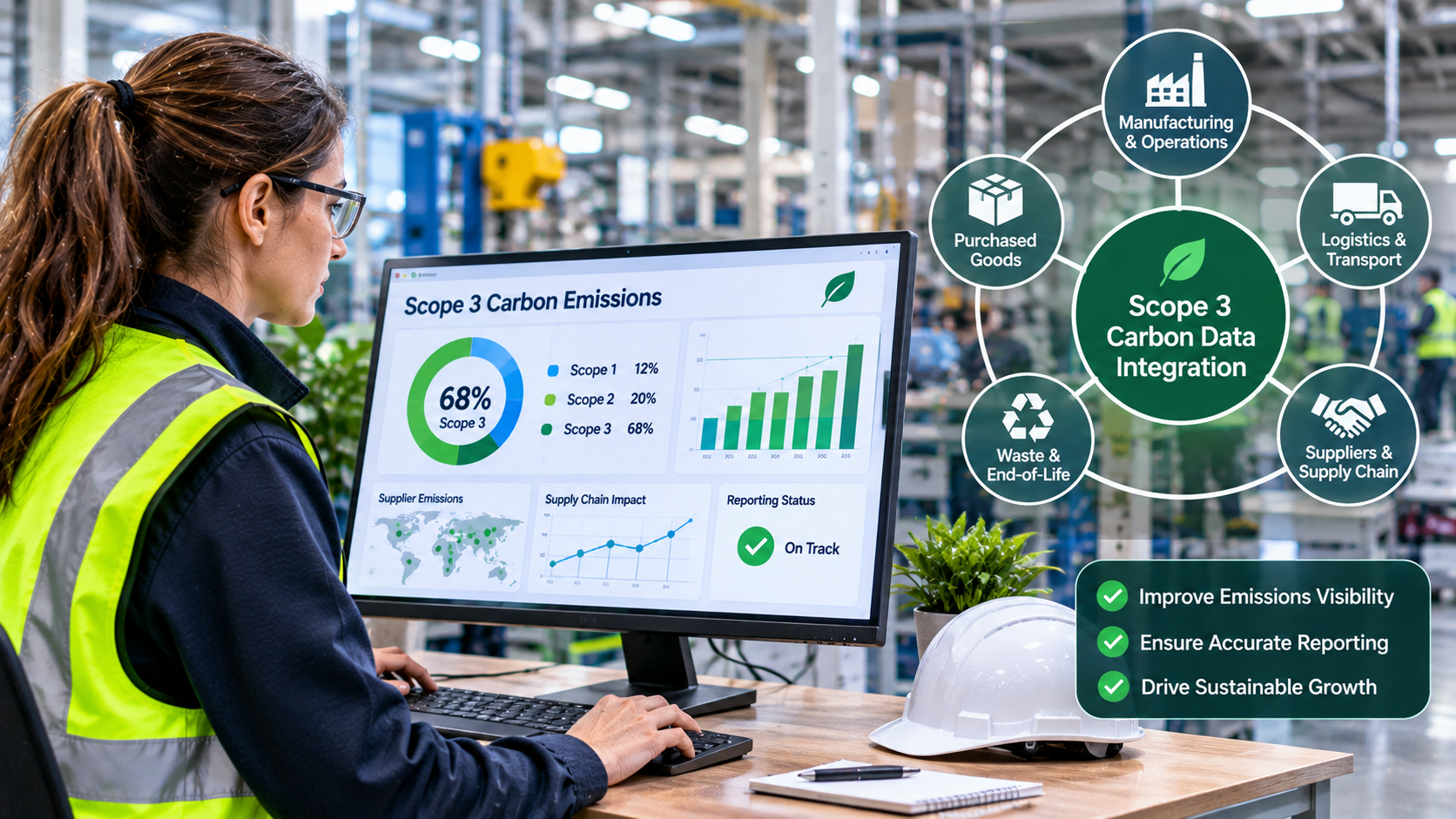
Scope 3 Carbon Data Integration UK | Nexteck
Discover how UK manufacturers can connect supplier emissions data, ERP systems and sustainability reporting to improve Scope 3 visibility, data quality and carbon management.
Scope 3 carbon data integration UK
Scope 3 emissions reporting UK, supplier carbon data management, carbon accounting system integration, manufacturing carbon reporting software, supply chain emissions data, ESG data integration UK, supplier sustainability reporting, carbon footprint data automation, emissions reporting for manufacturers, sustainability data architecture.
UK manufacturers, British manufacturing companies, London businesses, Midlands manufacturers, Birmingham supply chains, Manchester industrial businesses, UK exporters, UK wholesale and distribution companies.
Commercial investigation / technology consulting / enterprise integration.
Introduction: Why Scope 3 Emissions Data Is an Operational Technology Challenge
UK manufacturers and supply chain businesses increasingly need a reliable understanding of the environmental impact associated with their operations, purchased materials, logistics, suppliers and customers. However, gathering this information is not simply a reporting exercise. It is a complex data management challenge.
A manufacturer may have energy consumption records in its facilities management platform, purchasing information in an ERP system, transport data in a logistics application and supplier sustainability questionnaires stored in spreadsheets. Each system may use different formats, reporting periods, units and data definitions.
The result is fragmented emissions information that can be difficult to validate, compare and use for business decisions.
This is particularly important for Scope 3 emissions, which cover indirect value-chain emissions outside an organisation's direct operations and purchased energy. Depending on the business, relevant categories may include purchased goods and services, upstream transportation, business travel, waste, use of sold products and other value-chain activities.
Scope 3 carbon data integration connects information from internal systems and external suppliers so organisations can build a more consistent view of their value-chain emissions.
For UK manufacturers, distributors and exporters, the opportunity is to move beyond disconnected spreadsheets towards a controlled data architecture that supports sustainability reporting, supplier engagement, operational analysis and long-term business planning.
1. Understanding Scope 1, Scope 2 and Scope 3 Data
Before building a carbon data platform, a business needs to understand the different emissions categories.
Scope 1: Direct emissions
These are direct greenhouse gas emissions from sources owned or controlled by an organisation. Examples may include fuel combustion in company-operated equipment or vehicles and emissions from certain industrial processes.
Scope 2: Purchased energy emissions
Scope 2 generally covers indirect emissions associated with purchased or acquired electricity, steam, heat and cooling consumed by the organisation.
Scope 3: Value-chain emissions
Scope 3 includes other indirect emissions occurring across the organisation's value chain, both upstream and downstream.
For a manufacturer, this may involve:
Purchased raw materials and components
Supplier manufacturing activities
Inbound transportation and distribution
Waste generated during operations
Employee business travel
Outbound distribution
Processing and use of sold products
End-of-life treatment of sold products
The relevant categories depend on the organisation's activities and reporting boundary.
A company should not assume that every category is equally material. A structured assessment helps identify the categories with the greatest relevance and the data needed to estimate or calculate them.
2. Why UK Businesses Struggle with Scope 3 Data Collection
Scope 3 data is difficult because it often originates outside the organisation's own systems.
Supplier information arrives in inconsistent formats
One supplier may provide emissions information in a spreadsheet, another may provide a sustainability report and another may only provide activity information such as material quantities or transport distances.
These records may use different units, reporting periods and calculation methods.
Procurement systems are not designed as carbon databases
ERP and procurement platforms are generally designed to manage purchasing, suppliers, invoices, stock and financial transactions.
They may contain useful activity data, but they do not necessarily contain the emissions factors, methodology records or supporting evidence needed for a complete carbon assessment.
Supplier data may be incomplete
Smaller suppliers may not have dedicated sustainability teams or mature emissions reporting processes.
A buyer may therefore need to use estimates, industry factors or secondary data while documenting the limitations.
Duplicate and inconsistent records affect reporting quality
A supplier may appear under different names or identifiers across procurement, finance and logistics applications. This makes it difficult to match emissions information with the correct supplier, purchase category or reporting period.
Reporting processes depend too heavily on manual work
Employees may repeatedly request information, copy values between spreadsheets, check formulas and reconcile totals.
This increases administrative effort and makes it harder to repeat the reporting process consistently.
Businesses can begin by reviewing their wider technology environment and identifying where operational information is created, stored and exchanged. Nexteck's technology strategy and enterprise architecture services provide a starting point for this type of assessment.
3. Building a Reliable Scope 3 Data Architecture
A successful carbon data architecture should connect information sources without losing the context behind each record.
A typical architecture may include five layers.
Layer 1: Source systems
Relevant source systems may include:
ERP and procurement applications
Supplier relationship management platforms
Warehouse and inventory systems
Transport management software
Energy and facilities management applications
Finance and accounting systems
Supplier portals and questionnaires
Product lifecycle and manufacturing systems
Layer 2: Data collection and integration
Information can be collected through APIs, secure file transfers, structured templates, supplier portals or controlled manual uploads.
The appropriate method depends on the source system, data quality and supplier capability.
Layer 3: Data standardisation
The integration layer should standardise supplier identifiers, reporting periods, units, product categories and activity descriptions.
For example, a transport record may contain distance in kilometres while another source uses miles. A standardised process should convert the values consistently and retain the original source information.
Layer 4: Calculation and methodology
The organisation should document the calculation method, emissions factor source, applicable period, assumptions and data quality.
A calculation should be reproducible rather than existing only as a value in a spreadsheet.
Layer 5: Reporting and analysis
The final layer provides dashboards, category-level analysis, supplier comparisons and evidence for internal or external reporting.
This architecture can be designed around the organisation's existing applications rather than requiring an immediate replacement of its ERP or procurement platform.
4. Connecting Supplier and Procurement Data
Purchased goods and services can be a significant Scope 3 category for many manufacturers.
The procurement system often contains information that can help estimate emissions, such as:
Supplier identity
Product or material description
Purchase quantity
Unit of measurement
Purchase value
Delivery location
Purchase date
Product category
However, these fields need to be connected to suitable emissions information.
Create consistent supplier identifiers
Each supplier should have a reliable master record. This helps connect procurement transactions, supplier questionnaires, sustainability documents and emissions records.
Map procurement categories
A business should classify purchased goods and services into consistent categories. This makes it easier to apply appropriate calculation methods and compare activity across reporting periods.
Capture supplier-specific emissions data
Where available and suitable, supplier-provided emissions information may improve the accuracy of an assessment.
The organisation should record the reporting boundary, methodology, verification status and period associated with the information.
Track data gaps
If a supplier cannot provide emissions data, the business should record the gap and the method used to estimate the relevant activity.
It should not silently treat an estimate as supplier-verified information.
A structured integration approach can help manufacturers connect procurement, supplier and operational information. Explore Nexteck's industry-focused technology capabilities to understand how connected systems can support complex business environments.
5. Improving Transportation and Logistics Emissions Visibility
Transportation and distribution can create significant data requirements for businesses with complex supply chains.
Relevant information may include:
Transport mode
Shipment distance
Vehicle or service type
Weight or volume transported
Fuel or energy information, where available
Origin and destination
Freight provider
Shipment frequency
Refrigeration or other relevant operational factors
A transport management system may already hold some of this information. However, the records need to be connected to consistent calculation methods.
Connect logistics data with purchasing and sales
Inbound shipments can be linked with supplier and procurement records. Outbound shipments can be connected with customer orders and distribution records.
This helps businesses understand how transportation activity relates to specific supply-chain flows.
Avoid simplistic distance-only comparisons
A short shipment and a long shipment cannot be compared fairly without considering relevant factors such as transport mode, load, weight and methodology.
The calculation method should reflect the activity data available and the applicable emissions methodology.
Improve carrier data exchange
Where logistics partners can provide structured information, APIs or standardised reporting templates can reduce manual data collection.
6. Product-Level Carbon Data and Manufacturing Operations
Some manufacturers want to understand emissions at product, product-family or production-line level.
This requires connecting carbon-related information with operational records such as:
Bills of materials
Material quantities
Production volumes
Energy consumption
Process waste
Supplier components
Manufacturing locations
Packaging and distribution
The challenge is establishing a consistent relationship between product information and emissions data.
For example, a production record may show that a factory manufactured a certain quantity of a product during a reporting period. To estimate product-related emissions, the business may need to connect material quantities, production energy, process data and relevant allocation methods.
The organisation should document how shared energy and overhead emissions are allocated. Different allocation methods can produce different product-level results.
A well-structured data model makes these assumptions visible and allows them to be reviewed.
7. Carbon Data Quality: The Foundation of Trustworthy Reporting
A dashboard can look impressive while still containing unreliable information. Data quality needs to be managed throughout the reporting process.
Important checks include:
Completeness
Are the required suppliers, purchasing categories and reporting periods represented?
Consistency
Are units, supplier identifiers, category definitions and reporting boundaries applied consistently?
Accuracy
Are the source records reliable, and are calculations based on appropriate activity information and emissions factors?
Timeliness
Does the information represent the correct reporting period?
Traceability
Can a reported value be linked back to its original source, assumptions and calculation method?
Evidence management
Can the organisation retrieve supporting documents, supplier declarations and approval records when required?
Each carbon data record should ideally retain its source, collection date, reporting period, methodology, factor version and quality status.
This helps sustainability teams explain how a result was produced instead of relying on a number without supporting evidence.
8. The Role of AI and Automation in Carbon Data Management
AI and automation can reduce repetitive work in carbon data collection, but they should be used with appropriate review and governance.
Potential use cases include:
Document extraction: Extract supplier names, reporting periods, activity values and emissions information from sustainability reports and supporting documents.
Supplier classification: Suggest categories for supplier and procurement records.
Data anomaly detection: Highlight unusual changes in energy, purchasing or logistics activity.
Missing information alerts: Identify suppliers or business units that have not submitted required data.
Document comparison: Identify changes between reporting periods or supplier declarations.
Reporting assistance: Prepare draft summaries of data completeness, changes and unresolved exceptions.
AI-generated classifications and extracted values should be validated before being included in formal reporting. Organisations should also protect confidential supplier and commercial information when using AI services.
Nexteck's technology and software integration capabilities can be considered when assessing how automation fits into an organisation's wider data environment.
9. UK Reporting, Governance and Methodology Considerations
UK businesses should understand which sustainability reporting obligations apply to their organisation, group structure, size and activities.
Depending on the circumstances, relevant considerations may include:
Streamlined Energy and Carbon Reporting (SECR), where applicable
UK sustainability disclosure developments
Companies Act reporting requirements
Climate-related disclosure obligations, where applicable
Customer and supply-chain reporting requests
Contractual sustainability requirements
International reporting frameworks used by business partners
The Greenhouse Gas Protocol Corporate Value Chain (Scope 3) Standard is an important reference for understanding Scope 3 categories and calculation approaches.
The reporting rules and thresholds can change, and not every UK business is subject to the same obligations. Organisations should confirm their current requirements with qualified sustainability, accounting or legal advisers.
Technology can support evidence collection and reporting controls, but it does not independently establish regulatory compliance.
10. Implementing Scope 3 Carbon Data Integration: A Practical Roadmap
A phased approach helps businesses develop a usable carbon data foundation without overcomplicating the first implementation.
Phase 1: Establish the reporting boundary
Define the organisation, business units, facilities, reporting period and relevant value-chain categories.
Phase 2: Identify material categories
Review purchasing, logistics, operations and downstream activities to identify the most relevant Scope 3 categories.
Phase 3: Map existing data sources
Document which applications and suppliers hold the required activity information.
Phase 4: Assess data quality
Identify missing supplier records, inconsistent units, duplicate identifiers and weak supporting evidence.
Phase 5: Design the integration model
Define source systems, standard data fields, calculation ownership, validation rules and exception handling.
Phase 6: Pilot a priority category
Start with a manageable area, such as purchased goods or upstream transportation, and test the collection and reporting process.
Phase 7: Expand supplier engagement
Introduce standardised data requests, supplier guidance and appropriate submission methods.
Phase 8: Build reporting and governance
Create dashboards, data quality checks, approval workflows and evidence retention procedures.
Businesses can use the Nexteck SME Strategy & Tracking Toolkit as a reference for prioritising technology opportunities, defining ownership and tracking implementation progress.
11. KPIs for Scope 3 Data Management
The organisation should measure both emissions-related outcomes and the quality of the underlying information.
| KPI | What it measures |
|---|---|
| Supplier data coverage | Share of relevant suppliers providing usable data |
| Primary data coverage | Proportion of calculations based on primary activity or supplier data |
| Data completeness | Share of required records with sufficient information |
| Data validation exception rate | Records requiring correction or review |
| Reporting cycle time | Time needed to prepare the reporting dataset |
| Emissions by category | Estimated emissions across relevant Scope 3 categories |
| Supplier response time | Time taken to provide requested information |
| Missing evidence rate | Records without sufficient supporting documentation |
| Data refresh frequency | How regularly relevant information is updated |
| Methodology coverage | Share of records with documented calculation methods |
These measures should be interpreted alongside emissions methodology and business context. A higher primary-data coverage rate does not automatically mean total emissions have decreased.
12. Common Mistakes to Avoid
Treating carbon reporting as a spreadsheet-only exercise: This can create repeated manual work and limited auditability.
Collecting data without defining its purpose: Businesses should establish which reporting categories and decisions the information supports.
Mixing estimates with verified supplier information: Data quality and evidence status should remain visible.
Ignoring procurement master data: Inconsistent supplier and product records can undermine the entire integration process.
Overcomplicating the first implementation: Start with material categories and expand gradually.
Using AI outputs without validation: Automated extraction and classification should have appropriate review controls.
Assuming technology guarantees compliance: Reporting requirements and calculation methodologies need specialist oversight.
13. How Nexteck Can Help
Nexteck works across technology strategy, software architecture, data integration and business process improvement.
For UK manufacturers and supply-chain businesses, a technology assessment can help identify where supplier, procurement, ERP, logistics and reporting information is disconnected.
Potential areas of support include:
Reviewing existing data architecture
Mapping supplier and operational information flows
Identifying integration opportunities
Improving data quality and governance
Planning reporting dashboards
Assessing automation opportunities
Developing a phased technology roadmap
Explore Nexteck's industry capabilities, review its technology strategy services or use the SME Strategy & Tracking Toolkit to structure your technology priorities.
Planning a Scope 3 data integration project? Contact Nexteck to discuss your supplier data, ERP environment, reporting requirements and potential integration roadmap.
Frequently Asked Questions
What is Scope 3 carbon data integration?
Scope 3 carbon data integration connects supplier, procurement, logistics, manufacturing and other value-chain information to support more consistent emissions calculations and reporting.
Why is Scope 3 reporting difficult for UK manufacturers?
Scope 3 information often comes from external suppliers and multiple internal applications. Differences in data formats, units, reporting periods and calculation methods can make collection and validation difficult.
Which systems are useful for Scope 3 data collection?
ERP, procurement, supplier management, warehouse, transport, energy management and reporting systems can all provide relevant information, depending on the organisation's value chain.
Can Scope 3 emissions data be collected automatically?
Some information can be collected through APIs, supplier portals, structured files and automated document extraction. Supplier participation and data validation are still important.
What is the difference between primary and secondary emissions data?
Primary data is obtained from specific activities or value-chain partners. Secondary data comes from external datasets, industry averages or other reference sources. The suitability of each depends on the calculation and reporting context.
How can AI support carbon reporting?
AI can assist with document extraction, classification, anomaly detection and reporting preparation. Outputs should be reviewed and validated before formal use.
Is Scope 3 reporting mandatory for every UK business?
No. Requirements depend on the organisation, applicable legislation, reporting status and contractual obligations. Businesses should obtain advice on their specific circumstances.
How can manufacturers improve supplier emissions data quality?
They can standardise supplier requests, define reporting periods and units, establish supplier identifiers, retain evidence and introduce validation procedures.
Can Nexteck help connect ERP and sustainability data?
Nexteck can help assess system architecture, data flows, integration requirements and automation opportunities for connected business reporting.