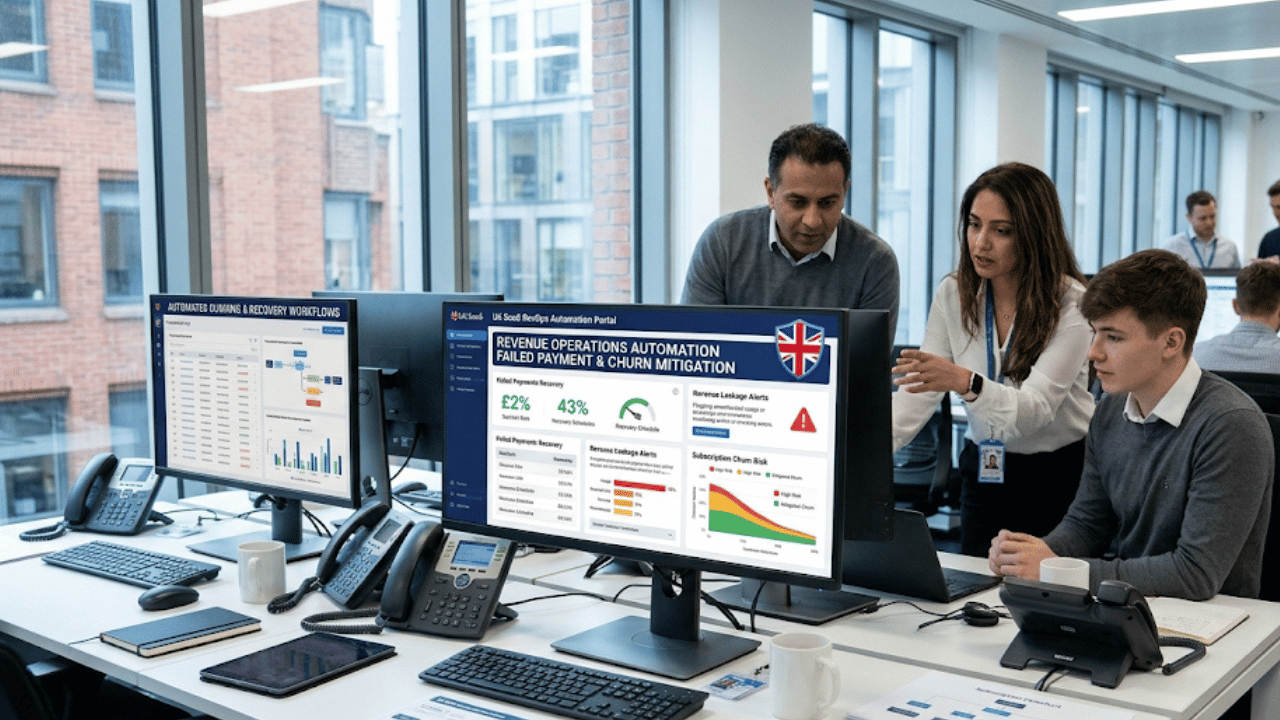
SaaS Revenue Operations Automation UK | Nexteck
Learn how UK SaaS businesses can connect subscription billing, payment recovery, renewals, CRM and finance systems to reduce revenue leakage and improve customer retention.
SaaS revenue operations automation UK
subscription billing automation UK, SaaS revenue management, failed payment recovery automation, subscription renewal management, recurring revenue operations, SaaS churn reduction technology, billing reconciliation software, subscription lifecycle automation, SaaS finance integration, revenue leakage prevention.
UK SaaS companies, London technology businesses, Manchester SaaS firms, Birmingham software companies, UK subscription businesses, British software providers, UK B2B technology companies, UK digital businesses.
Commercial investigation / B2B software and automation services.
Introduction: Why Recurring Revenue Needs Connected Operations
Subscription-based businesses depend on more than acquiring customers. They need to manage the complete commercial relationship: onboarding, subscription activation, billing, payment collection, renewals, plan changes, cancellations, refunds and financial reconciliation.
As a SaaS company grows, these activities can become spread across multiple systems. A subscription platform may manage customer plans, a payment provider processes transactions, a CRM stores account information and an accounting application records financial activity.
When these platforms do not share reliable information, employees often become the connection between them.
A failed payment may not trigger a timely customer notification. A cancelled subscription may remain active in another system. A renewal opportunity may not reach the account manager. Finance teams may spend hours comparing payment reports with subscription records.
These issues can create revenue leakage, avoidable administration and a fragmented customer experience.
SaaS revenue operations automation brings these processes together through connected data, defined business rules and monitored workflows. It helps UK subscription businesses create a more consistent operating model across sales, customer success, billing and finance.
1. Understanding Revenue Leakage in Subscription Businesses
Revenue leakage occurs when expected revenue is lost, delayed, incorrectly recorded or not collected because of operational weaknesses.
It can arise at different stages of the subscription lifecycle.
Failed and incomplete payments
A payment may fail because of an expired card, insufficient funds, a bank decline, incorrect payment details or a temporary technical issue.
If the business has no structured recovery process, the customer may receive no useful reminder or the internal team may not know which account requires attention.
Incorrect subscription status
A customer may upgrade, downgrade, pause or cancel a plan. If the change is not reflected across billing, CRM, access management and finance systems, the business can end up with inconsistent records.
Missed renewals
Annual and monthly subscriptions require clear renewal dates, customer communication and appropriate commercial ownership.
A missed renewal notification or an unassigned account can create unnecessary cancellations.
Billing and accounting mismatches
Payment providers, subscription platforms and accounting systems may use different transaction references, settlement dates and fee structures.
Without reliable reconciliation, finance teams may struggle to explain differences between invoices, payments, refunds and accounting entries.
Unrecorded commercial changes
Discounts, credits, plan changes and contract amendments can affect recurring revenue. If these changes are handled informally, reporting may not reflect the actual commercial agreement.
Businesses should first understand where these problems occur. Nexteck's technology strategy and architecture approach can help frame a wider review of systems, integrations and operating processes.
2. What Is SaaS Revenue Operations Automation?
SaaS revenue operations automation connects the systems and workflows involved in generating, collecting, recording and retaining subscription revenue.
It may bring together:
CRM and account management
Subscription and billing platforms
Payment gateways and payment service providers
Accounting and finance applications
Customer support and ticketing systems
Product access and entitlement management
Analytics and management reporting
The goal is to create consistent information across the subscription lifecycle.
For example, when a customer changes from one subscription plan to another, the approved change should be reflected in the billing platform, account record, access permissions and relevant financial records.
The exact integration depends on the systems involved and the company's accounting policies. Automation should not assume that every event is immediately recognised as revenue; financial reporting must follow the organisation's applicable accounting requirements.
3. Mapping the Complete Subscription Lifecycle
Before building automations, a business should map its subscription lifecycle from the first commercial interaction to renewal or cancellation.
Stage 1: Lead and opportunity
A potential customer enters the CRM through a website enquiry, sales conversation, referral or marketing campaign.
The CRM records the source, account owner, business requirements and sales progress.
Stage 2: Customer onboarding
Once an agreement is approved, customer information is passed to the subscription platform.
The system creates the appropriate account, plan, billing frequency and service access.
Stage 3: Subscription activation
The platform confirms the subscription status and triggers the required access or service configuration.
If payment confirmation is required before activation, the workflow should enforce that rule.
Stage 4: Recurring billing
The billing platform generates charges according to the agreed plan, billing date and payment method.
The business should retain a reliable link between customer, subscription, invoice and payment references.
Stage 5: Payment collection and recovery
Successful payments update the subscription record. Failed payments trigger the appropriate recovery workflow and customer communication.
Stage 6: Renewal and account management
Upcoming renewals can trigger account reviews, customer notifications and commercial follow-up.
Stage 7: Cancellation or plan change
The system records the customer's request, effective date, reason and any required access or billing changes.
This lifecycle map becomes the foundation for system integration and automation design.
4. Automating Failed Payment Recovery
Payment recovery is one of the most practical starting points for subscription automation.
A structured process can distinguish between different failure scenarios rather than treating every failed transaction in the same way.
Classify the payment failure
The payment provider may return a decline code or failure reason. The system can use this information to determine the next permitted action.
For example, a temporary issue may be suitable for a later retry, while an expired payment method may require the customer to update their details.
Apply controlled retry rules
Businesses can configure retry timing and limits based on payment-provider capabilities, customer agreements and operational policies.
The workflow should avoid excessive retries and respect applicable payment rules.
Send relevant customer notifications
A failed payment can trigger a clear notification explaining the issue and the next step.
Messages should be accurate, secure and appropriate to the customer's account status.
Escalate unresolved accounts
If payment recovery does not succeed, the system can create a customer-success task or support case.
Any restriction, suspension or cancellation should follow the contract, service policy and applicable legal requirements.
Measure recovery performance
Useful measures include payment recovery rate, average recovery time, failed payment value and the percentage of accounts requiring manual intervention.
The objective is to make payment recovery consistent and measurable—not to send customers repeated messages without context.
5. Subscription Renewal Automation and Churn Prevention
Renewals are a critical moment in the customer relationship.
A business that waits until the renewal date to contact a customer may miss the opportunity to understand dissatisfaction, resolve service issues or discuss a suitable plan.
A renewal workflow can begin well before the contract or subscription end date.
Build renewal visibility
The system should identify upcoming renewals, contract terms, account owners and relevant customer activity.
Trigger account reviews
Higher-value or higher-risk accounts may need a human review. A workflow can create a task for the account manager with the relevant account history.
Identify customer risk signals
Potential indicators include:
Reduced product usage
Repeated support complaints
Unresolved service issues
Declining engagement
Failed payments
Repeated downgrades
Unanswered renewal communications
These signals should be treated as indicators for review, not proof that a customer intends to cancel.
Coordinate renewal communication
CRM workflows can help schedule reminders, assign ownership and record customer responses.
A human account manager should remain involved where negotiation, service concerns or contract changes require judgement.
For businesses operating across multiple sectors, Nexteck's industry capabilities provide context for how connected systems and automation can support different operating environments.
6. Connecting Billing, CRM and Finance Systems
Revenue operations become difficult when the same customer or subscription has different identifiers in different applications.
A connected architecture should establish reliable relationships between records.
| System | Key information |
|---|---|
| CRM | Customer, account owner, opportunity and contract context |
| Subscription platform | Plan, billing frequency, renewal date and status |
| Payment provider | Payment attempts, transaction references and settlements |
| Accounting system | Invoices, credits, fees and financial entries |
| Customer support | Complaints, service issues and resolution history |
| Product platform | Access permissions, usage and service entitlements |
| Reporting platform | Revenue, retention, payment and operational KPIs |
Establish a consistent customer identity
A business should define how customer IDs, subscription IDs, invoice references and payment references connect.
This prevents duplicate records and makes reconciliation more reliable.
Define the source of truth
Not every application should control every field.
For example, the subscription platform may own plan status, while the accounting system owns accounting entries. The CRM may hold commercial account ownership.
These responsibilities should be documented.
Handle integration failures
A reliable integration should include error logging, retry rules, exception queues and alerts.
If a payment succeeds but the subscription record fails to update, the system should detect the mismatch and route it for correction.
Protect against duplicate events
Payment and subscription platforms may send repeated notifications. Integrations should use appropriate event identifiers and idempotent processing so the same event does not create duplicate actions.
7. Revenue Reconciliation and Financial Visibility
A subscription business should be able to explain how its billing records relate to payment activity and financial reporting.
Reconciliation may involve:
Invoices issued
Payments received
Payment processor fees
Refunds and chargebacks
Discounts and credits
Failed or pending transactions
Settlement timing differences
Tax-related records
Accounting entries
Automation can match transactions using stable references and flag exceptions for review.
A useful exception workflow should identify the unmatched amount, transaction reference, relevant customer and responsible team.
It should also preserve the original record and correction history.
This is particularly important for businesses with multiple payment providers, currencies, subscription plans or legal entities.
8. Using AI and Analytics in Revenue Operations
AI can help teams interpret operational information, prioritise work and identify unusual patterns.
Potential applications include:
Churn risk indicators: Analyse permitted customer activity and account signals to identify accounts that may need attention.
Payment exception classification: Group failed transactions by reason and suggest an appropriate next step.
Revenue anomaly detection: Highlight unexpected changes in payment volumes, refunds, discounts or recurring billing.
Customer support summarisation: Summarise relevant service history for account managers preparing for renewal discussions.
Forecasting assistance: Use historical subscription and renewal information to support scenario planning.
Knowledge assistance: Help employees find approved billing procedures, customer policies and internal guidance.
AI predictions should be tested against actual outcomes. Businesses should avoid treating a model's churn score or payment recommendation as a guaranteed result.
Sensitive financial and customer data should only be processed through approved systems with appropriate access, privacy and security controls.
9. A Practical Implementation Roadmap for UK SaaS Businesses
A phased approach helps businesses improve revenue operations without creating unnecessary disruption.
Phase 1: Audit the current subscription process
Map customer acquisition, onboarding, billing, failed payment recovery, renewals, cancellations and reconciliation.
Identify duplicate entry, manual handoffs and unresolved exceptions.
Phase 2: Review data quality
Check customer identifiers, subscription references, billing records, contract dates and payment references.
Resolve duplicate accounts and inconsistent statuses.
Phase 3: Prioritise high-impact workflows
Start with processes that are frequent, measurable and operationally costly.
Common starting points include failed payment alerts, renewal reminders and billing reconciliation.
Phase 4: Design the integration architecture
Define which system owns each record, which events trigger updates and how failures are handled.
Document security, access and monitoring requirements.
Phase 5: Pilot the automation
Test successful payments, failed payments, refunds, plan changes, cancellations, renewals and integration errors.
Include realistic exception scenarios rather than testing only the ideal workflow.
Phase 6: Expand and optimise
Use operational data to refine retry rules, communication timing, escalation routes and reporting.
Businesses can use Nexteck's SME Strategy & Tracking Toolkit as a reference for structured diagnostics, opportunity prioritisation and KPI governance.
10. KPIs for Subscription Revenue Operations
The right measures depend on the company's subscription model, billing frequency and customer profile.
| KPI | Business purpose |
|---|---|
| Monthly Recurring Revenue (MRR) | Tracks recurring subscription value |
| Annual Recurring Revenue (ARR) | Tracks annualised recurring subscription value |
| Payment success rate | Measures successful payment attempts |
| Failed payment recovery rate | Measures recovered failed payments |
| Voluntary churn | Tracks customer-initiated cancellations |
| Involuntary churn | Tracks cancellations associated with payment failure |
| Gross revenue retention | Measures retained recurring revenue before expansion |
| Net revenue retention | Includes expansion, contraction and churn |
| Renewal rate | Measures subscriptions renewed |
| Billing exception rate | Tracks transactions requiring manual investigation |
| Reconciliation completion time | Measures the time needed to resolve financial differences |
| Manual intervention rate | Shows how often employees must step into automated workflows |
MRR, ARR, churn and retention should be calculated consistently using documented definitions. Comparing metrics across businesses without understanding differences in billing models can lead to misleading conclusions.
11. Security, Privacy and Financial Controls
Subscription systems process commercially sensitive information and may handle personal data and payment-related records.
UK SaaS businesses should consider the UK GDPR and Data Protection Act 2018 where personal data is involved, along with relevant payment security obligations and contractual requirements.
Important controls include:
Role-based access to billing and customer information
Secure authentication and administrator permissions
Encryption and secure integration credentials
Payment data minimisation
Defined data retention policies
Audit trails for refunds, credits and plan changes
Approval controls for high-value adjustments
Monitoring of unusual account activity
Tested backup and incident response procedures
Businesses should avoid storing sensitive card details unless they have the appropriate compliant infrastructure. Where possible, payment providers should handle payment credentials through their approved mechanisms.
12. Common Mistakes to Avoid
Automating an unclear process
If billing responsibilities and approval rules are not defined, automation may simply make an inconsistent process run faster.
Treating every failed payment the same way
Different decline reasons may require different recovery actions. Retry rules should be based on provider information and documented policy.
Ignoring integration exceptions
A dashboard showing successful payments is not enough if subscription records or accounting entries fail to update.
Over-automating customer communication
Customers should receive useful, relevant messages rather than repeated generic reminders.
Measuring activity instead of outcomes
The number of automated emails sent does not demonstrate improved revenue performance. Businesses should measure payment recovery, retention, reconciliation quality and manual effort.
Neglecting ownership
Every workflow needs a business owner responsible for reviewing exceptions, maintaining rules and approving changes.
13. How Nexteck Can Support SaaS Revenue Operations
Nexteck supports technology strategy, software architecture and connected business operations. For SaaS organisations, this can involve reviewing subscription workflows, identifying revenue-process gaps and assessing how CRM, billing, payment and finance platforms should exchange information.
A structured assessment can help clarify:
Where revenue operations rely on manual work
Which systems contain critical customer and subscription records
Where billing and finance information becomes inconsistent
Which workflows are suitable for automation
How exceptions and approvals should be controlled
Which KPIs should be monitored after implementation
Explore Nexteck's technology strategy and software architecture services or review its industry-focused technology capabilities. Businesses can also use the Nexteck SME Strategy & Tracking Toolkit to support structured opportunity planning.
Want to reduce manual billing work and improve subscription revenue visibility? Contact Nexteck to discuss your SaaS systems, integration requirements and revenue operations roadmap.
Frequently Asked Questions
What is SaaS revenue operations automation?
SaaS revenue operations automation connects subscription, billing, payment, CRM and finance workflows to reduce repetitive administration and improve visibility across recurring revenue operations.
How can UK SaaS companies reduce failed payments?
Businesses can classify payment failures, configure appropriate retry rules, send relevant customer notifications and create escalation workflows for unresolved accounts.
What causes revenue leakage in subscription businesses?
Common causes include failed payments, missed renewals, incorrect subscription statuses, billing errors, unrecorded discounts, reconciliation gaps and disconnected systems.
Can subscription billing integrate with CRM and accounting software?
Yes. Integration can synchronise customer, subscription, invoice, payment and financial information, subject to the capabilities of the platforms and the integration design.
What is the difference between voluntary and involuntary churn?
Voluntary churn occurs when a customer chooses to cancel. Involuntary churn generally results from payment or billing problems that lead to a subscription ending without an intended customer cancellation.
Can automation improve SaaS customer retention?
Automation can support timely renewal reminders, account follow-ups, service escalation and customer communication. Retention also depends on product value, customer experience, pricing and service quality.
What is subscription payment reconciliation?
Subscription payment reconciliation compares billing records with payment transactions, processor settlements, refunds, fees and accounting records to identify and resolve differences.
Can AI help predict subscription churn?
AI can analyse permitted customer and operational data to identify patterns associated with cancellation risk. Predictions should be validated and used to support—not replace—human account management.
Which KPIs should SaaS businesses track?
Common metrics include MRR, ARR, payment success rate, failed payment recovery, churn, gross revenue retention, net revenue retention, renewal rate and billing exception rate.
How can Nexteck help with SaaS revenue automation?
Nexteck can help assess technology architecture, identify workflow and integration gaps, prioritise automation opportunities and plan connected systems for subscription operations.