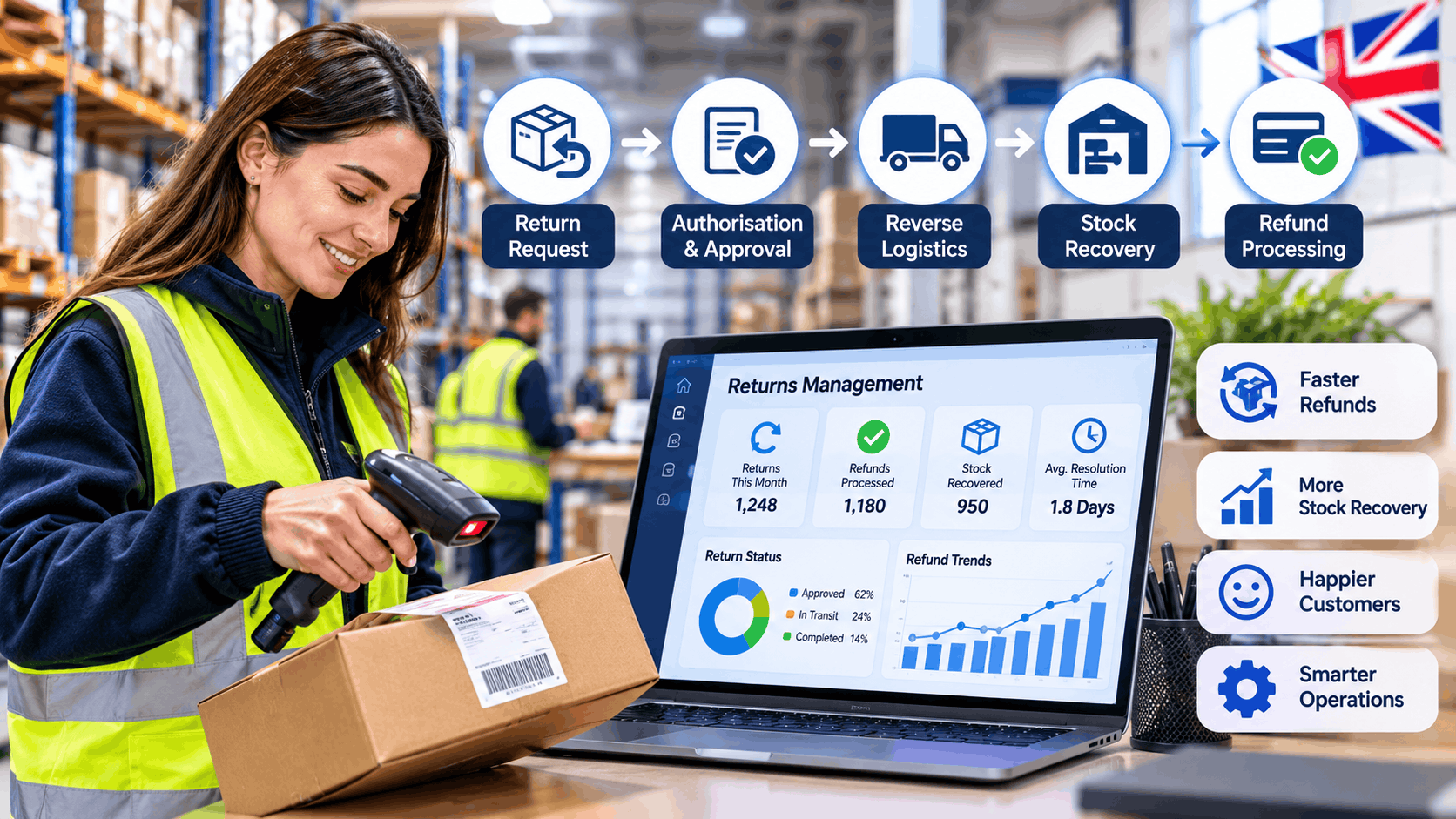
Returns Management Software UK | Reverse Logistics Automation
Discover how UK wholesalers, distributors and e-commerce businesses can automate returns authorisation, refunds, product inspections and reverse logistics using connected software and workflow automation.
Returns Management Software UK
Reverse logistics software UK, returns authorisation system, RMA management software, product returns automation, e-commerce returns management, wholesale returns management, refund workflow automation, returns processing software, returns tracking system, product inspection workflow, stock recovery automation, warehouse returns management, returns portal integration, distributor returns management, UK reverse supply chain technology.
London, Birmingham, Manchester, Leeds, Bristol, Nottingham, Liverpool, Sheffield, Glasgow, Edinburgh and the wider United Kingdom.
E-commerce directors, wholesale business owners, distribution managers, warehouse managers, customer service leaders, finance managers, operations directors and IT decision-makers.
Introduction: Why Product Returns Need Better Operational Control
Product returns are a normal part of selling and distributing goods. Customers may receive damaged products, order incorrect items, identify a fault, change their requirements or request a return under an applicable returns policy.
For wholesalers, distributors and e-commerce businesses, the challenge is managing the entire process after a return is requested.
A single returned product can involve customer service, order management, warehouse operations, product inspection, inventory records, finance and supplier coordination. If these activities are handled through disconnected systems, teams may struggle to identify the current status of a return, confirm whether a refund is authorised or determine whether an item can be returned to saleable stock.
Manual processes can also make it difficult to understand why products are being returned, which suppliers are responsible for recurring issues and how much value is being lost through damaged or unprocessed goods.
A connected returns management and reverse logistics system can help businesses manage the complete journey from the original return request through to inspection, refund, replacement, repair, supplier recovery or final disposition.
For UK businesses operating across multiple sales channels, warehouses and suppliers, this is an opportunity to improve operational visibility and reduce unnecessary administration.
A well-designed process should connect customer communication with warehouse and finance workflows, while ensuring that every returned item receives the appropriate checks before its status is updated.
Companies considering wider technology improvements can explore Nexteck's industry technology capabilities to understand how connected business systems can support distribution and commercial operations.
1. What Is Reverse Logistics?
Reverse logistics is the process of moving products from customers or downstream locations back through the supply chain for inspection, repair, refurbishment, restocking, recycling, supplier return or disposal.
It covers more than transporting an item back to a warehouse.
A typical reverse logistics process may include:
Customer return request.
Return eligibility assessment.
Return Merchandise Authorisation (RMA).
Return label or collection arrangement.
Warehouse receipt and identification.
Product inspection and condition assessment.
Refund, replacement or repair decision.
Inventory status update.
Supplier recovery or warranty claim where relevant.
Final closure and reporting.
The process should be designed around the product category, sales channel, contractual arrangements and applicable consumer or business obligations.
2. Why Manual Returns Processes Create Operational Problems
2.1 Returns Are Managed Across Different Departments
Customer service may receive a return request, while warehouse staff handle the physical item and finance processes the refund.
If each department works in a separate application, employees may have to exchange updates manually.
A central workflow can provide a shared view of the return status and the actions still required.
2.2 Unclear Return Authorisation
Without a consistent approval process, warehouses may receive products without sufficient information about the original order, reason for return or required action.
An RMA process can provide a unique reference that links the return to its original transaction.
2.3 Delayed Refunds and Replacements
Refunds may be delayed when inspection results, delivery information or approval records are not available to the finance team.
A connected process can notify the relevant department when the required checks have been completed.
2.4 Returned Stock Is Not Properly Classified
A returned product may be unopened, damaged, incomplete, defective or unsuitable for resale.
If the warehouse updates stock quantities without recording the product's actual condition, the business may create inaccurate availability information.
2.5 Limited Visibility of Return Reasons
Businesses may record returns using broad categories such as "unwanted" or "faulty" without collecting enough detail to identify recurring problems.
More structured return reason data can help management identify product quality issues, fulfilment errors, supplier problems and misleading product information.
3. What Should a Returns Management System Include?
A useful returns management platform should connect customer-facing processes with warehouse, finance and supplier operations.
3.1 Customer Returns Portal
A self-service portal can allow customers to submit a return request and provide relevant information.
Depending on the business model, the portal may collect:
Original order reference.
Product identifier.
Quantity being returned.
Reason for return.
Description of the issue.
Photographs or supporting evidence where appropriate.
Preferred resolution, where permitted.
Collection or return delivery information.
The portal should explain the relevant return process clearly and avoid promising outcomes before the request has been assessed.
3.2 Return Merchandise Authorisation
An RMA record provides a unique reference for tracking the return.
It can connect the original order, product, customer, return reason, delivery details, inspection result and final resolution.
Approval rules can be configured according to product category, order value, condition, contract or business policy.
3.3 Warehouse Receipt and Inspection
When an item reaches the warehouse, employees should be able to identify it using the RMA reference or another approved identifier.
The inspection workflow may record:
Date received.
Product and quantity.
Packaging condition.
Product condition.
Missing accessories or components.
Serial number where relevant.
Inspection photographs.
Fault description.
Recommended next action.
A clear inspection process helps prevent returned goods from being treated as saleable stock before they have been assessed.
3.4 Refund and Replacement Workflow
Once the required checks are complete, the system can route the return for the appropriate decision.
Possible outcomes include:
Refund.
Replacement.
Exchange.
Repair.
Supplier return.
Warranty claim.
Refurbishment.
Recycling or disposal.
The system should retain the decision, approval and transaction references so that customer service, finance and warehouse teams can understand what happened.
3.5 Returns Reporting Dashboard
A management dashboard can show return volumes, reasons, processing time, outstanding RMAs, inspection outcomes and recovered stock value.
This gives business leaders a clearer view of where returns create operational cost and where process improvements may be possible.
4. Connecting Returns Management With ERP, WMS and E-commerce Platforms
Returns management becomes more effective when it connects with the systems already used to run the business.
E-commerce Integration
The returns platform can retrieve relevant order and product information from the e-commerce system.
This reduces manual entry and helps link a return to the original transaction.
ERP Integration
ERP integration can connect returns with sales orders, customer records, credit notes, finance workflows and supplier transactions.
Approved financial actions should follow the organisation's controls and accounting procedures.
Warehouse Management System Integration
A Warehouse Management System (WMS) can receive expected return information and support warehouse receipt, inspection, storage and stock disposition.
The integration should distinguish between returned stock awaiting inspection, approved saleable stock and items requiring repair or other action.
Payment and Refund Integration
Payment integrations can help finance teams process authorised refunds using the appropriate transaction references.
Businesses should maintain controls over refund permissions, reconciliation and duplicate transactions.
Supplier and Manufacturer Integration
Where a product is eligible for supplier recovery or warranty support, relevant information can be transferred to the appropriate supplier workflow.
This can help the business track claims and outstanding supplier responses.
Companies assessing their wider systems architecture can explore Nexteck's technology strategy and software services to consider how e-commerce, ERP, warehouse and finance systems can be connected.
5. Automating the Return Journey From Request to Resolution
Automation can help reduce repetitive administration while making the return process easier to monitor.
Automated Return Eligibility Checks
A workflow can check the order reference, product details and configured return rules before creating an RMA for review.
Eligibility rules must be aligned with the organisation's policies and applicable legal obligations.
Automatic RMA Creation
Once the necessary information is received, the platform can generate a unique return reference and associate it with the original order.
Warehouse Arrival Notifications
The system can notify warehouse teams about expected returns and provide the information needed to identify incoming products.
Inspection-Based Routing
Inspection results can trigger different workflows. For example, an unopened product may follow a different route from a damaged or defective item.
Refund Approval Notifications
Once all required checks are complete, the finance team can receive a notification to review the authorised refund.
Supplier Claim Reminders
The platform can monitor outstanding supplier claims and alert responsible employees when an action is overdue.
Automation should support, rather than bypass, approval controls. High-value refunds, unusual product conditions and disputed claims may require human review.
6. Using AI to Improve Returns Analysis
AI can help businesses identify patterns across large volumes of return records.
Potential use cases include:
Return reason classification: Grouping customer descriptions into categories such as damaged, incorrect item, sizing issue or product fault.
Document and image assistance: Helping organise submitted evidence and extract relevant details for review.
Product issue detection: Identifying recurring return patterns associated with particular products, suppliers or batches.
Demand and recovery insights: Analysing historical return data to help estimate workload and potential stock recovery.
Customer service assistance: Summarising return history and relevant policy information for support teams.
AI recommendations should be reviewed where they affect customer outcomes, refund decisions or product quality assessments. Image analysis should not be treated as conclusive proof of a fault without suitable verification.
7. Measuring Returns and Reverse Logistics Performance
A returns dashboard should help managers understand both operational efficiency and the commercial impact of returned products.
| KPI | What It Measures |
|---|---|
| Return rate | Percentage of sold units or orders returned under a defined method |
| RMA approval time | Time between request submission and authorisation |
| Return processing time | Time between warehouse receipt and resolution |
| Refund cycle time | Time between the relevant approval point and refund completion |
| First-time inspection completion | Percentage of returns assessed without requiring additional information |
| Stock recovery rate | Proportion of returned products successfully restored to saleable inventory |
| Supplier recovery rate | Proportion of eligible supplier claims successfully recovered |
| Return reason distribution | Frequency of different return causes |
| Outstanding RMA volume | Number of returns awaiting action |
| Cost per return | Operational cost associated with processing returns |
The business should define each KPI consistently. For example, refund cycle time should specify whether measurement starts at customer request, warehouse receipt or completion of the required inspection.
8. A Practical Reverse Logistics Technology Roadmap
Phase 1: Review the Existing Returns Process
Map how customers request returns, how approvals are handled, how warehouses inspect products and how refunds are authorised.
Identify manual handovers, duplicated records and recurring delays.
Phase 2: Define Return Categories and Rules
Establish standard reason codes, product condition categories, approval responsibilities and resolution options.
Ensure the process reflects the relevant consumer rights, business contracts and product-specific requirements.
Phase 3: Review Existing Software
Assess e-commerce platforms, ERP, WMS, CRM, payment systems and supplier management tools.
Identify which system owns each important record.
Phase 4: Design Integration and Automation
Define the data exchanged between systems, validation rules, refund permissions, exception handling and audit requirements.
Phase 5: Pilot a Defined Product Category
Begin with a manageable product group, warehouse or sales channel.
Test RMA creation, warehouse inspection, refund approvals, stock status updates and reporting.
Phase 6: Expand and Monitor
Roll out the approved process across additional products and locations. Review KPIs and user feedback regularly.
Businesses can use the Nexteck SME Strategy & Tracking Toolkit to organise diagnostic findings, prioritise technology opportunities and track improvement actions.
9. Choosing the Right Returns Software Approach
Not every business needs a fully bespoke reverse logistics platform.
Off-the-shelf returns software: Suitable when standard customer portals, RMA workflows, return labels and refund integrations meet business requirements.
Integration of existing systems: Appropriate when current e-commerce, ERP and WMS platforms are capable but do not share information reliably.
Bespoke returns management software: Worth considering when a business has complex product categories, multi-stage inspections, specialist supplier claims, multiple warehouses or customer-specific return processes.
The selection process should consider total cost of ownership, licensing, integration, scalability, security, data portability and long-term support.
Nexteck's industry technology capabilities provide a starting point for organisations reviewing technology requirements across distribution and commercial operations.
10. Customer Experience, Data Protection and Financial Controls
A returns process should be convenient for customers while protecting business information and financial integrity.
Important considerations include:
Clear communication of return conditions and next steps.
Secure customer and order information.
Restricted access to refund and credit-note functions.
Audit trails for return approvals and status changes.
Appropriate payment and financial reconciliation controls.
Secure handling of uploaded images and supporting documents.
Defined retention and deletion policies.
Supplier and warehouse access permissions.
Procedures for disputed returns and exceptions.
UK businesses selling to consumers should ensure their returns processes are consistent with applicable consumer law, including the Consumer Rights Act 2015 and Consumer Contracts Regulations 2013 where relevant. Business-to-business returns may be governed differently by contract. Legal requirements should be reviewed for the specific transaction and product category.
11. Common Reverse Logistics Mistakes to Avoid
Treating every return in the same way: Different product categories may need different inspection and resolution workflows.
Updating stock too early: Returned items should not automatically become saleable inventory.
Separating refunds from inspection: Financial actions should be linked to the relevant approval and evidence.
Ignoring supplier recovery: Eligible warranty and supplier claims can be missed without clear ownership and tracking.
Using inconsistent return reasons: Poor classification makes management reporting less useful.
Automating without exception handling: Disputed, damaged or incomplete returns still need a clear review process.
Ignoring the customer journey: Customers need understandable status updates and clear instructions.
12. How Nexteck Can Help UK Wholesalers and E-commerce Businesses
Returns management is a cross-department technology challenge. It involves customer service, warehouse operations, finance, supplier relationships and inventory control.
Nexteck supports technology strategy, systems integration and custom software planning for organisations seeking to improve business processes through connected technology.
A potential engagement may include:
Reviewing the current returns and refund workflow.
Identifying manual tasks and disconnected systems.
Mapping e-commerce, ERP, WMS and finance dependencies.
Assessing RMA automation and supplier recovery opportunities.
Defining a practical integration architecture.
Developing a prioritised implementation roadmap with measurable KPIs.
Explore Nexteck's technology and software services, review its industry capabilities or use the SME Strategy & Tracking Toolkit to organise an initial technology assessment.
Looking to improve returns operations? Contact Nexteck to discuss your RMA workflow, warehouse processes, refund administration and system integration requirements. A structured assessment can help identify where automation and better data management could make the greatest operational difference.
Frequently Asked Questions (AEO)
What is returns management software?
Returns management software helps businesses receive, authorise, track, inspect and resolve product returns through a structured digital workflow.
What is reverse logistics in e-commerce?
Reverse logistics in e-commerce covers the movement and processing of products returned by customers, including inspection, refund, replacement, restocking, repair and supplier recovery where applicable.
What is an RMA system?
A Return Merchandise Authorisation (RMA) system creates and manages references for authorised returns, linking the returned product to its original order and the subsequent inspection and resolution process.
Can returns management software integrate with ERP systems?
Yes. Integration can connect return records with sales orders, customer data, credit notes, inventory records and finance workflows, depending on the systems involved.
How does a returns management system help warehouses?
It can provide expected return information, identify incoming items, support inspection records and help ensure returned products receive the correct stock status.
Can returns processing be automated?
Yes. Businesses can automate RMA creation, notifications, inspection routing, approval reminders and reporting while retaining human review for exceptions.
How can AI help with reverse logistics?
AI can support return reason classification, document extraction, trend analysis and identification of recurring product issues. Important decisions should retain suitable human oversight.
What is the difference between a refund and a supplier recovery claim?
A refund is a financial resolution between the seller and customer. A supplier recovery claim is a separate process through which the seller may seek reimbursement or another remedy from a supplier under applicable contractual or warranty arrangements.
What should UK businesses consider when choosing returns software?
They should assess product categories, return policies, customer experience, RMA workflows, ERP and WMS integration, refund controls, reporting, security and implementation costs.
How can Nexteck support returns management automation?
Nexteck can help review business workflows, assess system architecture, identify integration opportunities and plan software improvements for UK wholesalers, distributors and e-commerce businesses.