Regulatory Change Management Automation UK | Nexteck
Learn how UK financial services firms can automate regulatory change tracking, compliance control mapping, evidence management and risk monitoring through connected technology.
Regulatory change management automation UK
regulatory compliance automation UK, financial services compliance software, regulatory change management system, compliance control mapping, regulatory obligations tracking, audit evidence management, financial services risk monitoring, compliance workflow automation, regulatory reporting data integration, compliance technology consultancy UK.
UK financial services firms, London financial services, Birmingham financial businesses, Manchester fintech companies, UK investment firms, British insurance businesses, UK banking technology, UK regulated businesses.
Commercial investigation / compliance technology / enterprise automation.
Introduction: Why Regulatory Change Management Needs a Connected Technology Approach
UK financial services organisations operate in an environment where regulatory expectations, supervisory communications, reporting requirements and internal control responsibilities need continuous attention.
Banks, insurers, investment businesses, payment companies and fintech organisations may receive regulatory updates from multiple sources. These updates can affect policies, customer processes, risk assessments, technology controls, reporting obligations and staff responsibilities.
The challenge is not simply discovering that a regulatory document has changed. The organisation must understand whether the change applies, identify the affected business activities, assess the impact, assign ownership, update relevant controls and retain evidence of the actions taken.
When this process depends on email chains, disconnected spreadsheets and manually maintained registers, important relationships can become difficult to track.
For example, a compliance team may record a new requirement in one spreadsheet while the relevant operational team maintains its control procedures elsewhere. The business may struggle to establish whether the requirement has been assessed, whether the control has changed or whether evidence has been reviewed.
Regulatory change management automation helps connect regulatory intelligence, obligation registers, control frameworks, action ownership and evidence management.
For UK financial services firms, the objective is to create a traceable process that supports informed decisions, consistent control ownership and more efficient compliance operations.
1. What Is Regulatory Change Management?
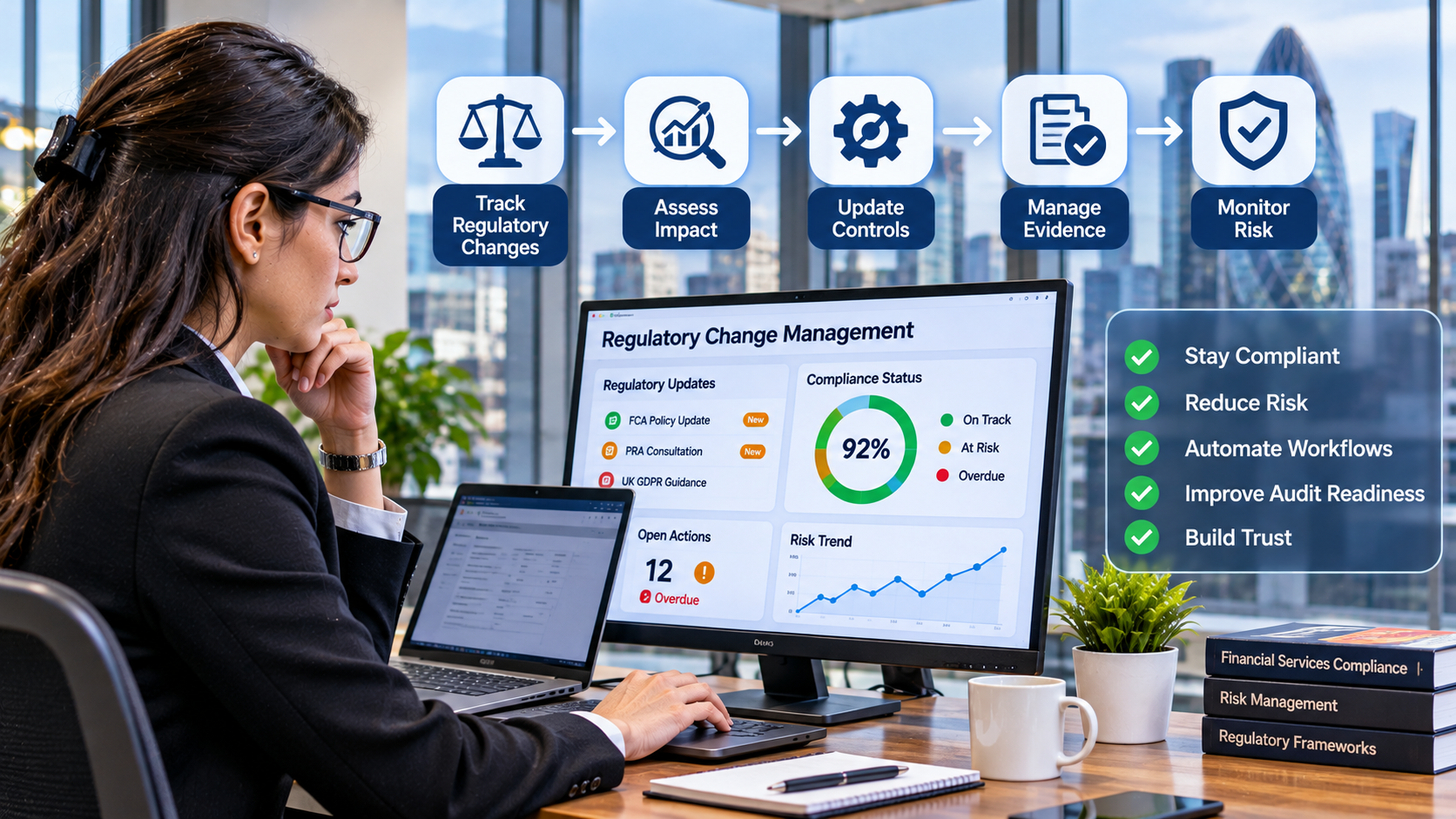
Regulatory change management is the structured process an organisation uses to identify, assess, implement and monitor changes in laws, regulations, supervisory expectations, standards and other relevant obligations.
It usually involves several stages:
Identify relevant regulatory publications and changes.
Determine whether the change applies to the organisation.
Interpret the potential business impact.
Identify affected policies, processes, systems and controls.
Assign accountable owners.
Plan and implement required changes.
Test or review the updated controls.
Retain supporting evidence.
Monitor outstanding actions and future developments.
The process differs between organisations because their regulatory permissions, products, customers, legal entities and operating models are different.
A payment institution, insurer and investment manager may all need regulatory monitoring, but their obligations and control environments will not be identical.
Technology should therefore support the organisation's own compliance framework rather than impose generic rules without context.
2. Why Manual Regulatory Tracking Creates Operational Risk
Many businesses already have compliance registers and internal procedures. Problems often arise because these records are maintained separately.
Regulatory updates are distributed across multiple sources
A compliance team may need to monitor legislation, regulator publications, policy statements, consultations, supervisory communications and industry standards.
Different sources may publish updates in different formats and on different schedules.
Applicability assessments are difficult to track
A regulatory update does not automatically apply to every business.
Employees need to assess the organisation's activities, permissions, products, legal entities and relevant processes before determining the required response.
Ownership becomes unclear
A regulatory change may affect compliance, operations, IT, finance, customer service, risk and senior management.
Without clear ownership, actions can remain open because each team assumes another department is responsible.
Evidence is spread across different locations
Policies, approval records, training logs, system screenshots, testing reports and meeting minutes may be stored in separate document repositories.
This makes it harder to establish a complete history of how an obligation was assessed and implemented.
Reporting becomes labour-intensive
Management may need to combine information from several registers to understand open actions, overdue assessments and control weaknesses.
A connected workflow can reduce this administrative burden and make exceptions more visible.
Businesses reviewing these challenges can start with a wider assessment of their technology and operating processes. Nexteck's technology strategy and enterprise architecture services provide a starting point for identifying disconnected systems and improvement opportunities.
3. Building a Regulatory Obligations Register
A central obligations register provides a structured view of the requirements relevant to the organisation.
It should not simply be a list of regulatory documents. Each record should connect the source requirement with its applicability, business impact, ownership and supporting controls.
Useful fields may include:
Regulatory source and publication reference
Publication and effective dates
Relevant legal entity
Business activity or product
Obligation description
Applicability assessment
Responsible business owner
Affected policies and procedures
Related risks and controls
Required actions
Target completion date
Evidence references
Review and approval history
Current status
Use consistent obligation categories
Requirements can be grouped by business area, regulatory topic, product, legal entity or control domain.
This makes it easier to identify which teams need to review a change.
Preserve the original source
A regulatory obligation should retain a link or reference to the authoritative source document.
The organisation should also record the relevant version and publication date so that employees can understand which requirement was assessed.
Record applicability decisions
A requirement may be relevant to one legal entity but not another.
The organisation should record the reasoning behind applicability decisions and provide a route for review when business activities change.
4. Automating Regulatory Change Identification and Triage
Automation can help compliance teams monitor relevant information and organise new developments.
Potential functions include:
Monitoring approved regulatory information sources
Detecting new publications and updated documents
Identifying changes between document versions
Categorising publications by subject
Extracting dates and reference numbers
Flagging potentially relevant business areas
Creating an assessment task
Notifying the appropriate compliance owner
However, a publication alert should not be treated as a confirmed regulatory obligation.
A human reviewer should establish whether the information is authoritative, whether it represents a material change and whether it applies to the organisation.
Distinguish between consultations and final requirements
A consultation paper, final policy statement, supervisory notice and legislation may have different implications.
The system should preserve the publication type and status rather than treating all documents as immediately effective requirements.
Manage effective dates
Some changes have future implementation dates or transitional arrangements.
A workflow should capture these dates and support planning, reminders and progress reporting.
Prioritise relevant developments
A business can use its existing risk framework to prioritise regulatory changes according to applicability, impact, urgency and implementation complexity.
This helps teams focus on relevant developments rather than creating tasks for every publication.
5. Mapping Regulatory Obligations to Policies, Risks and Controls
One of the most important functions of a regulatory change management system is connecting requirements to the organisation's internal control environment.
A single obligation may relate to several controls. Equally, one control may support multiple obligations.
A structured mapping model can connect:
Regulatory obligations
Internal policies
Business processes
Risk statements
Control objectives
Control activities
Responsible owners
Testing procedures
Supporting evidence
Remediation actions
Example: Access management
Suppose a regulatory or internal policy requirement leads an organisation to review access management arrangements.
The organisation may need to identify:
Relevant systems and applications
User access approval processes
Privileged account controls
Periodic access reviews
Joiner, mover and leaver procedures
Exception approvals
Evidence of completed reviews
The technology platform can connect the requirement with these control records and show whether the relevant review has been completed.
Example: Outsourcing and third-party oversight
A change affecting third-party oversight may require an organisation to review supplier registers, contractual records, due diligence processes, service monitoring and exit planning.
A connected obligations register can identify affected departments and track the associated actions.
This is especially relevant where multiple business units depend on shared technology providers.
Nexteck's industry-focused technology capabilities provide context for designing connected systems across complex and regulated business environments.
6. Automating Compliance Actions and Ownership
Once a change has been assessed, the organisation needs to turn the findings into managed work.
A regulatory change workflow can automatically create actions based on the assessment outcome.
Assign accountable owners
Each action should have a responsible person or team, a due date and a clear description of the expected result.
Define approval responsibilities
Some changes may require review by compliance, legal, risk, information security or senior management.
Approval rules should reflect the organisation's governance structure.
Track dependencies
A regulatory change may require several linked actions.
For example, a policy update may depend on a system change, which may depend on supplier input and technical testing.
The workflow should make these dependencies visible.
Escalate overdue actions
The system can send reminders and escalate overdue work according to documented rules.
Escalation should be based on business impact and internal policy rather than sending identical alerts for every task.
Record closure evidence
An action should not be marked complete solely because an employee changes its status.
The workflow should require appropriate evidence or approval where the control framework demands it.
7. Centralising Audit Evidence and Compliance Records
Audit evidence is often one of the most time-consuming parts of compliance operations.
A connected evidence repository can link documents and records directly to obligations, controls, reviews and actions.
Relevant evidence may include:
Approved policies
Risk assessments
Control testing results
Access review records
Training completion reports
Supplier due diligence documents
Management approvals
Incident and remediation records
System configuration evidence
Meeting decisions and action logs
Apply consistent evidence metadata
Evidence records should include relevant information such as owner, date, version, related control, reporting period and approval status.
Preserve version history
When a policy or procedure changes, the organisation should be able to identify the approved version that applied at a particular time.
Manage access and confidentiality
Compliance records may contain sensitive business, customer, employee or security information.
Access should be controlled according to role and business need.
Make evidence retrieval easier
A reviewer should be able to navigate from a requirement to the associated control and its supporting evidence without searching through unrelated folders.
The goal is to make the compliance record more structured and traceable, not simply to create another document storage location.
8. Where AI Can Support Regulatory Change Management
AI can help compliance teams process large volumes of regulatory information, but it must operate within a controlled framework.
Potential applications include:
Document summarisation: Produce initial summaries of regulatory publications for employee review.
Change comparison: Highlight differences between document versions.
Topic classification: Suggest categories such as operational resilience, data protection, financial crime or outsourcing.
Obligation extraction: Identify statements that may require assessment as potential obligations.
Control mapping assistance: Suggest internal policies or controls that may be relevant to a new requirement.
Evidence search: Help employees locate relevant records across approved document repositories.
Management reporting: Draft summaries of open actions, upcoming dates and outstanding assessments.
Why human review remains essential
AI may misinterpret context, miss exceptions or present an interpretation as more certain than the source supports.
Regulatory interpretation, applicability decisions and approval of control changes should remain with appropriately qualified and authorised personnel.
Organisations should also maintain source references, review records, access controls and clear rules governing the use of confidential information.
9. Integrating Compliance Technology with Existing Business Systems
A regulatory change management platform becomes more useful when it connects with the applications employees already use.
Potential integrations include:
| System | Integration purpose |
|---|---|
| Governance, Risk and Compliance platform | Obligations, risks and control records |
| Document management | Policies, procedures and evidence |
| Identity and access management | User access reviews and permissions |
| HR and learning systems | Training and role-based responsibilities |
| IT service management | Technology changes and remediation tasks |
| Third-party risk platform | Supplier assessments and monitoring |
| CRM and operational systems | Customer and business-process impacts |
| Reporting platform | Management dashboards and oversight |
Define the source of truth
A business should determine which application owns each type of record.
For example, the document management platform may own approved policies, while the GRC platform manages obligation and control relationships.
Build reliable integrations
Integration design should account for authentication, data permissions, event failures, duplicate records and audit logging.
Avoid unnecessary system duplication
A new compliance platform should complement the existing architecture rather than create another isolated repository.
Businesses can review Nexteck's software architecture and integration approach when assessing how compliance workflows should connect with existing business applications.
10. Regulatory Change Management Implementation Roadmap
A phased approach helps organisations establish governance before introducing advanced automation.
Phase 1: Assess the current operating model
Review how regulatory information is collected, assessed, assigned, implemented and evidenced.
Identify manual registers, duplicated records and unclear responsibilities.
Phase 2: Define the obligations and control structure
Establish consistent categories, obligation records, control identifiers, ownership and approval responsibilities.
Phase 3: Prioritise regulatory sources
Identify the authoritative sources relevant to the organisation's activities and define how changes will be monitored.
Phase 4: Design the workflow
Define assessment stages, risk prioritisation, action assignment, escalation and evidence requirements.
Phase 5: Integrate priority applications
Start with the systems that hold the most important obligation, policy, risk and evidence information.
Phase 6: Pilot with a defined business area
Test the workflow with a selected regulatory topic, legal entity or operational function.
Include new publications, future effective dates, non-applicable changes and overdue actions.
Phase 7: Measure and expand
Review performance, employee adoption, data quality and control effectiveness before extending the platform.
Organisations can use the Nexteck SME Strategy & Tracking Toolkit to help structure technology diagnostics, prioritise opportunities and establish implementation tracking.
11. KPIs for Regulatory Change Management
A useful dashboard should help management understand the status and quality of the regulatory change process.
| KPI | What it measures |
|---|---|
| Regulatory assessment completion | Share of identified changes assessed |
| Applicability decision time | Time required to determine relevance |
| Open regulatory actions | Outstanding implementation activities |
| Overdue action rate | Actions past their agreed deadlines |
| Control mapping coverage | Obligations linked to relevant controls |
| Evidence completeness | Controls with required supporting evidence |
| Review completion rate | Scheduled reviews completed |
| Remediation closure time | Time taken to close identified gaps |
| Regulatory change backlog | Unassessed or unresolved changes |
| Repeat control findings | Recurring issues identified through reviews |
| Owner assignment coverage | Actions with a clearly accountable owner |
Metrics should be defined consistently. A high completion rate alone does not prove that controls are effective or that an organisation is compliant.
12. UK Regulatory and Governance Considerations
The regulatory environment depends on the organisation's activities and permissions.
Depending on the business, relevant sources and frameworks may include:
Financial Conduct Authority (FCA) publications and requirements
Prudential Regulation Authority (PRA) requirements, where applicable
Bank of England publications and relevant supervisory expectations
UK data protection legislation
Payment Services Regulations and related requirements, where applicable
Anti-money laundering requirements, where applicable
Operational resilience expectations
Outsourcing and third-party risk requirements
Relevant conduct, governance and reporting obligations
A business should identify the rules that actually apply to its legal entities, products and activities.
Regulatory change management technology can help maintain records and coordinate work, but it cannot independently determine legal applicability or guarantee compliance. Legal and compliance professionals should validate the organisation's obligations and interpretations.
13. Common Mistakes to Avoid
Treating every regulatory publication as an obligation
A publication needs to be assessed for authority, relevance, applicability and implementation implications.
Using automation without clear ownership
Every obligation and action should have accountable ownership and appropriate approval routes.
Keeping controls separate from requirements
Without traceable links, it can be difficult to demonstrate how an organisation responds to a regulatory change.
Storing evidence without context
A document repository is not sufficient if employees cannot connect evidence with the relevant obligation, control and reporting period.
Over-relying on AI summaries
AI-generated summaries should not replace review of authoritative source material.
Ignoring integration and data quality
Disconnected records can create duplicate actions and inconsistent reporting.
Measuring task completion instead of control effectiveness
A completed workflow does not automatically demonstrate that the underlying control is operating effectively.
14. How Nexteck Can Help
Nexteck supports technology strategy, software architecture, system integration and business process improvement.
For UK financial services organisations, a structured technology assessment can help identify where regulatory information, policies, control records, evidence and operational workflows are disconnected.
Potential areas of support include:
Reviewing existing compliance technology architecture
Mapping regulatory and operational data flows
Identifying workflow automation opportunities
Assessing integration between GRC and business systems
Improving evidence management and reporting
Defining data ownership and governance requirements
Planning phased technology improvements
Explore Nexteck's industry expertise, review its technology strategy and architecture services or use the SME Strategy & Tracking Toolkit to support structured technology planning.
Looking to improve regulatory change tracking, compliance workflows or audit evidence management? Contact Nexteck to discuss your current systems, integration requirements and technology improvement priorities.
Frequently Asked Questions
What is regulatory change management automation?
It is the use of software and connected workflows to identify regulatory developments, coordinate applicability assessments, assign actions, map controls and maintain evidence of implementation.
Why is regulatory change management important for UK financial services firms?
It helps firms understand relevant changes, coordinate responsibilities, track implementation and maintain records supporting their compliance and governance processes.
Can regulatory updates be monitored automatically?
Approved sources can be monitored using automated tools, alerts and document comparison. Human reviewers still need to validate the source and determine whether a change applies.
What is a regulatory obligations register?
It is a structured record of relevant regulatory requirements, applicability decisions, responsible owners, linked controls, actions and supporting evidence.
How does control mapping improve compliance management?
Control mapping connects obligations with internal policies, risk statements and control activities. It helps organisations understand how requirements are addressed and where gaps may exist.
Can AI help with regulatory compliance?
AI can assist with document summarisation, change comparison, classification and evidence search. Regulatory interpretation and important approval decisions should remain under appropriate human oversight.
What systems should a regulatory change management platform integrate with?
Potential integrations include GRC platforms, document management, identity management, HR and learning systems, IT service management, third-party risk applications and reporting platforms.
How can firms improve audit evidence management?
They can standardise evidence metadata, connect records to controls and obligations, maintain version history and apply role-based access.
Is regulatory change management software suitable for smaller financial services businesses?
Yes. Smaller firms can start with a structured obligations register, defined responsibilities and a limited set of workflows before expanding integrations.
How can Nexteck support regulatory change management automation?
Nexteck can help assess technology architecture, identify integration opportunities, review business workflows and plan practical automation improvements.