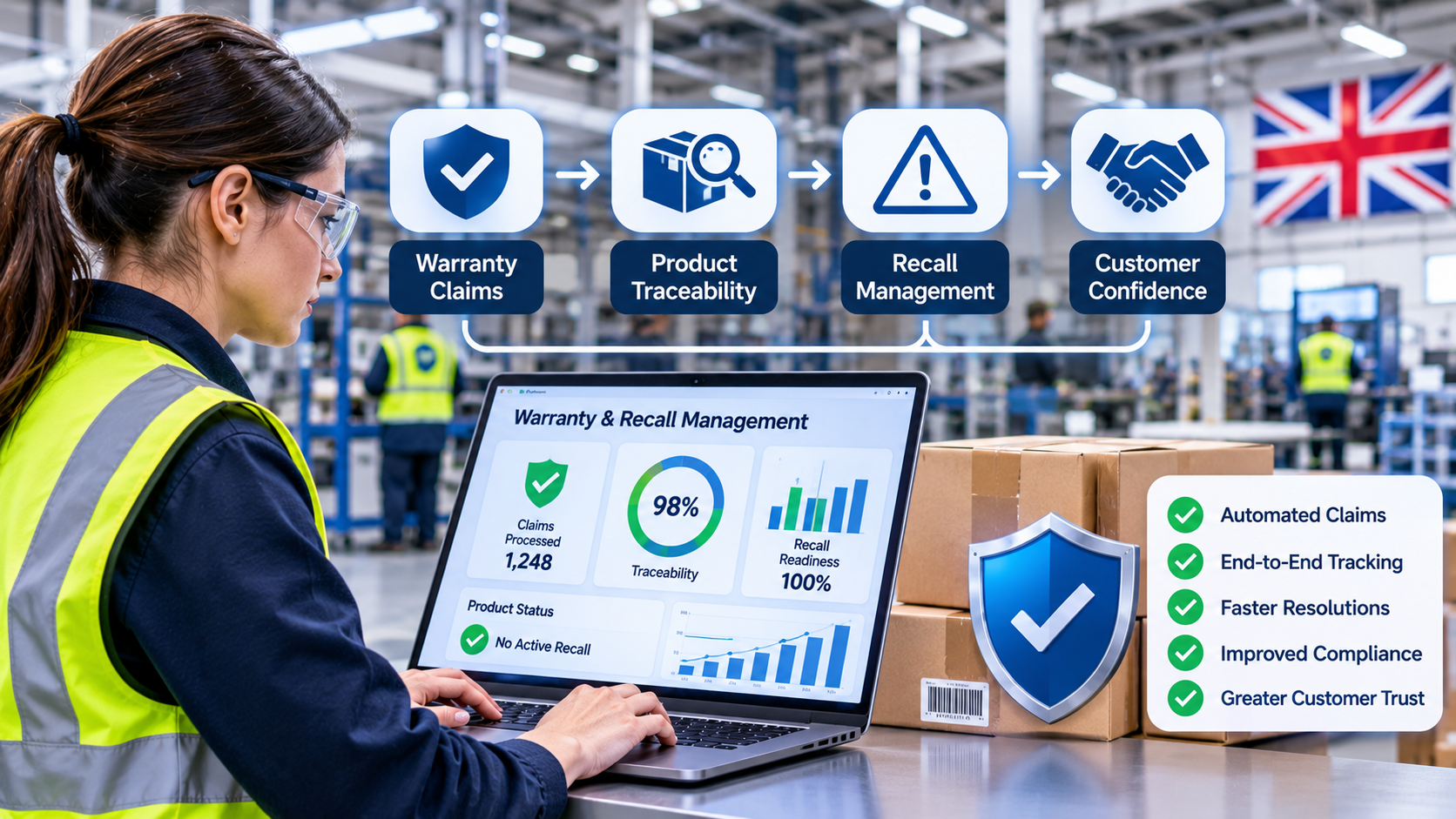
Warranty & Product Recall Management Automation UK | Nexteck
Discover how UK manufacturers and distributors can automate warranty claims, product traceability, supplier coordination and product recalls with connected business systems.
Product warranty management software UK
warranty claims automation UK, product recall management system, warranty management automation, manufacturer after-sales software, product traceability UK, distributor warranty claims, supplier quality management, product serial number tracking, warranty workflow automation, returns and repair management.
UK manufacturers, UK distributors, London manufacturing businesses, Midlands manufacturers, Birmingham industrial suppliers, Manchester distributors, UK engineering companies, British product manufacturers.
Commercial investigation / B2B technology solution.
Introduction: Why Warranty and Recall Management Need Better Systems
For manufacturers and distributors, the customer relationship does not end when a product is delivered. Warranty enquiries, repair requests, replacement decisions, supplier investigations and product safety concerns continue throughout the product lifecycle.
When these activities are managed through disconnected spreadsheets, shared inboxes and manual forms, even a straightforward warranty claim can become difficult to track. Teams may struggle to confirm purchase dates, identify the correct product version, check warranty eligibility or determine whether a reported fault affects other customers.
Product recalls create an even greater operational challenge. A business may need to identify affected batches, locate distributors, contact customers, coordinate replacement stock and maintain a clear record of every action taken.
Warranty management automation connects these processes through structured workflows and integrated business systems. It gives service, quality, operations and finance teams a more consistent view of product issues and the actions required to resolve them.
For UK manufacturers, engineering businesses, wholesalers and distributors, the objective is not simply to process claims faster. It is to improve traceability, reduce avoidable administration, protect customer confidence and make product-quality information more useful for business decisions.
1. The Operational Problems Behind Manual Warranty Management
Many businesses have a warranty process, but that does not necessarily mean they have a connected warranty management system.
A customer may submit a claim through email, while the sales team checks the original invoice in an ERP system. A service engineer may record the fault in a separate application, and finance may maintain a spreadsheet of replacement costs.
This creates several recurring problems.
Incomplete product and purchase information
A warranty decision often depends on information such as:
Product model and serial number
Purchase or installation date
Customer and distributor details
Warranty terms and exclusions
Batch, component or manufacturing information
Previous repairs or replacement history
If these records are spread across different systems, employees may spend unnecessary time collecting information before they can even assess a claim.
Slow claim assessment
Without defined approval rules, claims can move between customer service, technical support, quality assurance and finance without clear ownership. Employees may not know who needs to approve a repair, replacement or refund.
Limited visibility of recurring defects
A single fault may appear insignificant. However, several similar reports involving the same component, batch or production period could indicate a wider quality issue.
If claims are not categorised consistently, management may fail to recognise patterns early.
Poor communication with customers and distributors
Customers want acknowledgement, clear next steps and realistic updates. Manual processes make it difficult to provide consistent communication when several teams are involved.
A structured technology assessment can help identify these gaps before software is selected. Businesses can review their wider operating environment through Nexteck's technology strategy and architecture approach.
2. What Is Warranty Management Automation?
Warranty management automation uses software, business rules and system integrations to manage the lifecycle of a product warranty claim.
A connected workflow can:
Receive a claim through a customer or distributor portal.
Validate the product, serial number and purchase information.
Check warranty eligibility against approved business rules.
Assign the case to the correct service or technical team.
Request photographs, diagnostic reports or supporting documents.
Record inspection findings and decisions.
Trigger an approved repair, replacement or credit process.
Update inventory, finance and customer records.
Send status notifications.
Retain a complete history for reporting and audit purposes.
The automation should handle repetitive administration while leaving technical judgement and unusual decisions with authorised employees.
For example, a standard claim with complete information and a valid warranty may follow a predefined route. A claim involving suspected misuse, safety concerns or an unusual failure pattern should be escalated for human review.
3. Building a Connected Product Traceability Framework
Warranty automation is only as reliable as the product information behind it.
A manufacturer or distributor should be able to connect a customer complaint with the relevant product record. Depending on the industry, this may include a serial number, batch identifier, manufacturing date, component reference, supplier record or installation location.
Serial number and batch tracking
Serial numbers help distinguish individual products, while batch identifiers can connect multiple units to a shared manufacturing or supply event.
A traceability system should record:
Product identity and model
Manufacturing or assembly batch
Component and supplier references
Inspection and quality results
Dispatch and delivery records
Customer or distributor destination
Repair, service and replacement history
Linking product records with operational systems
A product record may need information from several applications:
| System | Information required |
|---|---|
| ERP | Product codes, orders, invoices and stock |
| CRM | Customer and distributor details |
| Quality management | Inspections, defects and corrective actions |
| Service management | Repairs, engineer visits and case status |
| Warehouse management | Batch locations and replacement stock |
| Finance | Credits, replacement costs and claim values |
A well-designed integration connects these records without forcing employees to re-enter the same information.
Businesses considering this approach can explore Nexteck's industry and engineering supply-chain capabilities, including its focus on connected operations and business systems.
4. Automating the Warranty Claim Lifecycle
A successful warranty workflow needs clearly defined stages, responsibilities and decision rules.
Stage 1: Claim submission
Customers, installers or distributors submit a claim through an online form or service portal.
The form should collect only the information needed for initial assessment. Conditional questions can request additional details based on the product category or reported fault.
Stage 2: Automatic validation
The system checks whether the product exists, whether the purchase details match and whether the warranty period is potentially valid.
If information is missing, the claimant receives a request for clarification rather than allowing an incomplete case to move forward unnoticed.
Stage 3: Technical assessment
The claim is assigned according to product type, fault category, severity or specialist responsibility.
Employees can review evidence, record diagnostic findings and request further information.
Stage 4: Approval and resolution
Rules can route standard claims for approval while escalating exceptions.
Possible outcomes include:
Repair authorisation
Replacement approval
Customer credit
Distributor credit
Rejection with a recorded explanation
Further technical investigation
Stage 5: Finance and inventory updates
Once an authorised decision is made, integrations can update the relevant financial and stock records.
This helps prevent a replacement from being issued without the appropriate inventory transaction or a credit from being processed without supporting case information.
Stage 6: Customer communication and closure
Customers receive a clear update, while the business retains the resolution details and supporting evidence.
5. Product Recall Management: From Detection to Controlled Action
A product recall is not simply a large warranty claim. It may involve safety, regulatory, contractual, reputational and operational considerations.
A recall management workflow should support rapid investigation and controlled communication. The appropriate actions depend on the product, the risk, the applicable legal requirements and advice from relevant specialists.
Identify the affected products
The business needs to identify potentially affected models, batches, serial number ranges, components or production periods.
Accurate traceability can help narrow the investigation and avoid relying on incomplete manual records.
Locate the distribution chain
A manufacturer may have supplied products to wholesalers, retailers, installers or direct customers.
The system should help establish where affected units were dispatched and which organisations may hold them.
Coordinate recall activities
A controlled recall process may include:
Internal escalation and decision records
Affected product and batch identification
Distributor and customer contact lists
Approved customer communications
Quarantine and stock-control instructions
Return, repair or replacement tracking
Evidence of completed actions
Management reporting and case closure
Maintain an auditable history
Every important decision should have a timestamp, responsible owner and supporting record.
Where a product safety issue may require formal notification or regulatory action, automation should support the process rather than replace specialist legal or regulatory judgement.
6. Supplier Quality and Corrective Action Integration
Warranty claims can reveal issues that originate outside the organisation.
For example, a recurring component failure may relate to a supplier batch, a material specification or a manufacturing process. If the warranty system is isolated from supplier quality records, the business may repeatedly resolve individual claims without addressing the underlying cause.
A connected process can link a customer complaint to:
Supplier and component references
Incoming inspection results
Non-conformance reports
Corrective and preventive actions
Supplier response deadlines
Replacement component records
Verification of corrective action effectiveness
This creates a feedback loop between after-sales service, procurement, engineering and quality teams.
The wider technology environment should be reviewed as a complete operating model, not as a collection of isolated applications. Nexteck's business technology and software architecture services can be a starting point for evaluating integration requirements.
7. Where AI Can Support Warranty and Recall Operations
Artificial intelligence can help teams organise information and identify patterns, but it should be introduced with clear controls.
Potential use cases include:
Document extraction: Extract product references, dates and claim details from invoices, service reports and supporting documents.
Claim classification: Suggest a fault category based on the customer's description and available product information.
Duplicate detection: Highlight potentially repeated claims involving the same customer, serial number or issue.
Trend analysis: Identify unusual increases in claims associated with a model, component or supplier.
Knowledge assistance: Help service teams locate relevant warranty policies, technical instructions and approved troubleshooting guidance.
Draft communication: Prepare customer updates for employee review.
AI should not independently make high-impact safety decisions, approve disputed claims or issue recall instructions without appropriate human authorisation. Businesses should also define access permissions, data retention, audit logging and processes for correcting inaccurate AI outputs.
8. Implementation Roadmap for UK Manufacturers and Distributors
A phased implementation is generally easier to govern than attempting to replace every system at once.
Phase 1: Map the existing process
Document how claims arrive, how eligibility is checked, who approves decisions and how repair or replacement work is recorded.
Identify duplicate data entry, missing information and unnecessary handoffs.
Phase 2: Establish reliable product data
Review product codes, serial numbers, batch references, customer records and warranty terms.
Resolve inconsistent identifiers before connecting systems.
Phase 3: Define workflow rules
Agree claim categories, approval thresholds, escalation paths, service targets and exception handling.
Phase 4: Integrate priority systems
Start with the applications that have the greatest operational impact, such as ERP, CRM, service management and inventory.
Phase 5: Pilot with one product group
Test the workflow using a limited product range or business unit. Include normal claims, incomplete submissions, disputed cases and replacement scenarios.
Phase 6: Measure and improve
Review processing time, claim accuracy, repeat faults, stock recovery, customer communication and employee workload.
For businesses that need a structured way to identify technology priorities, Nexteck's SME Strategy & Tracking Toolkit provides a framework covering diagnostics, benchmarking, opportunity planning and KPI governance.
9. KPIs to Measure Warranty and Recall Performance
A system should produce meaningful operational measures rather than simply count the number of claims.
| KPI | What it measures |
|---|---|
| Average claim resolution time | Time from submission to final decision |
| First-time information completeness | Claims received with sufficient initial information |
| Claims requiring manual rework | Administrative effort caused by missing or incorrect data |
| Repeat fault rate | Recurring issues for products or components |
| Warranty cost per product | Warranty expenditure relative to product volume |
| Repair versus replacement ratio | How claims are resolved |
| Supplier-related claim rate | Claims linked to supplier components or materials |
| Recall traceability time | Time required to identify potentially affected products |
| Customer update compliance | Whether agreed communication milestones are met |
| Open claim backlog | Unresolved cases by age and priority |
Targets should be set using the organisation's baseline, product complexity and service commitments rather than copied from unrelated businesses.
10. Security, Data Protection and Governance
Warranty systems may hold customer contact information, purchase records, photographs, service reports and commercial supplier information.
UK organisations should consider the UK GDPR and Data Protection Act 2018 where personal data is processed. Appropriate controls may include:
Role-based access to customer and product records
Secure authentication and administrator controls
Encryption in transit and at rest
Defined retention and deletion rules
Audit logs for approvals and record changes
Supplier and integration security reviews
Tested backup and recovery procedures
Clear incident escalation responsibilities
Product safety and recall processes should also be reviewed against the legal and regulatory requirements relevant to the products being sold. A software workflow is not a substitute for specialist compliance advice.
11. Choosing the Right Warranty Management Technology
The best solution depends on the organisation's size, product complexity, claim volume and existing software environment.
Before selecting a platform, decision-makers should ask:
Can the system identify products through serial numbers and batch references?
Can warranty rules vary by product, customer or sales channel?
Can customers and distributors submit claims online?
Can the workflow connect with ERP, CRM and inventory systems?
Can technical evidence and approval history be retained?
Can the business identify recurring defects?
Can recall activities be tracked across distribution channels?
Can employees manage exceptions without bypassing controls?
Can reporting be adapted as the business grows?
A technology decision should be based on workflow fit, integration capability, security, ownership and total operating cost—not simply the number of features shown in a product demonstration.
12. How Nexteck Can Help
Nexteck works across technology strategy, software architecture, system integration and business process improvement. For manufacturers and distributors, the first step is understanding how product, customer, supplier, service and financial information currently moves through the organisation.
A structured engagement can help identify disconnected applications, manual claim processes, traceability gaps and opportunities for automation.
Explore Nexteck's industry capabilities, review its technology strategy approach or use the SME Strategy & Tracking Toolkit to support a more structured technology discussion.
Looking to improve warranty claims, product traceability or recall readiness? Contact Nexteck to discuss your current processes, integration challenges and potential automation roadmap.
Frequently Asked Questions
What is warranty management automation?
Warranty management automation uses software and connected workflows to receive claims, validate product information, route approvals, coordinate repairs or replacements and maintain claim records.
How can UK manufacturers improve warranty claim processing?
Manufacturers can improve claim processing by standardising claim forms, maintaining accurate serial number and batch data, connecting warranty workflows with ERP and CRM systems, and defining clear approval responsibilities.
What is a product recall management system?
A product recall management system helps an organisation identify affected products, trace distribution records, coordinate communications, track returned or quarantined stock and maintain evidence of recall actions.
Can warranty management software integrate with ERP systems?
Yes. Depending on the platforms and integration design, warranty software can exchange product, order, invoice, stock, supplier and financial information with ERP systems.
How does product traceability help with recalls?
Product traceability connects product identifiers with manufacturing, component, inspection, dispatch and customer records. This can help businesses investigate the scope of a potential issue and identify affected distribution routes.
Can AI detect recurring product defects?
AI and analytics can help identify patterns in claim descriptions, product identifiers and fault categories. Findings should be reviewed by qualified quality or engineering personnel before action is taken.
Is warranty automation suitable for small and medium-sized manufacturers?
Yes. SMEs can begin with a focused workflow for claim registration, eligibility checks and case tracking, then add integrations as business requirements grow.
What should businesses measure after implementation?
Useful measures include claim resolution time, repeat fault rate, warranty cost per product, information completeness, open claim backlog and recall traceability time.
How can Nexteck support warranty and recall automation?
Nexteck can help businesses assess technology architecture, identify integration requirements, review operational workflows and plan practical software and automation improvements.