Premium Software at an Affordable Price: How UK Businesses Can Invest in Quality Technology Without Overspending
Affordable Custom Software Development UK | Premium Quality
Discover how UK businesses can access high-quality custom software, better user experiences and reliable digital solutions through cost-conscious software planning and development.
affordable-premium-software-development-uk
Affordable custom software development UK
Affordable software development company UK
Custom software development UK
Premium software development services
Cost-effective software solutions
Bespoke software development London
Affordable software developers London
Custom software development Hounslow
Software development services UK
Business software solutions
Custom business application development
Enterprise software solutions UK
Affordable web application development
Mobile app development UK
Software development for small businesses
Software development for SMEs
Cost-effective digital transformation
Business process automation software
Custom application development company
Software architecture consulting UK
Software development project cost
Scalable software solutions
Secure custom software development
Software maintenance and support UK
Business workflow automation
Software integration services
Premium digital solutions for businesses
User-friendly business software
Technology consulting London
Affordable business technology solutions
Software ROI for UK businesses
Software development company England
Digital solutions United Kingdom
Custom CRM and business systems
Software modernisation services
Software development for startups
Business software cost optimisation
London, Hounslow, West London, England, UK, United Kingdom, UK SMEs, London businesses, software solutions for UK companies.
Commercial investigation and transactional — business owners comparing custom software options, development costs, quality, technology partners and expected value.
Introduction: Premium Software Should Deliver Value, Not Just a High Price
Businesses need technology that helps them serve customers, manage operations and compete effectively. Yet many business owners face the same challenge: they want dependable, professional software, but they also need to protect cash flow and control project costs.
Some companies delay digital improvements because they assume custom software will be too expensive. Others choose the cheapest available option, only to discover that the product lacks essential features, performs poorly or requires expensive rework.
Neither approach is ideal.
The objective should be to invest in high-quality software at a cost that makes commercial sense. That means choosing the right features, suitable technology, clear project scope, appropriate security controls and a realistic maintenance plan.
For businesses in London, Hounslow, West London, England and across the United Kingdom, affordable software development does not have to mean compromising every aspect of quality. It means understanding which capabilities are essential, which improvements can wait and how to measure the value delivered by the investment.
Premium software should be reliable, usable, secure and maintainable. It should solve a real business problem rather than simply look impressive during a demonstration.
At Nexteck, the current focus includes technology strategy, systems integration, software architecture and business process improvement. This is relevant because cost-effective technology decisions often begin before coding: businesses need to understand the problem, assess existing systems and choose the most appropriate solution.
1. What Does Premium Software at an Affordable Price Really Mean?
Affordable premium software is not necessarily the cheapest software on the market. It is software that provides the required quality and functionality without unnecessary expense.
A useful definition of quality includes several dimensions.
Reliable functionality
The software should perform its essential tasks correctly and consistently. Users should be able to complete important workflows without frequent failures or unexpected behaviour.
Good user experience
The interface should be understandable and usable. Customers and employees should not need extensive workarounds to complete routine tasks.
Appropriate security
The application should protect data and restrict access according to the risks and requirements of the business.
Maintainable architecture
The software should be structured so that authorised developers can understand, test and improve it over time. Maintainability matters because software requirements and dependencies change.
Performance and scalability
The solution should meet current performance requirements and have a sensible path for growth. Not every business needs enterprise-scale infrastructure from day one, but its architecture should reflect realistic future needs.
Transparent costs
The business should understand what it is paying for, which deliverables are included, what assumptions apply and which ongoing expenses may arise.
Premium quality is therefore about fitness for purpose, dependable execution and long-term value—not the number of features or the size of the initial budget.
2. Why the Cheapest Software Option Can Become Expensive
Price matters, but the initial quotation is only one part of the total cost of owning software.
Imagine a company that purchases an inexpensive business application. At first, the product appears to meet its needs. Over time, staff discover that important workflows are missing, reports require manual work and integrations do not function reliably.
The company may then spend additional money on workarounds, support, customisation or replacement software.
The original purchase may have been inexpensive, but the overall cost can become significant.
Hidden development costs
A low initial quote may exclude important work such as requirements analysis, data migration, integration, testing, documentation or deployment support.
Businesses should compare proposals based on equivalent deliverables rather than headline prices.
Poor usability and training
If software is difficult to use, employees may need extra training or continue using spreadsheets and manual processes. This can reduce the value of the original investment.
Technical debt
Rushed implementations can create fragile code, inconsistent data models and dependencies that are difficult to maintain. Fixing these problems later may cost more than addressing them during development.
Integration problems
Software that cannot exchange information reliably with existing systems can create duplicate data entry and reporting inconsistencies.
Security and maintenance risks
Unsupported software, weak access controls or unpatched dependencies can create operational and security risks. The business may eventually need an urgent upgrade or replacement.
The lesson is not that the cheapest option is always wrong. It is that a purchasing decision should consider the complete cost, quality and risk profile.
3. Start With the Business Problem Before Choosing Software
One of the most effective ways to control software costs is to avoid building the wrong product.
Businesses sometimes start with a list of requested features without identifying the problem those features are supposed to solve. This can result in unnecessary functionality and a project that becomes larger with every review.
A more effective approach starts with discovery.
Identify the current problem
Describe the issue in practical terms. For example, employees may enter the same customer information into multiple systems, managers may spend hours preparing reports or customers may struggle to book services online.
Understand who is affected
Identify the users involved and how the problem affects their work. A process that causes occasional inconvenience may require a different investment from one that creates daily delays or significant errors.
Map the existing workflow
Document the steps, systems, approvals and information involved. This helps identify where software is genuinely needed and where a simpler process change may be sufficient.
Define the desired outcome
Set a measurable objective where possible. Examples include reducing manual processing, improving task completion, decreasing data errors or making customer enquiries easier to manage.
Evaluate possible solutions
Options may include improving an existing system, integrating two products, automating a repetitive task or building a custom application.
Custom development should be selected when it offers a meaningful advantage over practical alternatives.
Businesses reviewing these questions can explore Nexteck's website for its current technology strategy and business systems focus.
4. Custom Software vs Off-the-Shelf Software: Which Is More Cost-Effective?
There is no universal answer. The right choice depends on the uniqueness of the business process, available products, integration needs and long-term operating costs.
Off-the-shelf software
Off-the-shelf software is a product developed for a broad market. It may be suitable when its standard functionality meets the company's requirements.
Potential advantages include quicker implementation, established features, available support and predictable subscription arrangements.
Potential limitations include restricted customisation, recurring fees, integration constraints and workflows that do not fit the business particularly well.
Custom software development
Custom software is designed around specific requirements. It may be useful when a business has distinctive workflows, specialist data requirements or processes that existing products cannot adequately support.
Potential advantages include greater control over functionality, tailored user journeys and integration designed around the business.
However, custom software also brings responsibility for development, testing, hosting, maintenance and future improvements.
A hybrid approach
Some businesses benefit from combining existing platforms with a smaller custom module or integration.
For example, a company may retain its current accounting software while developing a portal that connects customer requests to an internal workflow.
This can avoid rebuilding capabilities that already work well.
How to make the decision
Compare the options using:
Fit with the required workflow.
Initial implementation cost.
Subscription and licence costs.
Integration requirements.
Data migration effort.
Security and compliance needs.
Maintenance responsibilities.
Flexibility for future changes.
Vendor dependency and exit options.
The most cost-effective solution is the one that meets the business need reliably over its useful life.
5. How to Build Premium Software Without Unnecessary Features
Software projects can become expensive when every idea is treated as essential.
A disciplined scope helps businesses concentrate investment on the capabilities that matter most.
Define the minimum viable product
A minimum viable product (MVP) contains the core features needed to deliver the intended value and test whether the solution works for real users.
For example, an appointment application might initially include service selection, availability, booking, confirmation and basic administration.
Advanced loyalty programmes, complex analytics or multiple integrations may be introduced later if the initial product demonstrates a need for them.
Separate essential and optional requirements
Create a list of must-have features, useful enhancements and future possibilities. This makes trade-offs more transparent when budget or delivery constraints arise.
Prioritise by business impact
Features should be evaluated by the problem they solve, the number of users affected, the risk they address and the cost of implementation.
Avoid building duplicates
Before adding a feature, check whether an existing system already provides it. A well-designed integration may be more economical than developing the same capability from scratch.
Test assumptions early
Wireframes, prototypes and early user testing can reveal problems before a large amount of development work has been completed.
Scope discipline is not about cutting quality. It is about investing in the right quality at the right time.
6. Why User Experience Is a Core Part of Affordable Software
Software can be technically impressive but commercially disappointing if users find it confusing.
Poor usability creates indirect costs. Employees may need extra training, customers may abandon tasks and support teams may receive repeated questions about the same problems.
A well-designed user experience can reduce these sources of friction.
Clear navigation
Users should understand where they are and how to reach the functions they need.
Simple workflows
Common tasks should require a reasonable number of steps. Unnecessary fields, repeated questions and confusing approval sequences should be reviewed.
Helpful error messages
When something goes wrong, the application should explain the problem and, where possible, provide a recovery path.
Responsive design
Web applications should work across relevant screen sizes. Mobile users should not have to struggle with tiny controls or layouts that require excessive scrolling.
Consistent interaction patterns
Similar tasks should behave consistently throughout the application. This makes the software easier to learn and reduces avoidable mistakes.
Usability testing
Test the application with representative users before release. Observe whether they can complete essential tasks and identify areas where the interface creates confusion.
Better UX does not automatically guarantee more revenue, but it can improve the conditions needed for successful adoption and customer satisfaction.
7. Software Architecture: Paying for What You Actually Need
Software architecture defines how an application is structured and how its components interact. Architecture decisions can influence reliability, security, performance, development speed and maintenance costs.
A common mistake is to choose the most complex architecture because it sounds future-proof.
In reality, the right architecture depends on the current problem and credible expectations for future growth.
Keep the design proportionate
A small internal tool may not need the same infrastructure as a high-volume customer platform. Starting with unnecessary complexity can increase implementation and operating costs.
Plan clear component boundaries
Well-defined responsibilities make systems easier to understand and modify. Components should communicate through appropriate interfaces and have clear ownership of important data.
Use established technology where suitable
Mature frameworks and libraries can reduce duplicated work and provide tested capabilities. Their maintenance status, security and compatibility should still be assessed.
Design integrations carefully
Systems should exchange data through clear, documented interfaces. Error handling and monitoring are important because connected services can fail independently.
Document important decisions
Documentation should explain the key architecture choices, system dependencies, deployment process and maintenance requirements.
Avoid premature optimisation
Performance should be measured under relevant conditions. Optimising imaginary bottlenecks can consume budget without improving the actual user experience.
A proportionate architecture aims to meet current requirements while leaving a practical route for future improvements.
8. Transparent Budgeting for Software Development Projects
A clear budget helps businesses make informed decisions and avoid surprises.
The project estimate should explain the work involved, assumptions, exclusions and likely ongoing costs.
Discovery and requirements
This stage clarifies the business problem, scope, user journeys and technical constraints. It can reduce the risk of expensive misunderstandings later.
Design and prototyping
Design work helps validate the proposed experience and establish the expected behaviour before implementation.
Development
The estimate should identify the major functionality, integrations, data requirements and technical components included in the build.
Testing and quality assurance
Testing should be included in the project plan. Treating it as optional can create avoidable problems after release.
Deployment
Deployment may involve hosting configuration, environment setup, data migration, production checks and release coordination.
Maintenance and support
Ongoing costs may include hosting, monitoring, software updates, security work, third-party services, support and enhancements.
Change management
New requirements can affect time and cost. Agree how changes will be assessed, approved and documented.
A professional proposal should make it possible to understand not only the initial investment but also the responsibilities that continue after launch.
9. Affordable Software Development for UK SMEs
Small and medium-sized businesses often need practical technology without the overhead of a large enterprise programme.
A sensible approach is to match the solution to the size of the problem and the organisation's ability to maintain it.
Start with high-impact processes
Look for recurring problems that consume employee time, create errors or affect customer service.
Improve existing systems first
Sometimes a configuration change, process redesign or integration can solve the issue without building a completely new product.
Phase the investment
Divide the work into manageable stages with clear outcomes. This allows the business to review progress and make informed decisions before committing to later phases.
Keep the technology manageable
Choose tools and architecture that the business can support, either internally or through an agreed external maintenance arrangement.
Train the team
Software provides limited value if employees do not understand how to use it. Documentation, onboarding and practical training should be considered part of the implementation.
Measure results
Review whether the software is improving the workflow it was designed to address. Use the findings to decide what should be improved next.
For businesses in London, Hounslow, West London and elsewhere in the UK, this approach can help align technology spending with real operational priorities.
10. Security and Quality Should Not Be Optional Budget Items
Cost optimisation should not remove essential safeguards.
The appropriate security and quality measures depend on the application's users, data, industry and operational risk.
Authentication and permissions
Users should receive access only to the information and actions required for their role.
Data protection
Sensitive data should be collected, stored, transmitted and retained according to the application's requirements and applicable obligations.
Testing
Testing should cover important workflows, error conditions, permissions, integrations and relevant device or browser combinations.
Backup and recovery
Businesses should understand how important data can be restored and how the application will recover from foreseeable failures.
Dependency updates
Third-party libraries and services need appropriate monitoring and maintenance. Outdated components may introduce avoidable security or compatibility problems.
Monitoring
Application errors and service interruptions should be visible to the people responsible for support.
These measures help protect the investment and reduce the risk of expensive incidents. The aim is not to add every possible control, but to implement safeguards proportionate to the actual risk.
11. How to Calculate Software Return on Investment
Return on investment (ROI) compares the value generated by an investment with its cost. For software projects, the calculation should include both direct and ongoing expenses.
Potential benefits may include:
Reduced manual processing time.
Fewer data-entry errors.
Faster customer response.
Improved task completion.
Lower costs from duplicated systems.
Better visibility into business performance.
Increased capacity without proportional administrative effort.
Improved customer retention or conversion, where supported by evidence.
A simple financial model can compare the expected benefits with development, implementation, hosting, training, maintenance and support costs.
However, estimates should be realistic. Benefits may take time to appear, adoption may be lower than expected and some improvements may be difficult to quantify.
Businesses should establish baseline measurements before implementation and review the results after launch. This helps separate genuine improvements from assumptions.
A technology investment is more defensible when its expected value, risks and costs are clearly documented.
12. Choosing a Software Development Partner
The development partner can influence the project's quality, delivery process and long-term maintainability.
Understand the business before proposing technology
A suitable partner should ask about workflows, users, goals and constraints rather than recommending a large build immediately.
Explain the scope clearly
The proposal should identify features, deliverables, exclusions, dependencies and acceptance criteria.
Discuss technical trade-offs
A good technical recommendation should explain why a particular approach fits the requirements and what alternatives were considered.
Clarify ownership
Agree who owns the source code, documentation, designs and other deliverables, subject to the contract and any third-party licence terms.
Establish quality standards
Clarify how testing, security reviews, performance checks and deployment will be handled.
Plan post-launch support
Agree who will maintain the application, address bugs, update dependencies and handle future enhancements.
Review communication and governance
The project should have a clear process for progress updates, approvals, risk escalation and change requests.
Businesses can review Nexteck's official website to understand its current business and technology positioning and assess whether it aligns with their requirements.
13. The Role of Digital Transformation in Cost-Effective Software
Digital transformation does not necessarily mean replacing every system or adopting the newest technology. It means improving how a business operates through appropriate changes to processes, data and technology.
A business may discover that its main problem is not a lack of software but the way existing tools are used.
For example, disconnected systems may force employees to enter the same data repeatedly. A targeted integration could be more economical than replacing every application.
Similarly, a company struggling with manual reporting may benefit from clearer data definitions and automated reporting rather than a large new enterprise platform.
A practical transformation plan should:
Review the current systems and workflows.
Identify the most important operational bottlenecks.
Estimate the cost and impact of possible improvements.
Prioritise changes based on risk and value.
Implement improvements in manageable stages.
Measure the outcome and adjust the plan.
For companies evaluating their technology investment, Nexteck's website provides information about its technology strategy and business process focus.
14. Common Mistakes That Increase Software Costs
Unclear requirements: Uncertainty about the intended product creates rework and scope disputes.
Excessive features: Building functionality without evidence of need increases complexity and maintenance.
Choosing solely by price: A low quote may exclude essential work or create long-term risks.
Ignoring user feedback: Software that does not match real workflows may be poorly adopted.
Skipping testing: Defects discovered after launch can affect customers and require expensive fixes.
Neglecting documentation: Poor documentation can make future maintenance slower and more dependent on individual developers.
Overcomplicating the architecture: Unnecessary technical complexity can raise costs without creating meaningful value.
Forgetting ongoing expenses: Hosting, licences, updates and support should be considered before approval.
Failing to measure outcomes: Without baseline data, businesses may struggle to determine whether the investment worked.
Avoiding these mistakes helps businesses make more informed decisions and protect their software budget.
15. Affordable Premium Software for London, Hounslow and the Wider United Kingdom
Businesses across London, Hounslow, West London, England and the wider United Kingdom operate in different sectors, but they share the need to balance technology quality with commercial priorities.
A professional services company may need a secure customer portal. A retailer may need a better inventory workflow. A logistics business may require a delivery application. A growing SME may need to connect its CRM and finance systems.
Each requirement calls for a different solution.
Local keyword targeting can help customers discover relevant services, but a website should also communicate what the company actually provides, how projects are approached and which business problems it can address.
A page targeting “affordable software development UK” should explain the factors that affect cost, the importance of clear scope and the trade-offs involved in choosing between custom development and existing platforms.
Businesses should avoid claiming guaranteed savings, fixed delivery times or specific performance results unless those claims are supported by evidence.
Conclusion: Invest in Software Quality That Supports Real Business Value
Premium software at an affordable price is possible when businesses make informed decisions about scope, architecture, usability, security and maintenance.
The aim is not to minimise the initial quotation at any cost. It is to build or select a solution that meets the required standard without unnecessary complexity or uncontrolled spending.
For businesses in London, Hounslow, West London, England and across the United Kingdom, the strongest approach begins with a clear business problem. Evaluate existing tools, prioritise essential functionality, test assumptions early, define costs transparently and measure the results after launch.
High-quality software should make work easier, provide a dependable customer experience and remain practical to maintain. When investment is aligned with real needs, businesses can pursue digital improvement without treating every new technology idea as a major development programme.
To learn more about Nexteck's current technology and business strategy focus, visit Nexteck online.
Frequently Asked Questions
Can a business get premium software at an affordable price?
Yes, when the scope is realistic and the solution is selected according to actual requirements. Prioritising essential functionality, reusing suitable existing technology and planning maintenance can help control costs without removing important quality measures.
How much does custom software development cost in the UK?
Costs depend on functionality, integrations, data requirements, security, design, testing and ongoing support. A meaningful estimate requires an agreed scope and an understanding of the project's technical constraints.
Is custom software better than off-the-shelf software?
Not always. Custom software can be useful when existing products cannot meet important requirements. Off-the-shelf software may be more cost-effective when its standard features fit the business well.
How can a company reduce software development costs?
Businesses can clarify requirements, prioritise features, test prototypes, reuse suitable components, avoid unnecessary complexity and phase implementation. Essential testing and security should remain part of the plan.
Why is user experience important for business software?
Good UX helps customers and employees understand the interface and complete tasks. It may reduce confusion, support adoption and improve satisfaction when combined with reliable functionality and useful services.
What costs should be considered after software launch?
Post-launch costs may include hosting, software licences, monitoring, support, security updates, bug fixes, training and future enhancements. These should be considered before the project is approved.
What is an MVP in software development?
A minimum viable product is an initial version containing the core capabilities needed to deliver and test the intended value. It allows businesses to learn from actual usage before investing in additional features.
How can businesses measure software ROI?
Businesses can compare total project and operating costs with measurable benefits such as reduced manual work, fewer errors, faster processing or improved conversion. Baseline measurements help make the comparison more credible.
Is affordable software development suitable for small businesses?
Yes. Small businesses can benefit from solutions designed around their most important workflows. The best option may be an existing product, an integration or a focused custom application rather than a large bespoke platform.
How can a business choose a reliable software development partner?
Review the partner's discovery process, technical reasoning, scope definition, testing approach, security practices, ownership terms, communication process and post-launch support arrangements.
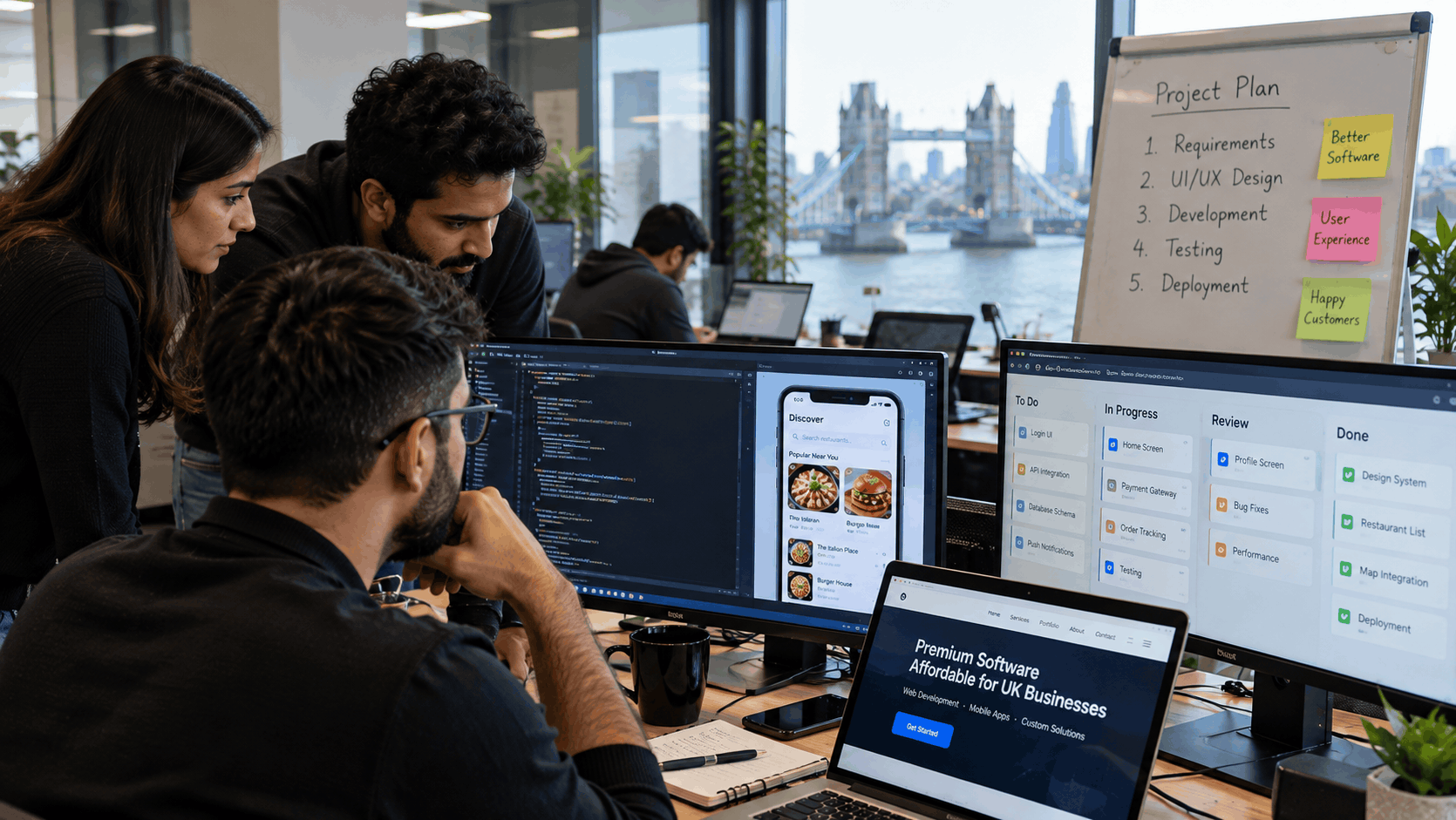
UK business team planning premium-quality software with a clear project scope, user-friendly interface and cost-conscious technology strategy.
High-quality software starts with clear requirements, proportionate investment and a focus on long-term business value.