IT Outsourcing vs In-House IT for UK SMEs: Cost, Control and Business Risk
IT Outsourcing vs In-House IT UK | SME Decision Guide
Compare IT outsourcing vs in-house IT for UK SMEs. Understand costs, security, support, scalability and how to choose the right IT operating model.
it-outsourcing-vs-in-house-it-uk-smes
IT outsourcing vs in-house IT UK
IT outsourcing for small businesses UK, outsourced IT support UK, in-house IT team costs, IT consultancy for SMEs, managed IT services UK, IT operating model, business IT support London, IT strategy for small businesses, IT support for growing businesses.
IT outsourcing London, IT consultancy Hounslow, IT support West London, SME IT services England, IT consulting United Kingdom, outsourced IT support UK.
Commercial investigation.
Introduction: Should your business hire an IT team or outsource technology support?
For a growing UK small or medium-sized enterprise (SME), technology decisions affect far more than computers and technical support. They influence staff productivity, data security, customer service, business continuity and the ability to introduce new services.
One of the most important decisions is whether to recruit an internal IT team, outsource selected responsibilities to a specialist provider or use a combination of both.
An in-house team offers direct access to people who understand the business, its systems and its priorities. Outsourcing can provide access to specialist expertise without employing every skill internally. A hybrid model can combine internal ownership with external technical capability.
There is no single right answer for every organisation. The best model depends on the complexity of your systems, the level of support required, security obligations, available budget and future plans.
For businesses reviewing their technology operating model, Nexteck is a starting point for exploring IT strategy, business technology planning and specialist advisory support.
What is in-house IT?
In-house IT means employing people directly to manage some or all of the organisation's technology responsibilities. Depending on the size of the business, this might involve a general IT manager, support technician, systems administrator, software engineer or a larger team with specialist roles.
An internal team can develop detailed knowledge of the business's workflows, employees, applications and operational priorities. It may also provide more direct control over how work is prioritised and how technology decisions are implemented.
However, employing IT staff creates ongoing responsibilities. Recruitment, salaries, training, employee benefits, management, equipment and professional development all contribute to the total cost. One employee is unlikely to have deep expertise across every area, from cybersecurity and cloud infrastructure to application development, networking and data governance.
An internal team therefore needs a clear scope and realistic expectations.
What is outsourced IT?
IT outsourcing means engaging an external company or independent specialist to perform defined technology services. The arrangement can cover day-to-day support, infrastructure management, cybersecurity, cloud administration, software development, project delivery or strategic advice.
The scope varies significantly between providers. A basic support contract may cover user issues and device management, while a specialist consultancy may focus on architecture, transformation planning or complex implementation projects.
Before comparing proposals, define exactly what is included. Check support hours, response targets, exclusions, escalation procedures, security responsibilities, reporting, contract terms and additional charges.
Outsourcing does not automatically transfer every business risk to the provider. Your organisation still needs appropriate oversight, access controls, supplier management and a clear understanding of its own obligations.
IT outsourcing vs in-house IT: At-a-glance comparison
| Factor | In-house IT | Outsourced IT |
|---|---|---|
| Availability | Depends on team size and working arrangements | Depends on the provider's agreed service hours |
| Business knowledge | Develops through direct involvement | Must be built through onboarding and documentation |
| Specialist expertise | Requires recruitment or training | May be available across a wider provider team |
| Cost structure | Salaries and employment-related costs | Contract fees, project fees and potential extras |
| Control | Direct management of employees | Control through scope, service levels and governance |
| Scalability | Requires recruitment or internal restructuring | May be easier to scale within the contract's scope |
| Strategic alignment | Strong when the team is closely integrated | Depends on provider capability and engagement model |
| Business continuity | Vulnerable if critical knowledge sits with one person | Depends on provider resilience and documented procedures |
| Best fit | Continuous internal work and business-specific responsibilities | Defined services, specialist needs and variable workloads |
These are general comparisons. An experienced internal team may offer broader expertise than a small provider, while a well-managed outsourcing arrangement may offer stronger continuity than a single-person IT department.
1. Calculate the real cost of an in-house IT team
A common mistake is comparing an employee's salary with an outsourcing provider's monthly fee. These costs do not necessarily cover the same responsibilities.
A realistic internal IT budget may include:
Salary and employer National Insurance contributions.
Pension contributions and employment-related benefits.
Recruitment and onboarding.
Training, certifications and professional development.
Laptops, diagnostic tools and software licences.
Security monitoring and backup services.
External specialists for projects outside the team's expertise.
Holiday and sickness cover.
Management time and recruitment if the team needs to expand.
For example, hiring one IT generalist may provide useful day-to-day support, but the business may still need external cybersecurity expertise, cloud architecture advice or specialist development support.
Build a yearly cost estimate for the specific roles and responsibilities your organisation requires. Use actual salary information, supplier quotations and realistic assumptions rather than relying on generic averages.
2. Understand what outsourced IT costs include
Outsourced IT costs depend on the service model, number of users, devices, locations, complexity, required coverage and contract scope.
Possible charging models include:
Monthly per-user or per-device support.
Fixed monthly service contracts.
Time-and-materials support.
Fixed-price project engagements.
Day-rate specialist consultancy.
Separate charges for licences, hardware, cloud services and out-of-hours support.
Ask providers to separate recurring charges from one-off implementation costs. Confirm whether onboarding, documentation, security reviews, backup monitoring and project work are included.
A low monthly price may exclude services that are important to your business. Conversely, a broad contract may include services you do not need.
For a clearer business case, Nexteck's technology advisory can be a starting point for exploring how technology requirements and business priorities fit together before committing to a larger engagement.
3. Assess the level of technical expertise your business needs
The right operating model depends partly on the range of technical work involved.
A small professional services firm might primarily need reliable user support, identity management, secure cloud applications and occasional strategic advice. A manufacturer with production systems, specialist equipment and multiple operational sites may need a different combination of internal expertise and external support.
List the skills required to keep the business operating safely. These may include:
End-user support and device management.
Network and cloud infrastructure.
Cybersecurity and access management.
Backup, disaster recovery and business continuity.
Software development and systems integration.
Data reporting and business intelligence.
Supplier and licence management.
IT budgeting, planning and governance.
Then identify which skills are needed every day, which are needed occasionally and which are required only for major projects.
This exercise can reveal that you do not need to recruit a full team or outsource everything. You may need an internal owner supported by external specialists.
4. Consider security and accountability
Security is not simply a question of whether IT is internal or outsourced. It depends on the controls, people, systems and responsibilities in place.
An internal team may have direct oversight, but it still needs appropriate training, monitoring and procedures. An external provider may offer specialist security capabilities, but your business must verify what is actually delivered.
Before signing an outsourcing agreement, clarify:
Who manages user access and privileged accounts?
How are security incidents escalated?
Who monitors backups and tests recovery?
What logs and reports can the business access?
How are subcontractors and third-party tools managed?
Who is responsible for patching and system updates?
How are confidential business and customer data protected?
What happens if the provider relationship ends?
Where personal data is processed, understand the relevant UK data protection responsibilities and contractual requirements. Seek specialist advice where the business operates in a regulated sector or handles particularly sensitive information.
For organisations evaluating technology risk alongside operational needs, Nexteck provides a starting point for exploring broader IT strategy and advisory options.
5. Think about business continuity and key-person dependency
A small internal IT team can become a single point of failure if one employee holds all the passwords, system knowledge, supplier contacts or recovery procedures.
Outsourcing can reduce certain forms of dependency, but it can also create a new one if the provider controls essential information without adequate documentation or exit arrangements.
Whichever model you choose, make sure the business retains appropriate access to its systems, configuration records, recovery instructions, supplier information and essential documentation.
Document critical processes and test recovery arrangements periodically. Define how access and knowledge will be transferred if an employee leaves or a supplier contract ends.
Business continuity should be part of the operating model from the beginning rather than an issue addressed only after an incident.
6. Evaluate response times and the support experience
A provider may advertise rapid response times, but businesses need to understand what those commitments mean in practice.
A response time is not necessarily a resolution time. A contract might promise acknowledgement within a particular period without guaranteeing when the underlying problem will be fixed.
Review service-level agreements (SLAs), including:
Support hours and out-of-hours coverage.
Priority definitions and escalation paths.
Response and resolution targets, where offered.
Communication during major incidents.
Reporting on recurring problems.
Availability of named contacts.
Arrangements for on-site support, if required.
For an internal team, establish similar expectations and clear priorities. Measure support quality using actual incident data, business disruption and employee feedback rather than ticket closure counts alone.
7. Choose the model that fits your stage of growth
Early-stage businesses
A small business with straightforward systems may benefit from outsourced support and occasional strategic advice. The priority is usually reliable technology, sensible security controls and predictable costs without building a large internal function prematurely.
Growing SMEs
As staff numbers, locations and applications increase, an internal IT owner may become valuable. That person can coordinate suppliers, manage technology priorities and ensure that IT decisions support the business plan, while external specialists handle defined technical tasks.
Larger or technically complex businesses
Organisations with demanding availability requirements, proprietary software or complex operational systems may need internal technical leadership and specialist employees. Outsourcing can still provide additional capacity, independent reviews or expertise for projects that do not justify permanent recruitment.
These are starting points, not fixed rules. A small company with critical software may need stronger internal ownership than a larger business with simple requirements.
8. When a hybrid IT model makes sense
A hybrid model combines internal ownership with external capability.
For example, an SME might appoint an internal IT manager to own priorities, budgets, access decisions and supplier relationships. An external provider could handle routine support, while a specialist consultant supports a major integration or software modernisation project.
This arrangement can provide continuity and business knowledge without requiring every technical skill to be employed permanently.
To make it work, define responsibilities clearly. Specify who approves changes, who responds to incidents, who owns the documentation and who is accountable for each service. Without clear ownership, internal and external teams may assume that the other party is handling a critical task.
9. Questions to ask before choosing an IT provider
Use these questions during supplier evaluation:
Which services are included in the proposed fee?
What is excluded or charged separately?
Who will be responsible for our account and escalations?
What support hours and service levels are agreed?
How will access, security and confidential data be handled?
How will you document our systems and processes?
What reporting will we receive?
How are backups and recovery arrangements tested?
How do you manage subcontractors and third-party dependencies?
What happens to our data, credentials and documentation when the contract ends?
Ask for examples of relevant experience and references where appropriate. Compare providers on delivery capability, transparency and fit, not price alone.
10. A practical decision framework
Before making a final decision, score the following areas from 1 to 5:
Internal workload: How much ongoing IT work requires a dedicated employee?
Specialist requirements: How many different technical skills are necessary?
Business criticality: What is the operational impact of an IT failure?
Budget flexibility: Can the organisation support the full employment or contract cost?
Control requirements: Which responsibilities must remain closely managed internally?
Scalability: How likely are requirements to change in the next 12–24 months?
Supplier risk: Could the business continue operating if a provider relationship ended?
Use the scores to structure discussion rather than applying a universal formula. The final decision should reflect the organisation's actual risk tolerance, operational needs and available resources.
If the answers are unclear, consider an independent review of your current systems, support requirements and technology roadmap before making a long-term commitment.
How Nexteck can support your IT operating model decision
The goal is not to outsource as much as possible or to hire an internal team at any cost. It is to create a technology operating model that supports business objectives, manages risk and makes efficient use of available resources.
A structured assessment can help document current responsibilities, identify skills gaps, review supplier dependencies and compare the cost and risk of different operating models.
For businesses in London, Hounslow, West London and across the UK, Nexteck is a starting point for exploring IT strategy and business technology advisory support.
Frequently asked questions
Is IT outsourcing cheaper than hiring an in-house IT team?
It can be, particularly when a business needs access to specialist skills only occasionally. However, the answer depends on the scope of support, employee costs, contract terms, service hours and internal workload. Compare equivalent responsibilities and total annual costs before deciding.
Should a small business outsource all its IT?
Not necessarily. Some businesses benefit from outsourced support, while others need an internal person to manage technology priorities, suppliers, security decisions and business-specific systems. A hybrid approach may provide a better balance.
What is the difference between outsourced IT support and IT consultancy?
Outsourced IT support typically focuses on agreed operational services, such as user support or infrastructure management. IT consultancy often focuses on assessment, planning, architecture, risk or transformation decisions. Some providers offer both, but the scope should be confirmed in writing.
What should an IT outsourcing contract include?
It should define the service scope, fees, support hours, service levels, responsibilities, security requirements, data handling, reporting, escalation, change management and exit arrangements. Seek legal advice for material contracts where appropriate.
How can an SME reduce dependency on one IT employee or provider?
Maintain accurate documentation, appropriate administrative access, tested backups, recovery procedures, supplier records and a clear handover process. Ensure critical knowledge is not held exclusively by one individual or supplier.
When should a business review its IT operating model?
Review it when the organisation grows, opens new locations, introduces critical software, experiences recurring service issues, faces new security requirements or finds that current support no longer meets operational needs.
Conclusion
IT outsourcing and in-house IT both have advantages. The right decision depends on the work your business needs done, the level of expertise required, the risks involved and the cost of maintaining reliable services.
For many UK SMEs, a clearly defined hybrid model can offer a practical balance between internal ownership and external specialist support. Start by mapping responsibilities, assessing risks and comparing realistic costs before choosing the structure.
If your organisation needs help evaluating its technology priorities, visit Nexteck to explore IT strategy and advisory options.
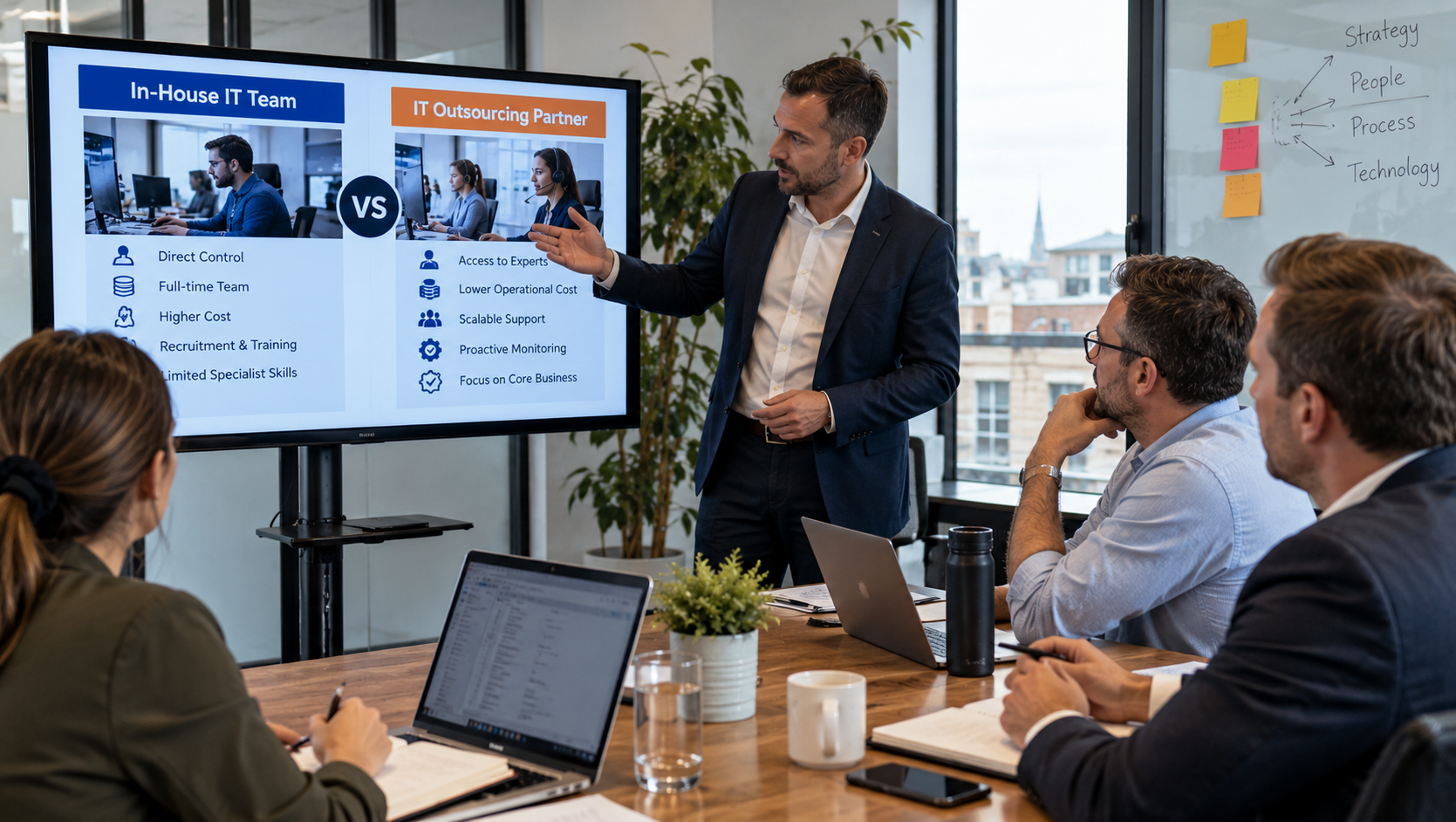
UK small business leadership team comparing outsourced IT support with an in-house IT team.
Comparing service requirements, expertise, cost and accountability helps SMEs choose an IT operating model that fits their business.