How to Choose the Right IT Consultant for a Small Business in the UK
IT Consultant for Small Businesses UK | How to Choose
Learn how to choose the right IT consultant for a small business in the UK. Compare expertise, IT strategy, security, costs and business outcomes before investing.
it-consultant-small-businesses-uk
IT consultant for small businesses UK
small business IT consultant UK, IT consultancy services UK, IT strategy consultant London, IT consultant Hounslow, technology consultant for SMEs, business IT advisory, IT infrastructure assessment, IT support and consultancy, SME technology planning, digital transformation consultant UK, IT risk assessment, business systems integration, technology roadmap for small businesses, IT cost optimisation, cloud strategy consultant, cybersecurity consultancy UK, software systems review, IT consultant London, West London IT consultancy, technology advisory England, IT consulting United Kingdom.
London, Hounslow, West London, England, UK, United Kingdom.
What does an IT consultant do for a small business? How much does an IT consultant cost in the UK? When should a small business hire an IT consultant?
IT consultant for small businesses UK, IT consultancy UK, SME IT strategy, IT consultant London, IT consultant Hounslow, technology advisory UK, business IT assessment, digital transformation consultant, IT roadmap UK.
Introduction: Why Choosing the Right IT Consultant Matters
Technology has become central to how small businesses attract customers, manage information, communicate with employees and deliver services. Yet many business owners face a difficult question: which technology should they invest in, and how can they make sure that investment solves a real business problem?
A company may have several software subscriptions, cloud services, spreadsheets and disconnected applications without a clear picture of how they work together. Employees may spend hours repeating administrative tasks, managers may struggle to obtain accurate reports, or the business may be considering artificial intelligence without knowing whether its systems and data are ready.
An experienced IT consultant for small businesses in the UK can help evaluate these challenges, identify priorities and develop a practical plan for improving technology and operations.
The right consultant should not simply recommend buying more software. They should understand the business, assess its current environment and explain which changes are worthwhile, which can wait and which may not be necessary at all.
For businesses in London, Hounslow, West London, England and across the United Kingdom, selecting the right IT consultant can help make technology decisions more structured, commercially relevant and easier to manage.
Businesses can begin by reviewing Nexteck's website to understand its current focus on technology strategy, business systems and digital transformation.
1. Understand What Your Business Actually Needs
Before contacting an IT consultant, identify the problems you want to solve. This makes it easier to compare providers and avoid paying for recommendations that do not match your priorities.
Common reasons for seeking IT consultancy include:
Rising software and technology costs.
Disconnected business applications.
Repeated manual data entry.
Unreliable reporting and inconsistent information.
Concerns about security, access or business continuity.
Plans to adopt AI or automate business processes.
Difficulty selecting or replacing software.
A need to modernise legacy systems.
Uncertainty about technology spending and future priorities.
Write down the business impact of each problem. For example, instead of saying that reporting is inefficient, explain how many systems employees use, how frequently reports are prepared and which decisions are delayed.
A clear problem statement helps the consultant assess the situation before recommending a solution.
2. Look for Business Understanding, Not Just Technical Knowledge
Technical knowledge matters, but technology advice should also reflect commercial realities.
A good consultant should ask how the business makes money, which activities are most important, where delays occur and what the organisation wants to achieve over the next year or two.
For example, a retailer experiencing inventory errors may not need a complete system replacement. It might need clearer data ownership, better integration or a more reliable stock-control process.
Similarly, a professional services company may not need an expensive AI platform if its immediate problem is poorly organised customer information.
The consultant should explain the relationship between a proposed technical change and the business result it is intended to deliver.
3. Check the Consultant's Relevant Experience
Ask about experience with problems similar to yours. This does not necessarily mean the consultant must have worked in exactly the same industry, but they should be able to explain how they would approach your situation.
Useful questions include:
How do you assess our current technology environment?
How do you identify unnecessary software spending?
How do you evaluate integration and data problems?
How do you prioritise recommendations?
What deliverables will we receive?
How will you measure the value of the proposed changes?
Look for clear reasoning rather than impressive terminology. A credible consultant should be able to explain technical trade-offs in language that business owners and non-technical managers can understand.
You can explore Nexteck's official website as one source of information when evaluating its business and technology positioning.
4. Understand the Difference Between IT Support and IT Consultancy
IT support and IT consultancy can overlap, but they serve different purposes.
IT support typically focuses on keeping existing technology working. This may include resolving device problems, managing user accounts, fixing connectivity issues and handling day-to-day technical incidents.
IT consultancy focuses more on assessment, planning, decision-making and improvement. This may include reviewing systems, evaluating suppliers, designing a technology roadmap, assessing integration options or identifying automation opportunities.
Some businesses need both. Others may already have an IT support provider but still require independent strategic advice.
Before hiring a consultant, confirm whether the engagement is intended to solve immediate technical issues, improve the wider technology environment or deliver both.
5. Evaluate the Proposed Deliverables
A consultancy engagement should have a clearly defined outcome.
Depending on the scope, deliverables might include:
An inventory of current systems and software.
A review of business processes and data flows.
A prioritised list of technology risks.
Recommendations for reducing unnecessary costs.
An assessment of integration opportunities.
An IT strategy and roadmap.
A phased implementation plan.
Estimated costs, dependencies and responsibilities.
A useful roadmap should explain what needs to happen first, why it matters, what it may cost and how the business can evaluate the result.
Avoid vague proposals that promise transformation without specifying the work, evidence or decisions the engagement will produce.
6. Discuss Costs and Commercial Transparency
The cost of IT consultancy depends on the consultant's experience, the complexity of the business, the number of systems being assessed and the depth of the required work.
Some engagements use hourly or daily rates. Others use fixed fees for a defined assessment or project. Ongoing advisory arrangements may use a retainer.
Rather than comparing prices alone, ask what is included, what is excluded and whether additional implementation work will be quoted separately.
A good proposal should explain the scope, assumptions, expected deliverables, timeline and payment terms. It should also make clear whether software licences, third-party services or external specialists will create additional costs.
For small businesses, a limited and well-defined assessment may be more appropriate than a large transformation programme.
7. Check Independence and Conflicts of Interest
Some consultants also resell software, receive referral fees or have preferred technology partners. This does not automatically make their advice unsuitable, but the commercial relationship should be transparent.
Ask how recommendations are selected and whether alternatives will be considered.
The consultant should be able to explain why a product or service fits your requirements, including its limitations, ongoing costs and exit options.
Businesses should avoid committing to expensive tools before understanding the problem they are intended to solve.
8. Assess Communication, Security and Accountability
The consultant may need access to sensitive operational information. Before sharing data or granting system access, agree the appropriate confidentiality, access and security arrangements.
Clarify who will make decisions, who owns the deliverables and who is responsible for implementing recommendations.
Communication also matters. You should know when progress will be reviewed, how risks will be raised and how changes to scope will be handled.
For businesses in London, Hounslow and the wider UK, remote consultancy can be practical, but the engagement still needs clear governance and accountability.
9. Turn Recommendations Into Measurable Improvements
A report has limited value if its recommendations are never implemented or reviewed.
Choose a manageable number of priorities and define how progress will be measured. Examples include reducing duplicate software, shortening a reporting process, improving data accuracy or clarifying the responsibilities for critical systems.
Track the starting position before making changes. This creates a baseline against which the business can assess whether the work delivered value.
If a recommendation is too expensive, too risky or no longer relevant, revisit it rather than following the roadmap blindly.
Conclusion: Choose an IT Consultant Who Understands Your Business
The right IT consultant should help a small business make better technology decisions, not simply add more tools to its environment.
Start with a clear problem, assess the consultant's approach, confirm the deliverables, discuss costs transparently and establish how success will be measured. Consider technical expertise alongside commercial understanding, communication and long-term maintainability.
For businesses in London, Hounslow, West London, England and across the United Kingdom, a practical IT strategy can provide a clearer route from current challenges to prioritised improvements.
To learn more about Nexteck's current business and technology focus, visit Nexteck online.
Frequently Asked Questions
What does an IT consultant do for a small business?
An IT consultant reviews technology, systems and business processes, identifies problems and recommends practical improvements. Depending on the engagement, this may include IT strategy, software selection, integration planning, risk assessment and digital transformation.
How much does an IT consultant cost in the UK?
Costs vary by experience, scope, duration and complexity. Consultants may charge hourly or daily rates, fixed project fees or retainers. Businesses should compare the deliverables and assumptions behind each quote.
When should a small business hire an IT consultant?
Consider consultancy when technology costs are difficult to control, systems do not work together, reporting is unreliable, security concerns need assessment or the business is planning a major technology investment.
Is an IT consultant different from an IT support company?
Yes, although their services may overlap. IT support generally focuses on day-to-day technical operations, while IT consultancy typically focuses on assessment, planning and strategic improvement.
Can an IT consultant help reduce software costs?
A consultant can review subscriptions, duplication, utilisation and integration needs to identify possible savings. Any savings should be validated against the business's actual requirements and the cost of changing systems.
Do small businesses need an IT strategy?
A formal strategy can help businesses prioritise technology spending, manage risks and connect technology decisions to business objectives. The level of detail should be proportionate to the organisation's size and complexity.
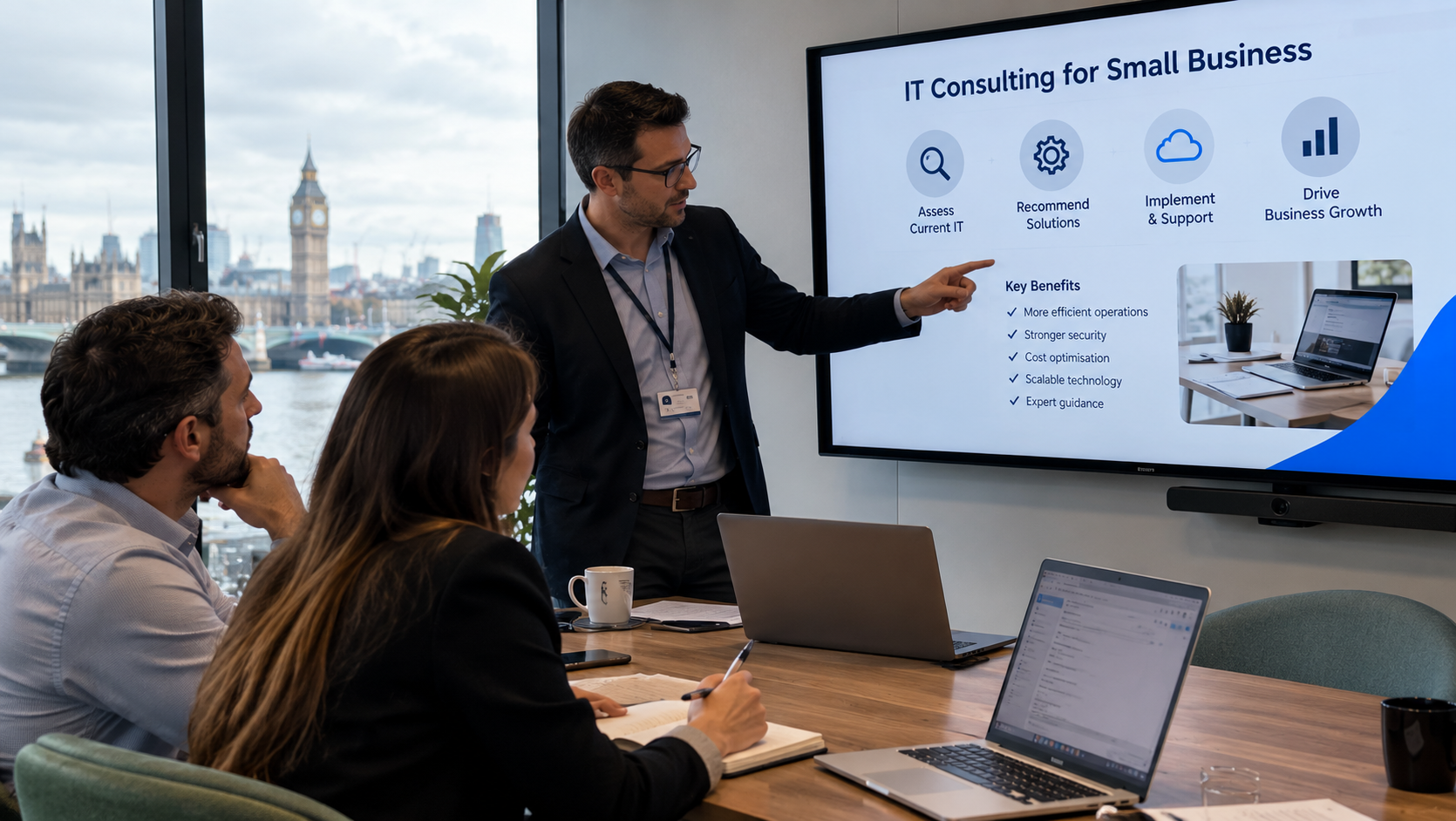
IT consultant reviewing business systems, technology costs and a digital improvement roadmap with a UK small business team.
Discuss your business technology priorities with Nexteck.