
B2B Integration & Distribution
EDI Automation UK: Wholesale & Distribution Guide
Discover how UK wholesalers and distributors can automate purchase orders, invoices, despatch advice and supplier communication through reliable EDI integration.
EDI automation UK
EDI integration UK, wholesale EDI software, electronic data interchange, B2B integration software, automated purchase order processing
Commercial + Informational
UK wholesalers, distributors, procurement directors, supply-chain managers, operations managers, IT leaders
London, Birmingham, Manchester, Leeds, Bristol, Liverpool, Sheffield, Leicester, Nottingham, Glasgow
EDI automation UK, EDI integration UK, electronic data interchange software, wholesale automation UK, distribution software integration, automated purchase order processing, supplier EDI integration, B2B data exchange UK, EDI invoice automation, despatch advice automation, EDI order management, wholesale technology solutions, supply chain integration software, custom EDI integration UK.
EDI Automation for UK Wholesale and Distribution Businesses: How to Streamline Purchase Orders, Invoices and Supplier Communication
Introduction: Why manual business-to-business communication limits distribution growth
Wholesale and distribution businesses depend on reliable communication between suppliers, buyers, warehouses, logistics providers and finance teams.
Every trading relationship can generate a considerable volume of business documents.
A typical transaction may involve a purchase order, order confirmation, delivery information, despatch advice, goods receipt, invoice and payment record.
When these documents are exchanged through emails, spreadsheets and manual data entry, processing can become slow and difficult to manage.
A supplier may send an order confirmation in a different format from the buyer's purchasing system. Warehouse employees may receive delivery information separately from the purchase order. Finance teams may need to compare invoices against manually updated records.
As transaction volumes increase, the administrative burden can become significant.
EDI automation in the UK provides a structured way for businesses to exchange standardised commercial documents electronically between their systems.
Electronic Data Interchange (EDI) can help wholesalers, distributors and manufacturers reduce repetitive document handling, improve transaction consistency and create more connected supply-chain operations.
However, implementing EDI successfully requires more than connecting two software applications. Businesses need to understand their document flows, trading-partner requirements, data standards and exception-handling procedures.
This guide explains how UK wholesale and distribution companies can approach EDI integration and automation.
1. What is Electronic Data Interchange (EDI)?
Electronic Data Interchange is the structured electronic exchange of business documents between organisations.
Instead of manually creating and sending documents through email, trading partners exchange information in agreed electronic formats that their systems can process.
Common EDI documents include:
EDI document | Purpose |
|---|---|
Purchase Order (ORDERS) | Communicates a buyer's order to a supplier |
Order Response | Communicates acceptance or changes to an order |
Despatch Advice (DESADV) | Provides information about dispatched goods |
Invoice (INVOIC) | Communicates an invoice electronically |
Remittance Advice | Provides information about a payment |
Sales Report | Shares relevant sales information |
Inventory Report | Communicates stock information |
The exact document types and message structures depend on the trading partners and applicable standards.
For example, GS1 UK provides an implementation guide for the EANCOM ORDERS message, explaining how buyers can use a standardised EDI message to send orders to suppliers.
The central benefit is that information can move between systems in a structured format rather than requiring repeated manual re-entry.
2. Why UK wholesalers and distributors need EDI integration
A wholesale business may manage hundreds or thousands of transactions across multiple suppliers and customers.
Without suitable automation, employees can spend substantial time performing routine administrative activities.
Manual purchase order processing
An employee may receive a purchase order by email, check its contents and enter the information into an ERP system.
This can create delays and increase the likelihood of mistakes involving quantities, product references or delivery dates.
Inconsistent supplier document formats
Different suppliers may use different document layouts, terminology and processes.
This can make it difficult to process information consistently across the organisation.
Invoice matching difficulties
Finance teams may need to compare supplier invoices with purchase orders and goods received records.
Missing references, quantity differences and pricing discrepancies can create additional investigation work.
Delayed despatch information
If warehouse and transport teams receive information late, they may struggle to plan receiving, picking, packing and delivery activities.
Limited transaction visibility
When business documents are spread across inboxes and different applications, managers may find it difficult to understand where an order is waiting or why a transaction has failed.
EDI integration can address these issues by creating more consistent document exchange between trading partners.
3. How an automated EDI workflow operates
A typical EDI transaction begins when one organisation sends a business document to another organisation.
The receiving system processes the document, validates its structure and transfers the relevant information into the appropriate business application.
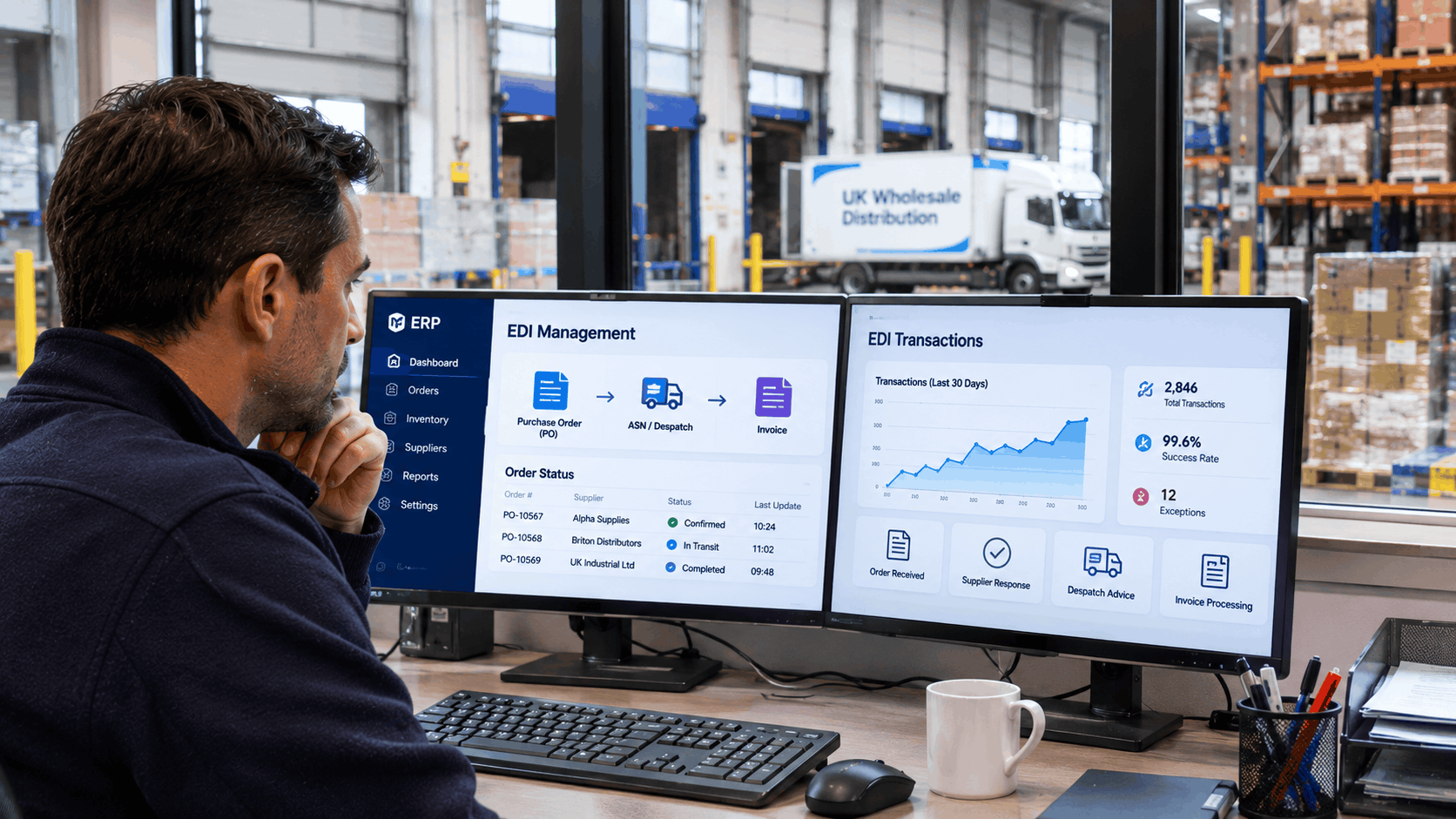
A simplified purchasing workflow looks like this:
Example: Automated wholesale purchasing workflow
Buyer creates purchase order
The buyer's ERP generates an order with product references, quantities and delivery details.
EDI translates and transmits the message
The document is converted into the agreed EDI format and sent to the supplier.
Supplier receives the order
The supplier's system validates the incoming information and records the transaction.
Order response is returned
The supplier confirms acceptance or communicates relevant changes.
Goods are dispatched
Despatch information is shared electronically with the buyer.
Invoice is received and matched
The buyer's system compares invoice information with the purchase order and goods receipt.
The workflow can be configured to match the commercial rules and operational requirements of the trading partners.
4. Automating purchase orders and supplier communication
Purchase order automation is often a practical starting point for an EDI project.
In a manual environment, an employee may need to create an order, export it, send it to a supplier and then check whether the supplier has received it.
With EDI integration, the process can become more structured.
Automated order generation
The purchasing system creates an electronic order using approved product and supplier records.
Standardised document exchange
The order is transformed into the format agreed with the supplier.
Validation before transmission
The system checks mandatory fields, product identifiers, quantities and other configured requirements.
Order acknowledgement
A response can update the buyer's order status and identify accepted, rejected or changed order lines.
Exception management
If a message fails validation or cannot be processed, it can be routed to an employee for investigation.
This helps procurement teams spend less time handling routine transactions and more time managing supplier performance, purchasing decisions and exceptions.
5. How EDI improves warehouse and despatch operations
Distribution businesses need accurate information about incoming and outgoing goods.
A warehouse team must know what products are expected, what quantities are being dispatched and which deliveries require attention.
EDI can connect commercial transactions with warehouse operations.
Advance despatch information
A supplier can send a despatch advice message before the goods arrive.
This may include:
Purchase order references.
Product identifiers.
Shipped quantities.
Packaging information.
Shipment references.
Expected delivery details.
The receiving business can use this information to prepare for goods receipt.
Goods receipt processing
Warehouse staff can compare expected quantities with the products physically received.
Differences can be recorded and routed for investigation.
Delivery coordination
Approved dispatch information can be shared with relevant logistics and receiving systems.
Reduced duplicate entry
When document information flows between connected applications, employees may no longer need to enter the same shipment details multiple times.
The exact level of automation depends on the capabilities of the warehouse and transport management systems.
6. Automating invoice processing and financial reconciliation
Invoice processing is another important opportunity for wholesale EDI integration.
A supplier invoice may need to be checked against an approved purchase order and the goods actually received.
This is often referred to as three-way matching.
The three records are:
Purchase order.
Goods receipt record.
Supplier invoice.
An automated workflow can compare relevant information such as product references, quantities, prices and other configured values.
For example:
Record | Example quantity |
|---|---|
Purchase order | 100 units |
Goods received | 100 units |
Supplier invoice | 100 units |
If the records agree and the relevant business rules are satisfied, the invoice may proceed through the configured approval process.
If the supplier invoices 105 units while the warehouse has recorded only 100 units received, the difference can be flagged.
The system should not automatically approve every transaction simply because an EDI message was received.
Financial approvals, tax treatment, tolerance limits and exception policies should be defined by the business and reviewed by appropriate finance personnel.
7. Connecting EDI with ERP, WMS and accounting software
EDI provides the communication format, but businesses also need systems that can process and use the information.
A typical wholesale technology environment may include:
System | Business function |
|---|---|
ERP | Orders, purchasing, inventory and financial records |
Warehouse Management System | Receiving, storage, picking and dispatch |
Transport Management System | Delivery and transport coordination |
Accounting software | Supplier invoices and financial transactions |
Supplier portal | Supplier information and communication |
EDI gateway | Electronic document exchange |
Reporting platform | Transaction monitoring and performance analysis |
An integration layer can connect these applications and manage the movement of information.
For example, an incoming EDI purchase order may be validated and transferred into the ERP. A subsequent goods receipt event may update inventory and provide information for invoice matching.
Nexteck's industry capabilities cover engineering supply chains and connected business technology, making system integration a relevant consideration for businesses managing complex supplier relationships.
8. Choosing between EDI standards and trading-partner requirements
EDI implementation needs to consider the standards and document formats accepted by the organisations involved.
Different trading partners may require different document specifications, identifiers and communication arrangements.
Businesses should evaluate:
The EDI standards required by their trading partners.
The document types that must be exchanged.
Product and location identification requirements.
Data validation rules.
Communication protocols.
Acknowledgement and error-handling procedures.
Security and access requirements.
Testing and onboarding processes.
GS1 UK provides guidance on standardised EDI messages, including the EANCOM ORDERS message for purchasing transactions.
A company should not assume that every supplier or customer uses an identical EDI implementation.
Trading-partner mapping and testing are important parts of the project.
9. Why EDI projects need proper exception handling
Automation does not eliminate every problem.
A message may fail because of missing information, an invalid product reference, an unsupported code or a communication issue.
A reliable EDI implementation should make these problems visible.
Important controls include:
Message validation: Check incoming and outgoing documents against agreed rules.
Acknowledgements: Record whether messages were received and processed as expected.
Duplicate prevention: Avoid processing the same business transaction more than once.
Error queues: Route failed messages to an appropriate employee.
Audit records: Maintain relevant transaction history.
Retry handling: Define how temporary communication failures are handled.
Reconciliation: Compare business records to identify missing or inconsistent transactions.
Without these controls, a company may exchange documents electronically while still having significant operational problems.
10. A practical EDI implementation roadmap for UK businesses
A phased approach can make EDI implementation more manageable.
Phase 1: Map trading-partner document flows
Identify the suppliers and customers involved, the documents exchanged and the current communication methods.
Phase 2: Prioritise transaction volumes
Focus on high-volume and repetitive transactions first.
For example, automating purchase orders from a major trading partner may offer more immediate value than connecting a low-volume supplier.
Phase 3: Review existing software
Assess the ERP, WMS, accounting applications and existing integration capabilities.
Identify whether an EDI gateway or custom integration is required.
Phase 4: Define standards and mappings
Agree the document formats, required fields, product identifiers and transaction rules with relevant trading partners.
Phase 5: Test end-to-end transactions
Test normal orders, changed orders, rejected lines, duplicate messages, partial deliveries, invoice discrepancies and communication failures.
Phase 6: Roll out in stages
Begin with a controlled group of trading partners before expanding to additional suppliers and customers.
Phase 7: Monitor transaction performance
Review processing times, failed messages, manual corrections and invoice exceptions.
The Nexteck SME Strategy & Tracking Toolkit can help businesses organise technology diagnostics, document operational gaps and prioritise integration opportunities.
11. How to measure the commercial value of EDI automation
An EDI project should have measurable business objectives.
Useful performance indicators include:
KPI | What it measures |
|---|---|
Purchase order processing time | Time required to process an order |
Manual data-entry hours | Staff time spent entering transaction information |
EDI transaction success rate | Proportion of messages processed successfully |
Invoice exception rate | Percentage of invoices requiring investigation |
Order acknowledgement time | Time taken to receive an order response |
Goods receipt discrepancy rate | Differences between expected and received goods |
Document processing cost | Internal cost of handling business documents |
Supplier onboarding time | Time required to connect a new trading partner |
A business should establish its baseline before implementation.
It can then compare the results after deployment to determine whether transaction handling has become more efficient.
The business case should also account for EDI platform fees, integration development, testing, trading-partner onboarding, maintenance and staff training.
12. When does a wholesale business need bespoke EDI integration?
A standard EDI service may be sufficient for organisations with straightforward transaction requirements.
However, more complex businesses may need custom integration when they operate:
Multiple ERP systems.
Several warehouse locations.
Different supplier message formats.
Complex product identification rules.
Special pricing and purchasing arrangements.
Multiple legal entities.
Custom invoice approval procedures.
Legacy business applications.
A bespoke integration can help connect these systems while preserving existing operational processes.
The best solution may combine an established EDI provider with custom APIs, data transformation services and workflow automation.
Nexteck's technology and software architecture capabilities provide a starting point for businesses assessing complex integration requirements.
13. Selecting the right EDI technology partner
A technology partner should understand the commercial transaction lifecycle as well as the technical requirements.
Before selecting a partner, consider whether they can:
Map supplier and customer document flows.
Understand ERP and warehouse workflows.
Configure appropriate EDI standards.
Design API and system integrations.
Implement transaction validation.
Handle duplicate messages and failures.
Support testing with trading partners.
Provide monitoring and documentation.
Explain long-term maintenance responsibilities.
A successful implementation should also include clear ownership of exceptions and a process for onboarding new trading partners.
Conclusion: Build a more connected wholesale and distribution operation
For UK wholesalers and distributors, reliable document exchange is an important part of efficient supply-chain management.
Manual purchase orders, inconsistent supplier communication, delayed despatch information and repetitive invoice processing can place unnecessary pressure on operational and finance teams.
EDI automation can help create more consistent transactions by connecting suppliers, buyers, warehouses and accounting systems through structured electronic document exchange.
The most effective implementation begins with mapping current business processes, understanding trading-partner requirements and prioritising the transactions that create the greatest administrative burden.
Looking to automate purchase orders, supplier communication or invoice processing? Nexteck can help assess your existing software environment and identify opportunities for connected B2B integration and bespoke technology architecture.
CTA: Explore Nexteck's industry capabilities, review the SME Strategy & Tracking Toolkit, or visit Nexteck to discuss your requirements.
Frequently asked questions
1. What is EDI automation?
EDI automation is the electronic exchange and processing of standardised business documents between organisations, reducing the need for manual document entry and handling.
2. What does EDI stand for?
EDI stands for Electronic Data Interchange. It enables businesses to exchange structured documents such as purchase orders, invoices and despatch advice electronically.
3. How can UK wholesalers benefit from EDI?
Wholesalers can use EDI to streamline supplier orders, improve document consistency, reduce repetitive administration and connect purchasing, warehouse and finance processes.
4. Which documents can be exchanged through EDI?
Common documents include purchase orders, order responses, despatch advice, invoices and remittance advice. The exact documents depend on the trading partners' requirements.
5. What is the difference between EDI and API integration?
EDI commonly exchanges standardised business documents between trading partners. APIs allow software applications to exchange data and trigger functions through defined interfaces. Businesses may use both together.
6. Can EDI integrate with ERP software?
Yes. EDI can be connected to ERP systems so that purchase orders, supplier responses, invoices and other transactions can be processed within existing business workflows.
7. Is EDI suitable for small and medium-sized UK businesses?
Yes. Smaller businesses can use managed EDI services or targeted integrations. The appropriate approach depends on trading-partner requirements, transaction volumes and existing software.
8. What is three-way invoice matching?
Three-way matching compares a purchase order, goods receipt record and supplier invoice to identify differences before an invoice proceeds through the configured approval process.
9. How long does EDI implementation take?
The timeline depends on the number of trading partners, document types, software integrations, data quality and testing requirements. A discovery assessment should establish a realistic delivery plan.
10. Does EDI eliminate manual work completely?
No. EDI can reduce repetitive processing, but exceptions such as incorrect product codes, quantity differences and failed messages may still require human intervention.