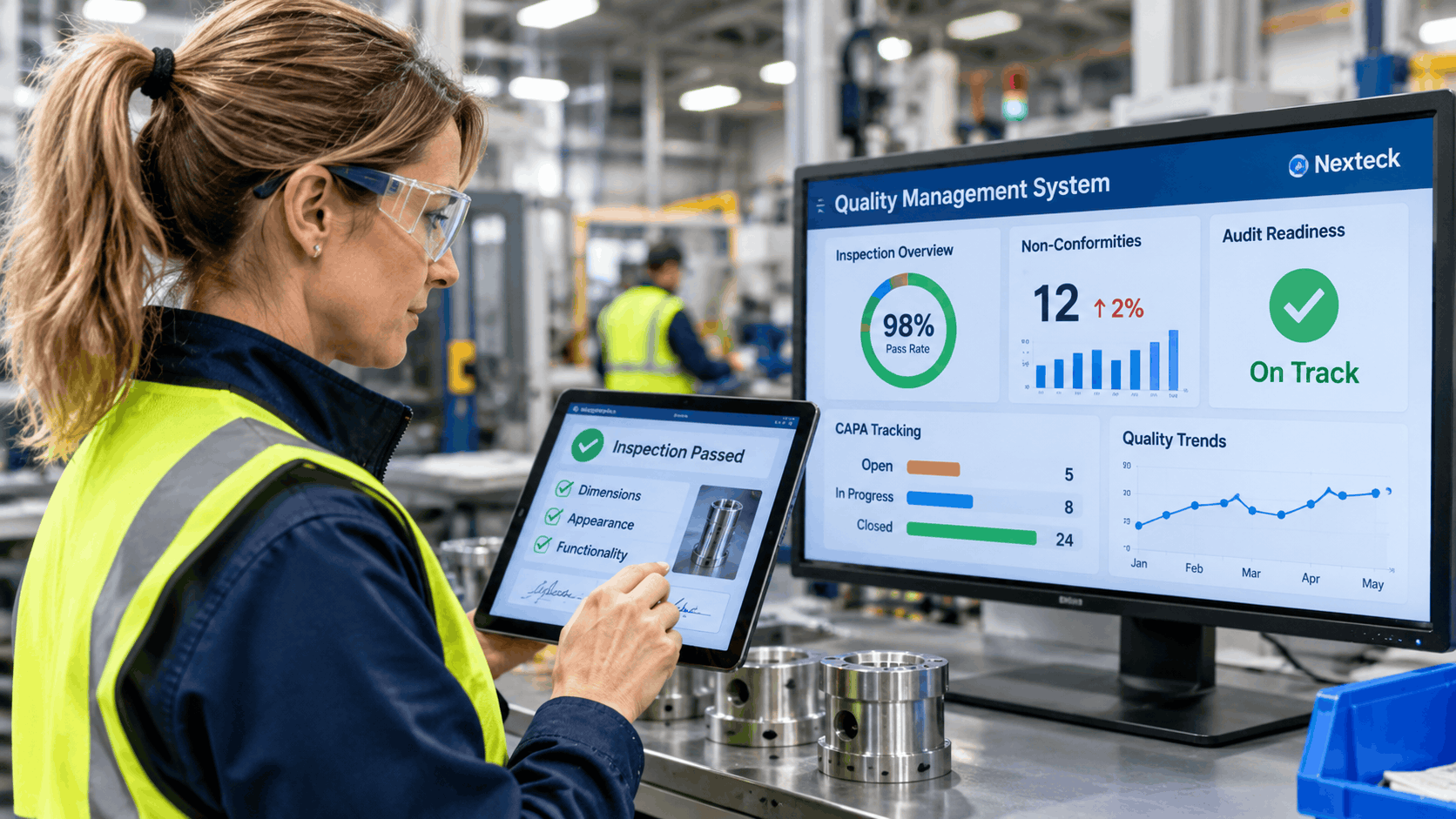
Digital Quality Management Systems UK | QMS for Manufacturers
Discover how UK manufacturers can digitise quality management, inspections, non-conformance reporting, corrective actions and audit records with a connected QMS strategy.
Digital Quality Management System UK
Quality management system software UK, QMS implementation UK, digital quality management, manufacturing quality control software, quality assurance automation, non-conformance management, corrective and preventive action software, CAPA management, inspection management software, supplier quality management, manufacturing audit management, quality compliance systems, ISO 9001 quality management software, digital inspection records, quality data analytics.
Digital quality management system UK, QMS software UK, quality management system for manufacturers, manufacturing quality control software, digital quality assurance, non-conformance management software, CAPA management UK, corrective action tracking, supplier quality management, inspection management system, quality audit software, manufacturing compliance technology, ISO 9001 QMS support, quality process automation, digital inspection forms, quality records management, production quality monitoring, UK manufacturing technology, quality data analytics, manufacturing systems integration.
UK manufacturers, engineering companies, production directors, quality managers, operations managers, compliance managers, supplier quality teams, and SME business owners.
Commercial investigation and solution discovery.
London, Birmingham, Manchester, Leeds, Sheffield, Coventry, Nottingham, Bristol, Leicester, Glasgow, Edinburgh and manufacturing hubs across the United Kingdom.
Digital Quality Management Systems (QMS) for UK Manufacturers: How to Improve Inspections, Non-Conformance Tracking and Audit Readiness
Quality is central to manufacturing performance. A product may meet its production target, arrive on schedule and satisfy a customer's specification, but a single quality failure can create rework, delayed deliveries, customer complaints and unnecessary operational costs.
For UK manufacturers, managing quality involves more than checking finished products. Teams need to control inspection procedures, maintain production records, manage supplier issues, document corrective actions and demonstrate that processes are being followed.
Many businesses still manage parts of this work through spreadsheets, paper inspection forms, email approvals and disconnected software applications. These methods can become difficult to maintain as production volumes, product variations and customer requirements increase.
A Digital Quality Management System (QMS) helps bring quality processes, records, responsibilities and performance information into a more structured digital environment.
It can support inspection management, non-conformance reporting, corrective and preventive action workflows, supplier quality processes, document control and audit preparation.
However, implementing QMS software is not simply a matter of replacing paper forms with online versions. Manufacturers need to understand their quality processes, define ownership, connect relevant systems and ensure employees can use the technology consistently.
This guide explains how UK manufacturers can plan a digital QMS, improve quality visibility and build a practical roadmap for better quality operations.
1. What Is a Digital Quality Management System?
A Quality Management System is the collection of processes, responsibilities, policies, procedures and records an organisation uses to manage and improve quality.
A digital QMS uses software and connected workflows to support these activities.
Depending on the platform and configuration, a digital QMS may include:
Quality inspection management.
Non-conformance reporting.
Corrective and preventive action tracking.
Document and procedure control.
Supplier quality records.
Employee training records.
Internal audit scheduling.
Equipment calibration records.
Customer complaint management.
Quality performance dashboards.
The purpose is to establish consistent, accessible and traceable quality information.
For example, if an inspection identifies a defect, the finding can be recorded against the relevant product, batch, production order or supplier. The responsible employee can investigate the issue, assign an action and record evidence of completion.
This creates a more structured record than relying on separate spreadsheets and email conversations.
Manufacturers evaluating broader technology improvements can explore Nexteck's industry and engineering focus when considering how connected systems support different operational environments.
2. Why UK Manufacturers Should Move Beyond Paper-Based Quality Processes
Paper forms and spreadsheets can be useful for small operations. The difficulty is that they often become fragmented as the organisation grows.
A quality manager may need to collect inspection records from several production areas, request missing documents from supervisors and manually prepare reports for management.
Common challenges include:
Delayed inspection reporting
When inspection results are recorded on paper, information may not become visible to management until forms are collected and entered into a spreadsheet.
This can delay investigation and corrective action.
Inconsistent quality records
Different teams may use different form versions, naming conventions or reporting methods.
This makes it harder to compare results across production lines, shifts or locations.
Poor visibility of recurring defects
Defect information may be stored across separate files, making it difficult to identify patterns by product, supplier, machine, process or production batch.
Slow corrective action follow-up
Actions can be assigned through email without a consistent process for ownership, deadlines, evidence and verification.
Difficult audit preparation
Employees may spend considerable time searching for approved procedures, inspection records, training evidence and corrective action documentation.
A well-designed digital QMS can help reduce these administrative difficulties while making quality information easier to access and review.
3. Core Features of Manufacturing QMS Software
The right QMS should reflect the organisation's actual quality requirements. The following capabilities are particularly relevant to manufacturers.
A. Digital inspection management
Digital inspection forms can help standardise quality checks across production stages.
They may support:
Incoming material inspections.
In-process quality checks.
Final product inspections.
Dimensional measurement records.
Visual inspection results.
Pass and fail criteria.
Photograph or document attachments.
Inspector identification.
Date and time records.
Where appropriate, inspection results can be linked to a product, batch, machine or production order.
B. Non-conformance management
A non-conformance occurs when a product, process, material or activity does not meet a defined requirement.
A digital non-conformance workflow can record:
What happened.
Where the issue was identified.
Which product, process or batch was affected.
The immediate containment action.
The person responsible for investigation.
The root cause.
The corrective action.
The verification result.
This helps businesses move from informal defect reporting to a controlled investigation process.
C. Corrective and preventive action (CAPA)
CAPA workflows help organisations manage actions arising from quality problems, audit findings, customer complaints or recurring process failures.
A practical CAPA record should include:
Issue description.
Risk or impact assessment.
Root cause investigation.
Assigned action owner.
Target completion date.
Supporting evidence.
Verification requirements.
Closure approval.
The system should distinguish between completing an action and verifying that the action has actually addressed the underlying cause.
D. Document control
Manufacturers may maintain procedures, work instructions, inspection plans, drawings, specifications and quality policies.
Document control capabilities can help manage:
Approved document versions.
Review dates.
Authorisation records.
Access permissions.
Revision history.
Obsolete document status.
Employee acknowledgement.
This helps reduce the risk of teams working from outdated instructions.
E. Supplier quality management
Supplier quality issues can affect production schedules, product performance and customer commitments.
A digital supplier quality workflow can maintain records of incoming inspections, supplier defects, corrective action requests, approvals and performance trends.
F. Audit management
QMS software can help schedule audits, record findings, assign actions and track closure evidence.
The system should make relevant records easier to retrieve without assuming that software alone guarantees certification or regulatory compliance.
4. Connecting QMS with ERP, MES and Production Systems
A standalone QMS can improve record management, but its value may be limited if important production and business information remains disconnected.
Manufacturers may use several applications:
ERP for purchasing, inventory and production orders.
MES for manufacturing execution.
QMS for quality procedures and records.
PLM for product specifications and engineering changes.
Maintenance software for equipment servicing.
Supplier portals for procurement communication.
When these systems exchange information appropriately, quality teams can work with more complete operational context.
For example, a non-conformance record could reference a production order from ERP, a machine or process identifier from MES and a supplier batch reference from purchasing records.
Integration can reduce repeated data entry and make investigation more efficient.
However, businesses should define which system owns each data field, how updates are synchronised and how failed integrations are handled.
Explore Nexteck's technology and systems approach when assessing the wider architecture required to connect business applications.
5. Using Quality Data to Identify Recurring Problems
A digital QMS can make quality information more useful for management decisions.
Instead of reviewing individual inspection forms, managers can examine trends across production operations.
Useful quality KPIs include:
| KPI | What it measures |
|---|---|
| First-pass yield | Products meeting requirements without rework |
| Defect rate | Frequency of identified defects |
| Scrap rate | Production output rejected as unusable |
| Rework hours | Time spent correcting quality problems |
| Non-conformance closure time | Time taken to close recorded issues |
| Repeat defect rate | Frequency of recurring issues |
| Supplier defect rate | Quality problems associated with supplied materials |
| CAPA overdue rate | Corrective actions not completed by target dates |
The exact definitions should be agreed internally so that different teams calculate metrics consistently.
Dashboards should help managers understand where action is required, rather than simply display large volumes of numbers.
6. Root Cause Analysis: Moving Beyond Repeated Corrections
One of the biggest benefits of structured quality management is the ability to investigate why problems occur.
Replacing a defective component may solve an immediate issue, but it does not necessarily prevent the same defect from returning.
Manufacturers can use recognised problem-solving techniques such as:
5 Whys: Repeatedly asking why an issue occurred to investigate underlying causes.
Fishbone diagrams: Organising potential causes into categories such as people, methods, machines, materials, measurement and environment.
Pareto analysis: Identifying the categories responsible for a significant proportion of recorded problems.
Failure Mode and Effects Analysis (FMEA): Assessing potential failure modes and prioritising risk-reduction actions.
A QMS should support the documentation and follow-up of these activities. The quality of the investigation still depends on people, evidence and appropriate technical judgement.
7. QMS and ISO 9001: Supporting a Structured Quality Management Approach
ISO 9001 is an internationally recognised standard for quality management systems.
Businesses seeking certification or maintaining an existing certified system need to understand the requirements applicable to their organisation and the scope of their quality management system.
Digital QMS software may support activities such as:
Documented information management.
Process monitoring.
Internal audit records.
Corrective action tracking.
Supplier evaluation records.
Performance measurement.
Management review preparation.
However, purchasing or implementing QMS software does not automatically make an organisation ISO 9001 certified.
Certification involves an appropriate assessment process and evidence that the organisation's quality management system meets the applicable requirements.
Manufacturers should use current standard documentation and competent quality professionals when planning certification work.
8. How to Choose the Right QMS Software in the UK
The best platform is not necessarily the one with the largest feature list.
Manufacturers should assess software against their actual workflows, technical environment and future requirements.
Consider the following areas:
Operational fit
Can the platform support incoming inspections, production checks, final inspections, supplier issues and corrective actions?
Integration capability
Can it exchange information with the ERP, MES, inventory and document systems already in use?
Usability
Can production operators, supervisors, quality engineers and managers use the system without unnecessary complexity?
Reporting
Can the platform provide meaningful quality KPIs and traceable records?
Access and security
Does it support appropriate permissions, authentication, audit history and data protection controls?
Scalability
Can the system support additional production lines, sites, users and product categories?
Ownership and portability
Understand data export options, contract terms, integration dependencies and the practical process for changing providers.
Businesses can use the Nexteck SME Strategy and Tracking Toolkit as a starting point for structured technology assessment and prioritisation.
9. A Practical QMS Implementation Roadmap
A phased implementation helps reduce disruption and gives employees time to adapt.
Phase 1: Quality process assessment
Document existing quality workflows.
Identify:
Inspection points.
Current forms and spreadsheets.
Non-conformance procedures.
CAPA responsibilities.
Audit requirements.
Supplier quality processes.
Reporting needs.
Deliverable: Current-state quality process map and improvement priorities.
Phase 2: Requirements and system selection
Define essential features, integration needs, user roles and reporting requirements.
Compare suitable QMS platforms or custom development options against the agreed requirements.
Deliverable: QMS requirements specification and solution shortlist.
Phase 3: Pilot implementation
Select one production area, product family or inspection workflow.
Configure forms, roles, notifications and approval processes.
Test the system with real operational scenarios.
Deliverable: Working pilot and documented user feedback.
Phase 4: Integration and wider deployment
Connect relevant systems where appropriate.
Train employees, migrate approved records and establish support procedures.
Deliverable: Controlled rollout across the selected business processes.
Phase 5: Performance review
Review inspection completion, data quality, overdue actions, recurring defects and employee adoption.
Use the findings to refine workflows and expand the programme.
Deliverable: QMS performance review and continuous improvement plan.
10. Common Digital QMS Implementation Mistakes
Digitising inefficient processes: Automating a poorly designed inspection workflow may preserve existing problems. Review the process before configuring software.
Making forms too complicated: Excessive fields and unnecessary approvals can discourage employees from recording information accurately.
Ignoring shopfloor usability: Production teams need a practical way to access and complete inspections in their working environment.
Failing to assign ownership: Every non-conformance and corrective action needs a responsible owner and a clear closure process.
Neglecting integration: Re-entering the same information into QMS, ERP and spreadsheets can create further inconsistencies.
Treating implementation as a one-time project: Quality processes and business requirements change. The system needs ongoing review and maintenance.
11. How Nexteck Can Help Manufacturers Plan Better Connected Technology
A digital quality programme should be aligned with the organisation's wider technology architecture and operational objectives.
Manufacturers need to understand how quality information relates to production, inventory, procurement, engineering and management reporting.
Nexteck's focus on technology strategy, software architecture and industry systems provides a basis for reviewing these requirements.
Businesses can start by exploring Nexteck's industry capabilities, reviewing its technology strategy and architecture focus, and considering the SME Strategy and Tracking Toolkit for structured assessment and prioritisation.
For manufacturers planning QMS implementation, ERP integration, inspection workflow automation or wider operational improvement, the first step is to identify the processes that create the greatest quality and business risk.
Frequently Asked Questions
1. What is a digital QMS in manufacturing?
A digital Quality Management System uses software to manage quality processes such as inspections, non-conformance reporting, corrective actions, document control, supplier quality and audit records.
2. What are the benefits of QMS software for UK manufacturers?
QMS software can improve record accessibility, standardise inspection workflows, support corrective action tracking, improve quality reporting and make audit preparation more organised.
3. Does QMS software guarantee ISO 9001 certification?
No. Software can support quality management activities, but certification depends on the organisation's actual quality management system and an appropriate certification assessment.
4. Can QMS software integrate with ERP systems?
Many QMS platforms support integration with ERP systems through APIs, connectors or other data exchange methods. The available capabilities depend on the products and their configuration.
5. What is non-conformance management?
Non-conformance management is the process of recording, investigating and addressing situations where a product, process or activity does not meet a defined requirement.
6. What is CAPA in quality management?
CAPA stands for Corrective and Preventive Action. It is a structured approach to investigating problems, implementing corrective measures and reducing the likelihood of recurrence.
7. How long does QMS implementation take?
The timeline depends on the number of processes, production sites, integrations, records and users involved. A focused pilot may be quicker than a multi-site enterprise rollout.
8. What should manufacturers look for in QMS software?
Important considerations include inspection workflows, CAPA, document control, audit management, supplier quality, reporting, usability, integration, security and scalability.
9. How can a manufacturer measure QMS performance?
Useful measures include defect rates, first-pass yield, rework hours, overdue corrective actions, repeat defects, supplier quality performance and inspection completion.
Final Thoughts: Make Quality Information Work for Your Business
A reliable quality management process depends on accurate records, clear responsibilities and timely action.
For UK manufacturers, a digital QMS can help connect inspections, non-conformance reporting, supplier quality, corrective actions and audit evidence in a more organised environment.
The strongest results come when software is supported by practical workflows, employee involvement, clear ownership and meaningful performance measurement.
Planning to improve manufacturing quality management?
Explore Nexteck's industry and engineering capabilities, review its technology strategy or use the SME Strategy and Tracking Toolkit as a starting point for assessing your technology priorities.