
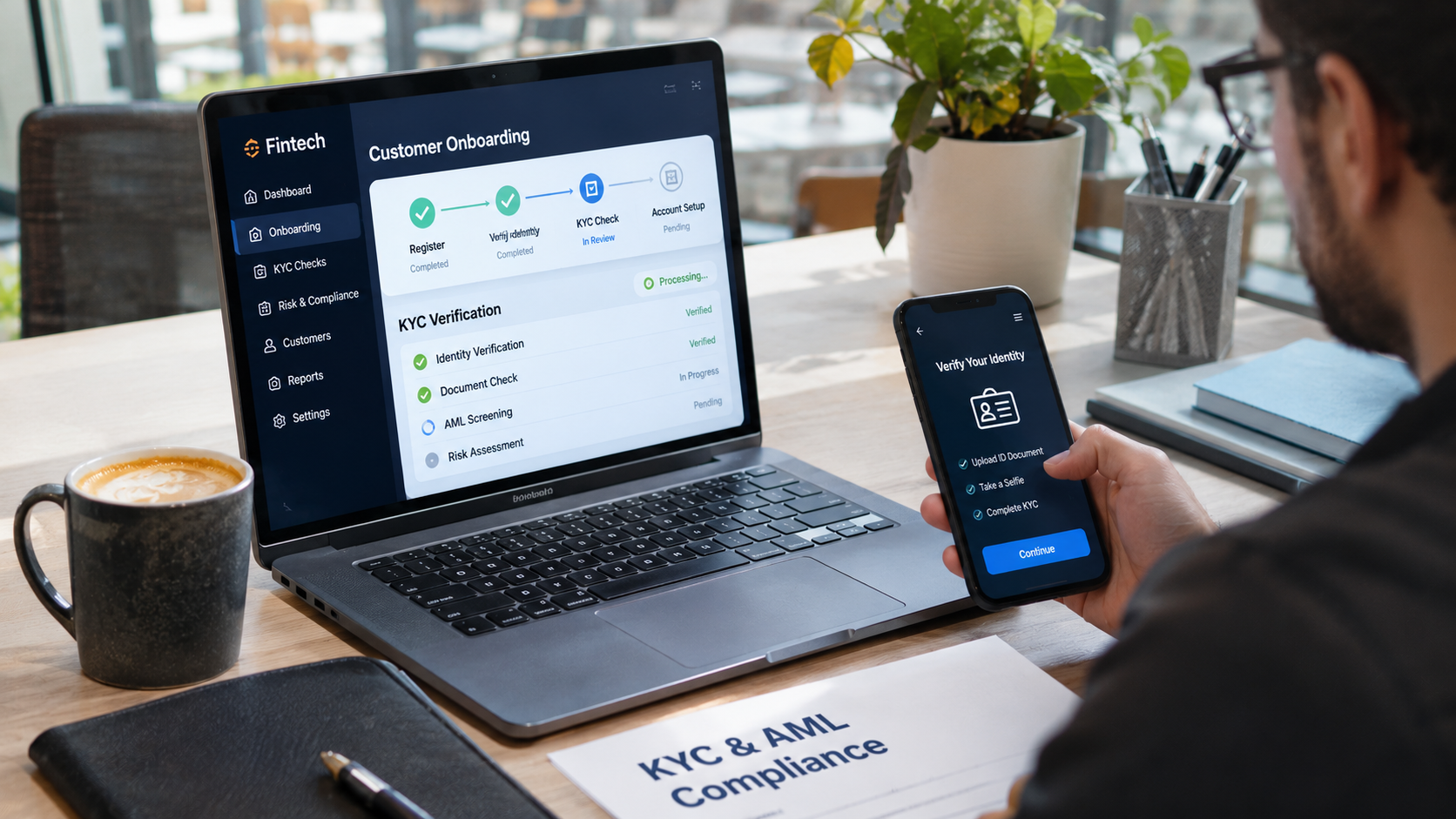
Fintech Customer Onboarding Automation UK | Nexteck
Discover how UK fintech companies can automate customer onboarding, KYC checks, document verification and compliance workflows while improving customer experience.
Fintech customer onboarding automation UK
KYC automation UK, fintech onboarding software, automated customer verification, AML workflow automation, fintech software development UK
Commercial + Informational
UK fintech founders, operations directors, compliance managers, CTOs
London, Manchester, Birmingham, Leeds, Edinburgh, Bristol, Cambridge
Customer Onboarding Automation for UK Fintech Companies
Suggested meta keywords: fintech customer onboarding automation UK, KYC automation UK, AML workflow automation, fintech onboarding software, customer verification software, automated identity verification, fintech software development London, financial services automation UK, compliance workflow software, digital onboarding solutions, fintech technology consultancy UK.
Customer Onboarding Automation for UK Fintech Companies: How to Improve KYC, Reduce Manual Reviews and Build a Better Client Experience
Introduction: Why customer onboarding has become a critical fintech challenge
For UK fintech companies, customer onboarding is much more than collecting a name, email address and proof of identity. It is a structured operational process involving customer information, identity verification, risk assessment, document collection, compliance checks and internal approvals.
As fintech businesses grow, these activities can become increasingly difficult to manage through disconnected applications, spreadsheets, email conversations and manual review queues.
A prospective customer may complete an online application but still need to submit additional documents. An operations employee may have to transfer information between systems, check incomplete records and request missing details. Compliance teams may then need to review the same information before an account can be approved.
Every unnecessary hand-off creates another opportunity for delay, duplication or human error.
Customer onboarding automation for UK fintech companies can help address these problems by connecting customer-facing applications, verification processes, internal review systems and reporting workflows.
The objective is not to remove human judgement from regulated financial services. It is to reduce repetitive administration, improve information quality and ensure that cases requiring attention reach the right people.
1. Understanding the problems with manual fintech onboarding
Manual onboarding can appear manageable when a fintech business has a relatively small customer base. However, the process becomes more complicated as applications increase and customer requirements become more varied.
Common operational problems include:
Repeated information entry
Customer details may be collected through an online form, copied into a CRM, transferred into an internal system and entered again into a compliance record.
This creates unnecessary work and increases the possibility of inconsistent information.
Incomplete customer applications
Customers may submit forms without the required documents or provide information that needs clarification. Without automated validation, employees must identify these issues manually.
Delayed verification and approvals
Applications may move between customer service, operations and compliance teams. If responsibilities and approval stages are unclear, cases can remain pending for longer than necessary.
Limited application visibility
Managers may struggle to understand how many applications are waiting, which stage is creating delays and why certain cases require additional reviews.
Difficulties scaling operations
A business may increase its customer acquisition activity without having an equally scalable onboarding process. The result can be growing administrative workloads and pressure on operational teams.
These challenges are not necessarily solved by purchasing another standalone application. They require a properly designed onboarding workflow.
2. What does customer onboarding automation actually involve?
Customer onboarding automation connects the different activities required to move an application from initial submission to approval, rejection or further review.
A typical automated process may include:
Customer registration through a secure digital form.
Automated validation of required information.
Document collection and classification.
Identity verification through an appropriate verification provider.
Risk-based routing for additional checks.
Compliance team review where necessary.
Approval or rejection through authorised processes.
Secure record creation and status updates.
Customer notifications and internal reporting.
The exact workflow depends on the fintech company's business model, customer type, risk profile, legal obligations and technology environment.
For example, a payments provider, lending platform and investment technology company may have very different onboarding requirements. Their software should reflect those differences rather than force every customer through the same generic process.
3. Automating KYC and AML workflows without removing human oversight
Know Your Customer (KYC) and Anti-Money Laundering (AML) processes are important considerations for many financial services businesses.
Technology can support these processes by organising information, managing tasks and making review requirements more visible.
Automated information collection
Digital onboarding forms can collect relevant customer details in a structured format. Required fields and validation rules can help reduce incomplete submissions.
Identity verification integration
Where appropriate, an onboarding platform can connect to an approved identity verification provider through an API.
The integration can receive verification results and update the relevant application record without requiring staff to manually transfer information.
Risk-based case routing
Applications can be routed according to configured business rules.
For example:
Standard applications can follow a defined review pathway.
Applications with missing information can be returned for clarification.
Cases requiring enhanced review can be assigned to authorised compliance staff.
Potentially suspicious or unusual cases can be escalated under the firm's approved procedures.
Automated routing should not be confused with automatically making every compliance decision. Human review and documented approval controls remain important.
Audit trails and decision records
An effective onboarding system should record relevant events, including document submissions, verification results, status changes, review assignments and authorised decisions.
This makes it easier for management and authorised teams to understand how an application progressed.
4. Why fintech companies need connected onboarding software
Automating one part of the process may provide limited benefits if the rest of the technology environment remains disconnected.
Consider a fintech company using:
A website for customer registration.
A CRM for customer records.
A third-party identity verification platform.
A separate compliance application.
An internal database for account information.
A reporting tool for operational performance.
If these applications do not exchange information reliably, employees may still spend considerable time moving data between them.
A connected architecture can create a more consistent process.
A well-designed fintech onboarding platform should consider:
Technology component | Business purpose |
|---|---|
Customer portal | Collect applications and supporting information |
API integration layer | Connect external and internal systems |
Document processing | Organise and extract relevant information |
Verification provider integration | Receive identity verification results |
Workflow engine | Manage routing, approvals and escalations |
CRM integration | Maintain customer relationship records |
Reporting dashboard | Monitor application progress and operational performance |
Access management | Restrict information according to user responsibilities |
For fintech businesses with complex requirements, bespoke software architecture may be more suitable than relying entirely on generic software products.
Explore Nexteck's Banking and Fintech industry capabilities to understand its focus on secure, compliant and automated financial workflows.
5. The role of AI document processing in fintech onboarding
AI document processing can support the collection and organisation of information from documents submitted during onboarding.
Depending on the technology and document types, it may help with:
Identifying document categories.
Extracting selected information from forms.
Recognising missing fields.
Organising documents against customer records.
Flagging inconsistent information for review.
Supporting structured data entry into internal applications.
However, extracted information should not automatically be treated as verified or correct.
A responsible implementation should include confidence thresholds, validation rules, exception handling and human review for important decisions.
For example, if a document-processing system extracts a customer name and date of birth, the information should be checked against the relevant source and business rules before being used in a consequential decision.
This is particularly important where financial information, identity documents or other sensitive personal data are involved.
6. Security, privacy and compliance must be part of the architecture
Financial services businesses handle information that requires careful protection.
An onboarding automation project should consider security and data protection from the beginning rather than treating them as final implementation tasks.
Important areas include:
Access control: Users should only access information required for their responsibilities.
Data encryption: Appropriate safeguards should protect information in transit and at rest.
Audit logging: Relevant system activity and approval events should be recorded.
Data retention: Retention and deletion rules should reflect applicable legal, regulatory and business requirements.
Third-party integrations: External providers should be assessed for security, reliability, data handling and contractual suitability.
Human oversight: Automated recommendations and extracted information should be reviewed appropriately before important decisions are made.
UK fintech companies should assess their specific obligations under applicable UK data protection and financial services rules, taking qualified compliance advice where necessary.
7. How to calculate the business value of onboarding automation
Fintech businesses should evaluate onboarding projects using measurable operational indicators rather than relying on general claims about AI efficiency.
Useful KPIs include:
KPI | What it measures |
|---|---|
Average onboarding completion time | Time from application submission to completion |
First-time submission rate | Applications submitted with all required information |
Manual review hours | Staff time spent reviewing and processing cases |
Application abandonment rate | Customers who leave before completing onboarding |
Rework rate | Applications requiring corrections or repeated processing |
Pending application volume | Cases waiting for action |
Escalation rate | Applications requiring additional attention |
System exception rate | Failed integrations or processing errors |
Before implementing automation, establish a baseline using actual business data.
For example, if a team processes 500 applications each month, calculate how much staff time is spent collecting documents, checking records and updating application statuses.
Then estimate the potential improvement from automating suitable tasks. Include implementation, integration, maintenance, training and ongoing software costs when assessing return on investment.
8. A practical implementation approach for UK fintech businesses
A phased approach can reduce implementation risk and make it easier to measure results.
Phase 1: Map the existing onboarding journey
Document every stage from initial customer enquiry to final account activation.
Identify repeated data entry, manual approvals, missing information and unnecessary hand-offs.
Phase 2: Identify the highest-value automation opportunities
Prioritise repetitive, rule-based activities that consume significant staff time.
Do not begin by automating every stage. Start with processes that have clear requirements and measurable outcomes.
Phase 3: Design the integration architecture
Determine how the customer portal, CRM, verification provider, compliance tools and internal databases should communicate.
Define data ownership, API permissions, error handling and access controls.
Phase 4: Build and test the workflow
Test normal applications, incomplete applications, failed verification responses, duplicate records and cases requiring escalation.
Include authorised users in testing so that operational requirements are understood.
Phase 5: Monitor performance and improve
Review processing times, application completion rates, manual workload and system exceptions.
Use the findings to refine the workflow gradually.
Businesses planning this type of programme can use the Nexteck SME Strategy & Tracking Toolkit to structure diagnostic questions, identify AI and IT opportunities, and prioritise operational improvements.
9. Why bespoke fintech software may be the right approach
Off-the-shelf onboarding products can be useful when their features match a company's requirements.
However, some fintech businesses have specialised approval structures, customer categories, legacy applications, reporting requirements or integration dependencies.
In these situations, a bespoke solution may provide greater control over the architecture and workflow.
A custom platform can be designed around:
Existing business processes.
Specific customer onboarding journeys.
Required third-party integrations.
Internal approval structures.
Reporting and management requirements.
Future product development plans.
The decision should be based on business requirements, total ownership cost, security, scalability and the level of customisation needed.
Nexteck's technology and business strategy services provide a starting point for UK businesses evaluating their technology architecture and automation opportunities.
10. Choosing the right fintech technology partner
A successful onboarding project requires more than writing software.
A technology partner should understand the business process, integration requirements, data protection considerations and operational outcomes.
Before selecting a partner, consider:
Experience with financial services workflows.
Ability to design secure software architecture.
API integration capabilities.
Understanding of identity verification and document processing.
Testing and deployment methodology.
Documentation and ongoing support arrangements.
Clear ownership and control of the developed software.
The right partner should be willing to understand the existing environment before recommending a technology solution.
Conclusion: Make fintech onboarding more efficient, connected and measurable
For UK fintech businesses, customer onboarding is an important part of both operational performance and customer experience.
Manual document handling, repeated data entry, disconnected applications and unclear approval processes can make it harder to scale efficiently.
A carefully designed automation strategy can help businesses organise information, connect systems, route applications and improve operational visibility while preserving appropriate human oversight.
The most effective approach starts with understanding the existing onboarding journey, identifying measurable problems and building a technology architecture around actual business requirements.
Looking to improve customer onboarding, KYC workflows or financial services automation? Speak with Nexteck about evaluating your current processes and identifying practical opportunities for secure, scalable fintech software.
CTA: Explore Nexteck's industry solutions or get started with a technology strategy discussion.
AEO: Frequently asked questions
1. What is customer onboarding automation in fintech?
Customer onboarding automation uses software, integrations and configured workflows to collect customer information, organise documents, manage verification steps and route applications for review and approval.
2. How can UK fintech companies automate KYC processes?
Fintech companies can connect digital application forms, identity verification providers, document processing tools and internal compliance workflows. The exact design should reflect the company's regulatory obligations and risk procedures.
3. Can AI verify customer identity automatically?
AI can support document extraction, classification and information checks. Identity verification should use appropriate verification processes and providers, with suitable human oversight and controls.
4. What is the difference between KYC and AML automation?
KYC focuses on establishing and verifying customer identity and understanding relevant customer information. AML covers broader processes designed to identify and manage money-laundering risks. Their workflows can overlap, but they are not interchangeable.
5. Is bespoke fintech onboarding software better than off-the-shelf software?
Not always. Off-the-shelf products can be suitable for standard requirements. Bespoke software may be more appropriate when a fintech business needs specialised workflows, integrations or control over its technology architecture.
6. How long does fintech onboarding automation take to implement?
The timeline depends on workflow complexity, integration requirements, data quality, security controls and testing. A discovery and technical assessment should establish a realistic implementation plan.
7. Which UK businesses can benefit from onboarding automation?
Payments providers, lending businesses, fintech platforms, financial intermediaries and other regulated or financial services organisations may benefit where onboarding involves repetitive information collection, verification and approval tasks.
8. How can a fintech business measure automation ROI?
Measure baseline processing time, staff hours, application completion rates, rework, pending cases and operational costs. Compare these figures after implementation while including development, integration and ongoing maintenance costs.