Custom Software vs Off-the-Shelf Software for UK SMEs: Which Is the Better Investment?
Custom Software vs Off-the-Shelf Software UK | SME Guide
Compare custom software vs off-the-shelf software for UK SMEs. Explore costs, integrations, scalability, security and total ownership to choose the right solution.
custom-software-vs-off-the-shelf-software-uk
custom software vs off-the-shelf software UK
custom software development UK, bespoke software for SMEs, off-the-shelf business software, bespoke software development London, business software integration UK, software development for small businesses, software total cost of ownership, scalable business software, SME digital transformation.
custom software development London, software consultancy UK, business software solutions Hounslow, bespoke software West London, SME technology consulting England, custom business applications United Kingdom.
custom software UK, off-the-shelf software UK, bespoke software development, SME software solutions, business software integration, custom applications London, software consultancy for SMEs, business technology strategy UK.
Commercial investigation.
Introduction: The right software is the one that fits your business
Choosing business software can become surprisingly expensive when the initial purchase price is the only factor considered. An inexpensive application may require manual workarounds, duplicate data entry or additional tools to support essential processes. On the other hand, a bespoke software project can demand significant upfront investment, ongoing maintenance and careful management.
For UK small and medium-sized enterprises (SMEs), the decision between custom software and off-the-shelf software should start with business requirements rather than assumptions about which option is more advanced.
Off-the-shelf software is a ready-made product designed for a broad set of users. Custom software is designed or developed around specific organisational requirements. A third option—integrating existing products or customising a current system—may provide the best balance.
Businesses exploring Nexteck's technology and software services can use this comparison as a starting point for evaluating their operational needs, existing technology and long-term plans.
What is off-the-shelf software?
Off-the-shelf software is a commercially available product that businesses can purchase, subscribe to or configure for their needs. Examples include accounting platforms, CRM systems, project management applications, inventory tools and customer support software.
The main advantage is speed. A suitable product may already include features that would otherwise take time and money to develop. It may also benefit from established documentation, regular product updates, support services and an ecosystem of integrations.
For a small business with standard requirements, this can be a sensible choice.
However, ready-made software is built to serve a wider market. A business may need to adapt its processes to the product, purchase additional modules or accept limitations in reporting and workflow design.
What is custom software?
Custom software is built or substantially tailored to meet a business's specific requirements. It can include a bespoke customer portal, an internal operations platform, a specialist booking system, a workflow application or an integration layer connecting existing products.
The strongest case for bespoke development usually arises when a business has a well-defined process that standard tools cannot support adequately, or when that process is important to its competitive advantage.
Custom development offers greater control over functionality and user experience, but it also creates responsibility for testing, maintenance, security, documentation and future enhancements.
Working with a provider that understands business technology strategy and custom development can help clarify whether a bespoke solution is justified or whether an existing product would meet the requirement at lower risk.
Custom vs off-the-shelf software: Key differences
| Decision factor | Off-the-shelf software | Custom software |
|---|---|---|
| Initial cost | Often lower for standard requirements | Usually higher for development-intensive projects |
| Time to launch | Often faster | Depends on scope, complexity and testing |
| Features | Designed for broad use cases | Designed around agreed business requirements |
| Flexibility | Limited by product capabilities and configuration | Greater control over functionality |
| Integrations | Depends on available connectors and APIs | Can be designed for specific integration needs |
| Maintenance | Usually managed partly by the vendor | Requires an agreed maintenance and ownership model |
| Updates | Controlled by the product provider | Planned according to the development and support arrangement |
| Scalability | Depends on product limits, plan and architecture | Depends on design quality, infrastructure and ongoing investment |
| Vendor dependency | Can be significant | Depends on code access, documentation and technical handover |
| Best fit | Common business processes | Distinctive, complex or poorly supported workflows |
These are general tendencies, not universal rules. Some off-the-shelf platforms are highly configurable, while some custom projects are relatively small. Compare actual proposals and product capabilities before making a decision.
1. Compare total cost of ownership, not just the starting price
A common mistake is comparing a software subscription with a custom development quote as though they cover the same things.
The true cost of a software decision can include:
Initial licence or development fees.
Monthly or annual subscriptions.
User-based charges and premium features.
Setup, configuration and data migration.
Integration development.
Training and change management.
Hosting, monitoring and backups.
Security reviews and testing.
Maintenance, support and future upgrades.
Internal time spent managing the solution.
For off-the-shelf software, costs may increase as the team grows or requires advanced features. For custom software, costs may rise when requirements change, integrations become more complex or ongoing support is not included in the original proposal.
Create a three-year or five-year cost model appropriate to your business. Use written quotations and realistic assumptions rather than generic online estimates.
A simple cost comparison example
Imagine a business comparing two options. The following figures are hypothetical examples, not market quotations or Nexteck pricing.
| Cost item | Ready-made platform | Custom application |
|---|---|---|
| Initial setup or development | £2,000 | £18,000 |
| Annual licence or support | £3,600 | £2,400 |
| Three-year total before additional costs | £12,800 | £25,200 |
In this illustration, the ready-made platform has the lower three-year cost. But the decision is not complete: the business must also consider whether each option meets its requirements, how much manual work remains, the cost of integrations and the consequences of limitations.
Custom software is not automatically cheaper in the long term. It must deliver sufficient value to justify the additional investment.
2. Assess how closely the software matches your workflow
The best starting point is to map the process you need to support.
For example, a distributor may need to manage customer orders, check stock across multiple warehouses, generate supplier requests, update accounting records and track delivery status.
If a ready-made platform handles these activities reliably, buying and configuring it may be more sensible than building a replacement.
But suppose the business uses a specialised approval process, unusual pricing rules or a unique method of coordinating suppliers that standard products cannot support. If workarounds have become expensive and errors affect customers, a tailored application or integration may be worth evaluating.
Document the essential requirements, the desirable features and the problems that cannot be solved by the current system. This prevents a project from becoming a long list of optional features without a clear commercial purpose.
3. Check integration requirements before committing
Businesses rarely operate with one application alone. They may use separate systems for accounting, CRM, stock, customer communication, e-commerce and reporting.
Before choosing a product, confirm:
Which systems must exchange information?
Are supported APIs or native connectors available?
Which application is the authoritative source for each record?
How will duplicate data be prevented?
What happens when an integration fails?
Can errors be detected, corrected and audited?
Are there extra charges for API access or higher usage limits?
Sometimes, the best solution is not custom software or a complete replacement. It may be a well-designed integration connecting existing products.
For businesses struggling with duplicated records and manual transfers, Nexteck's technology advisory is a relevant place to explore systems integration and software architecture options.
4. Consider security, privacy and regulatory responsibilities
Software must be evaluated for more than convenience.
Check authentication, access permissions, audit logs, data export options, backup arrangements, recovery procedures and the provider's security responsibilities. Understand where data is stored and processed, which third parties can access it, and how incidents are handled.
Where personal data is involved, assess applicable UK data protection obligations. Businesses in regulated sectors may also have additional contractual, operational or industry-specific requirements.
With off-the-shelf software, review the provider's security documentation, service terms and available controls. With custom software, establish clear requirements for secure development, testing, deployment, maintenance and incident response.
Neither approach is automatically more secure. The result depends on implementation quality, configuration, governance and ongoing operation.
5. Understand ownership and vendor lock-in
Vendor dependency is an important commercial consideration.
With a ready-made product, the provider generally controls its roadmap, pricing structure and product availability. Your contract may determine whether you can export your data, retain access after cancellation or migrate to another service.
With bespoke software, clarify who owns the source code and intellectual property, what rights apply to third-party components, and whether the business receives the documentation and access required to maintain the system.
Ask prospective developers:
Will source code and technical documentation be handed over?
Who owns the deliverables under the contract?
Are there third-party licences or recurring infrastructure costs?
Can another qualified team maintain the solution?
What support is included after launch?
What happens if the supplier relationship ends?
Ownership should be defined in the contract, not assumed from the fact that software was built for your company.
6. Choose software that can grow with the business
A solution that works for a team of five may not work in the same way when the business has fifty employees, several locations or multiple sales channels.
Assess anticipated user numbers, data volumes, reporting needs, permissions, integrations and operational dependencies. Ask what changes would be required if transaction volumes doubled or the business expanded into another region.
Off-the-shelf products may offer straightforward upgrades, but higher usage tiers can increase costs. Custom software can be designed around future needs, but scalability depends on architecture, testing, infrastructure and ongoing investment.
Avoid paying for hypothetical future requirements that may never materialise. Instead, identify likely changes and select an approach that can accommodate them at a reasonable cost.
7. When should a UK SME choose off-the-shelf software?
A ready-made product is often the better starting point when:
The process is common across many businesses.
A suitable product already meets most essential requirements.
The organisation needs a solution quickly.
The budget cannot support a bespoke development project.
Integrations are available and sufficiently reliable.
The business prefers vendor-managed updates and support.
Accounting, email, standard project management and common CRM requirements often fit this model, although the best choice depends on individual needs.
Before buying, test the product using realistic workflows and confirm that the necessary features are included in the quoted price.
8. When does custom software make more sense?
Custom development deserves serious consideration when:
A core business process cannot be supported adequately by existing products.
Manual workarounds are costly, frequent or prone to errors.
Multiple applications need a carefully designed workflow between them.
The business needs a distinctive customer or supplier experience.
Data or reporting requirements are not met by standard tools.
The expected operational or commercial value can justify the investment.
A bespoke solution should have a defined scope, acceptance criteria, delivery milestones, testing plan, documentation and maintenance arrangement.
The business should also consider whether a smaller custom module or integration could solve the problem without rebuilding an entire platform.
9. Consider a hybrid approach
Many SMEs do not need to choose one approach exclusively.
A hybrid model uses proven ready-made products for standard functions and custom software or integrations where the business has specific requirements.
For example, a company might retain its existing accounting system, CRM and e-commerce platform while adding a bespoke application to coordinate a specialised fulfilment process.
This can preserve useful existing investments while addressing gaps that affect performance.
The key is to maintain a clear architecture, defined ownership of data, reliable integration monitoring and an agreed approach to ongoing maintenance.
10. A practical decision framework for business owners
Use the following questions before approving a purchase or development project.
Business fit: Does the solution meet all essential requirements without excessive workarounds?
Commercial case: What measurable business outcome should it deliver, and how will that outcome be evaluated?
Total cost: What will it cost to implement, operate, support and change over the next three to five years?
Integration: Can it exchange information reliably with the existing technology stack?
Risk: Are security, privacy, availability, recovery and access requirements addressed?
Ownership: Can the business export its data and obtain the access or rights it needs?
Delivery: Is there a realistic implementation plan with clear milestones, testing and staff training?
Future needs: Can the solution adapt to likely changes without paying for unnecessary complexity today?
If several answers are uncertain, conduct a requirements assessment before committing to a major purchase or development contract.
How Nexteck can support the decision
The right decision begins with understanding the business, not selecting a technology because it is fashionable.
An independent technology assessment can document operational bottlenecks, evaluate existing systems, compare implementation options and identify the costs and risks associated with each route. It can also help determine whether the business needs a new product, a system integration, process improvements or bespoke development.
For organisations in London, Hounslow, West London and across the UK, Nexteck is a starting point for exploring business technology strategy, systems integration and custom software options.
The most useful outcome is a decision the business can justify commercially, implement safely and maintain over time.
Frequently asked questions
Is custom software better than off-the-shelf software?
Neither is universally better. Off-the-shelf software is often more suitable for standard requirements and faster deployment. Custom software can be more appropriate for distinctive workflows or requirements that existing products cannot meet adequately. Compare cost, fit, risk and maintenance before deciding.
Is custom software more expensive?
Custom software often requires a higher initial investment, but total cost depends on project scope, ongoing maintenance, subscriptions, integrations and business requirements. A multi-year comparison is more useful than comparing the initial development quote alone.
How long does custom software development take?
The timeline depends on scope, complexity, integrations, security needs, testing and stakeholder availability. A small, well-defined application may take considerably less time than a complex business platform. Request phased milestones and testable deliverables rather than relying only on a broad launch-date estimate.
Can an SME combine ready-made and custom software?
Yes. A hybrid approach can use established products for common functions and bespoke components for specific workflows or integrations. It is important to define data ownership, interfaces, security controls and maintenance responsibilities.
What should I ask a custom software development company?
Ask about relevant experience, discovery and requirements, project milestones, testing, security, source-code ownership, documentation, third-party licences, maintenance, support and the process for handling scope changes.
How can a business avoid wasting money on software?
Define the problem before choosing a product, review existing tools, compare total ownership costs, test essential workflows and establish measurable success criteria. Avoid paying for features that are not connected to a clear business need.
Conclusion: Make the decision around value, fit and long-term responsibility
The choice between custom software and off-the-shelf software is a business decision as much as a technical one. A ready-made product may deliver the fastest and most economical route for common processes. Custom development may be justified when standard tools cannot support an important workflow or when a tailored capability offers sufficient commercial value.
For many UK SMEs, the best answer will be a combination of existing software, better integration and carefully scoped bespoke development.
Before investing, document the requirements, compare total costs, assess security and ownership, and define how success will be measured. If you need help evaluating your options, visit Nexteck to explore a practical approach to technology strategy and software solutions for growing businesses.
custom-vs-off-the-shelf-software-uk-smes.webp
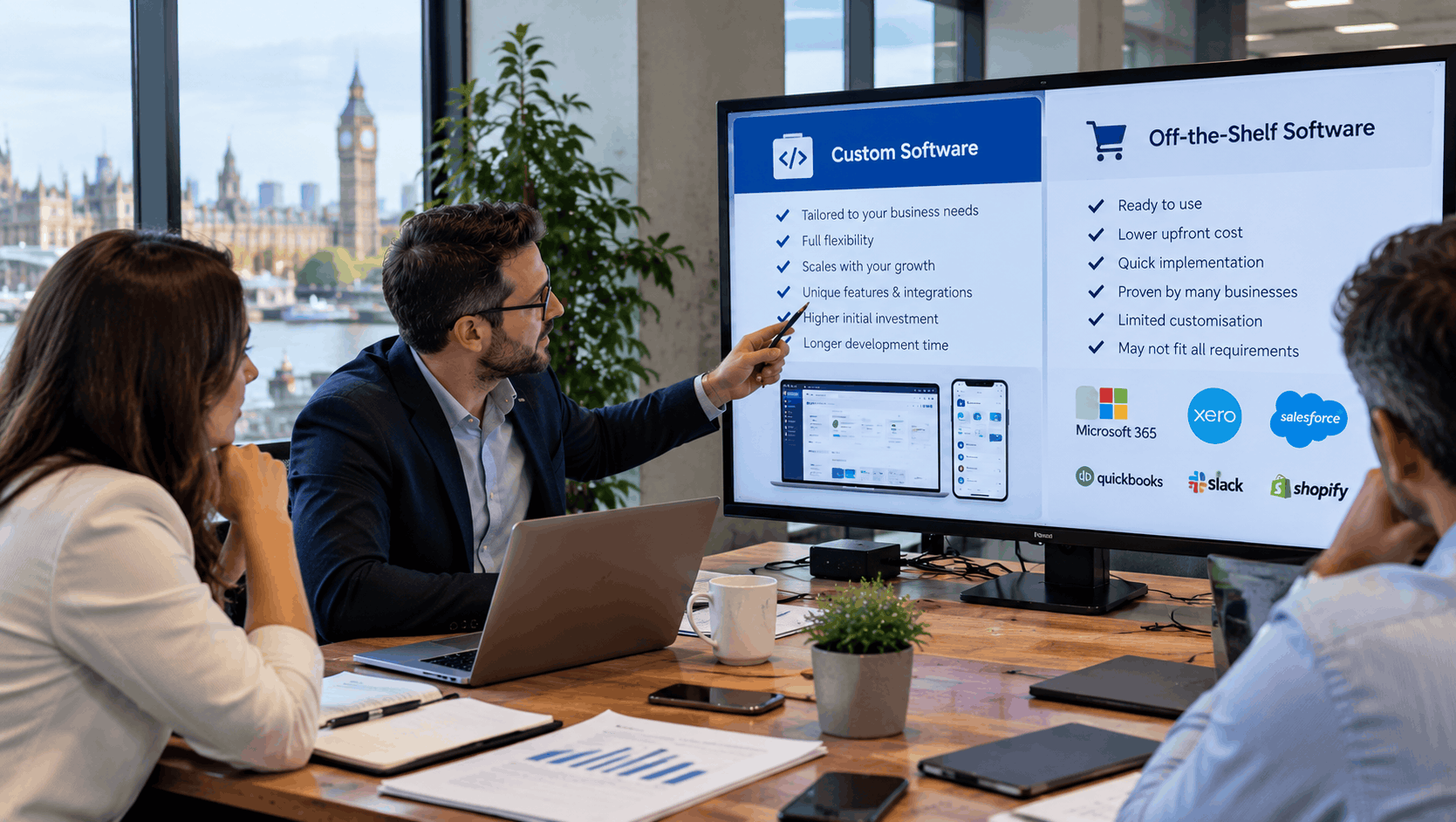
UK SME business team comparing custom software development with off-the-shelf business software
Comparing business requirements, integration needs and long-term costs helps SMEs choose the right software approach.