AI Data Readiness for UK SMEs: How to Prepare Business Data Before Automation
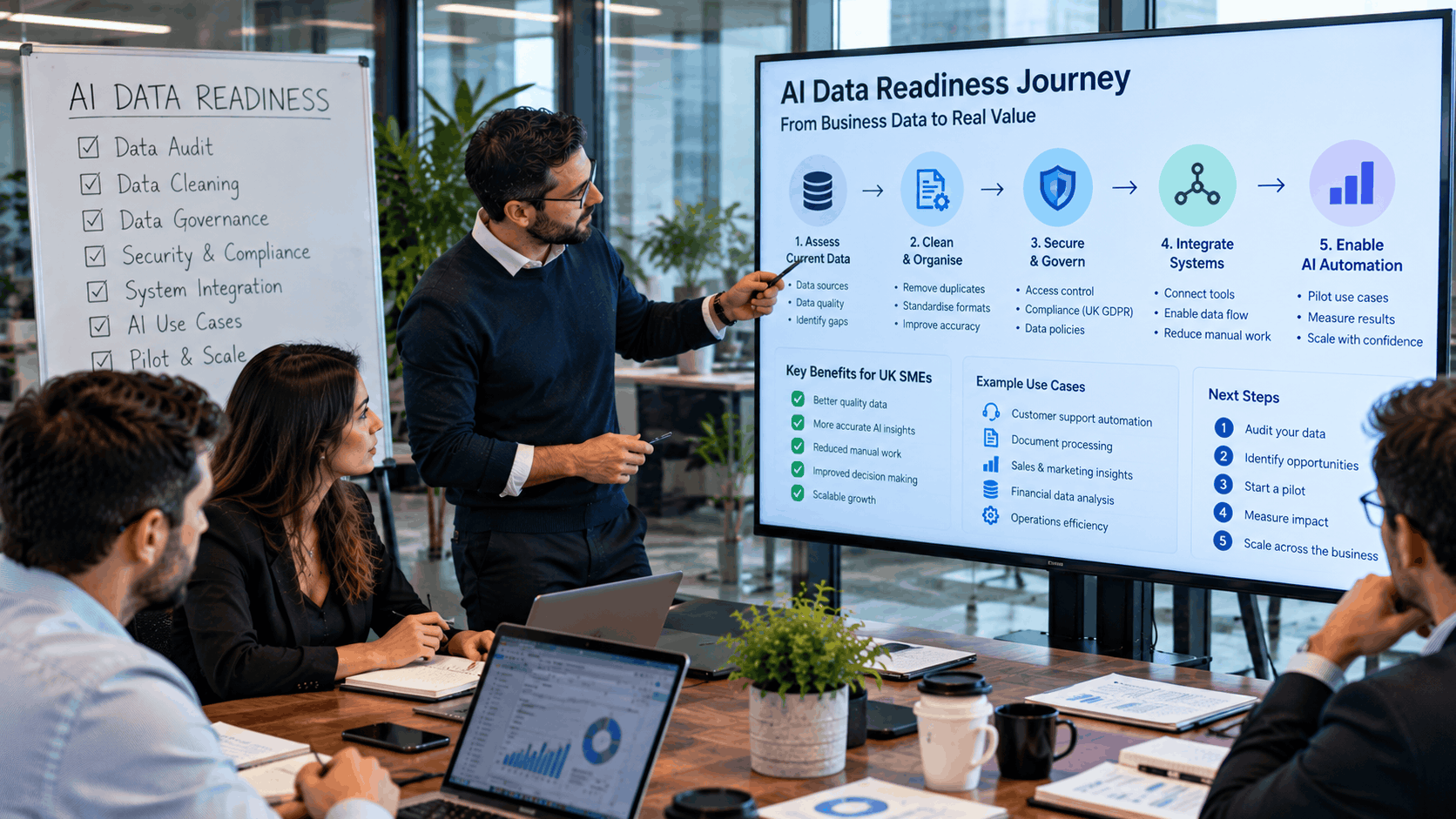
AI Data Readiness for UK SMEs | Prepare for Automation
Learn how UK SMEs can improve data quality, security and system integration before AI adoption. Discover practical steps for safer business automation.
AI data readiness for UK SMEs
AI readiness assessment UK, business data quality, AI automation for small businesses, data governance for SMEs, AI implementation UK, business systems integration, data preparation for AI, secure AI adoption, SME digital transformation.
AI readiness for UK SMEs, London business technology strategy, AI adoption for small businesses, UK data governance, business automation consulting.
Introduction: Why Business Data Matters Before AI Adoption
Artificial intelligence can help businesses classify information, summarise documents, support customer service and automate selected administrative tasks. However, the quality of the results depends heavily on the information available to the system, the workflow in which it operates and the safeguards surrounding its use.
Many UK SMEs already hold large amounts of business data across spreadsheets, email inboxes, accounting software, customer relationship management systems and document folders. That information may be incomplete, duplicated, inconsistently formatted or difficult to access securely.
Introducing AI before addressing these issues can create additional problems. A system may produce unreliable summaries, work with outdated records or struggle to identify the correct information. Automating a poorly designed process can make mistakes happen faster rather than improve the outcome.
AI data readiness is the process of assessing whether business information, systems, processes and governance are suitable for a particular AI use case.
For organisations reviewing their technology priorities, the Nexteck homepage provides a starting point for exploring its business technology strategy and AI readiness approach.
This guide explains how UK SMEs can prepare their data, assess risks and choose practical starting points for responsible AI adoption.
1. Start by Defining the AI Use Case
Before cleaning databases or purchasing AI tools, identify the business problem you want to solve.
Possible use cases include drafting responses to routine enquiries, categorising support requests, extracting information from invoices, searching internal documents or preparing initial summaries of business reports.
Each use case has different data requirements and risks. A tool that drafts an internal meeting summary has different implications from a system that processes customer records or influences financial decisions.
For each proposed use case, document:
The task the AI system should perform.
The people who will use the output.
The information the system needs.
The decisions that require human approval.
The consequences of an incorrect result.
The measures that will determine success.
Avoid adopting AI simply because it is available. A conventional workflow, better reporting or improved system integration may solve the problem more reliably.
The Nexteck SME Strategy & Tracking Toolkit describes a framework for identifying operational pain points, recording AI and IT opportunities, and prioritising actions according to impact, urgency and cost.
2. Map Where Your Business Data Lives
The next step is to understand where relevant information is stored and how it moves through the organisation.
A typical SME may keep customer information in a CRM, transaction records in accounting software, project details in spreadsheets and procedures in shared documents. Other information may exist in email conversations, supplier portals or industry-specific applications.
Create a data inventory covering the systems that support the chosen use case.
For each source, record:
The type of information it contains.
The department or person responsible for it.
How frequently it is updated.
Who can access it.
Whether it contains personal or confidential information.
How the information is exported, transferred or integrated.
Whether the source is considered authoritative.
This inventory helps identify gaps before the AI project begins. It can also reveal where employees are manually copying information between applications or maintaining multiple versions of the same record.
The Nexteck Industries page outlines sector-specific technology environments, including manufacturing, e-commerce, education, financial services and professional services. These different environments illustrate why data preparation must reflect the business's actual processes.
3. Improve Data Quality Before Automating
AI systems can produce misleading outputs when the source information is inaccurate, incomplete or inconsistent.
Data quality should therefore be reviewed against the needs of the proposed use case rather than treated as a general clean-up exercise.
Accuracy
Check whether important records reflect the real-world information they represent. For example, verify whether customer contact details and product identifiers are current.
Completeness
Identify missing fields that are necessary for the task. A document extraction workflow may fail if required reference numbers or dates are absent.
Consistency
Use agreed formats for dates, currencies, names, categories and identifiers. Inconsistent naming can make it harder to match records across systems.
Duplication
Identify duplicate customer, supplier, product or transaction records. Duplicate entries can distort reports and confuse automated workflows.
Timeliness
Determine whether the system needs current information or whether periodic updates are sufficient. An AI-generated report based on outdated data may be unsuitable for time-sensitive decisions.
Traceability
Where possible, preserve the source of important information so users can verify a result instead of relying on an unexplained answer.
Start with the fields that matter most to the selected use case. A small, well-maintained dataset may be more useful than a large collection of poorly structured records.
4. Establish Clear Data Ownership and Governance
Data governance defines who is responsible for business information, how it should be maintained and which rules apply to its use.
Without clear ownership, employees may change important fields, create duplicate records or use unapproved versions of documents. These problems become more difficult to manage when AI systems depend on information from several departments.
Assign an owner to each important data source. Define who can create, edit, approve and delete records, and document the process for correcting errors.
Useful governance practices include:
Documenting important data definitions.
Establishing access permissions.
Reviewing data quality regularly.
Recording material changes where appropriate.
Defining retention and deletion rules.
Maintaining procedures for reporting data problems.
Identifying who approves new AI use cases.
For example, a finance team should define which system is authoritative for invoice status rather than allowing an AI workflow to choose between conflicting spreadsheets.
The Nexteck Toolkit describes client diagnostics, operational planning, SOP and delegation registers, and KPI governance as parts of its framework. These activities can help businesses organise responsibilities before introducing automated workflows.
5. Review Privacy, Security and AI Provider Terms
AI readiness is not only about whether the data is technically usable. The business must also determine whether it is appropriate to share and process that information through the chosen system.
Before using a third-party AI service, review its terms, privacy documentation, data handling arrangements, retention settings, access controls and applicable contractual commitments.
Identify whether the proposed workflow includes personal information, confidential commercial records, financial data or customer communications.
Consider these safeguards:
Restrict access to authorised users.
Use approved accounts and tools.
Remove unnecessary personal information where appropriate.
Avoid including confidential details in unapproved services.
Review how prompts, uploaded files and outputs are handled.
Establish retention and deletion procedures.
Record when human review is required.
Define how suspected errors or data incidents will be reported.
UK businesses should assess applicable data protection obligations, including UK GDPR and the Data Protection Act 2018 where relevant. The correct approach depends on the data, purpose, legal basis and processing arrangements.
Do not assume that all AI tools handle information in the same way. Check the specific service and configuration before using it with business data.
6. Connect Systems Before Adding Unnecessary Complexity
Sometimes the main obstacle to AI adoption is not the AI technology itself but the way business systems store and exchange information.
If a sales team maintains customer details in one system and the finance team maintains different records elsewhere, an automated process may struggle to identify the correct information.
Review existing integration options before building a new AI workflow. Suitable connectors, APIs, scheduled data transfers or improved configuration may resolve the problem.
Document how information moves between systems, which system owns each record and how failures are detected.
Where integration is not currently practical, consider a limited workflow that uses an approved, controlled data source rather than connecting every application at once.
The Nexteck homepage is a starting point for exploring business technology, systems integration and AI readiness in the context of operational requirements.
7. Choose a Low-Risk Pilot Project
A small pilot helps an organisation test its assumptions before investing in a wider rollout.
Choose a task with a clear purpose, manageable consequences and a way to verify the output. Internal document search, drafting routine communications for staff review or categorising non-sensitive enquiries may be suitable starting points, depending on the business and the tools involved.
Define the boundaries before testing:
Specify the information the system can access.
Identify what the AI is and is not permitted to do.
Decide which outputs require human approval.
Prepare representative test cases.
Record errors and unexpected behaviour.
Measure performance against the existing process.
Decide whether to continue, adjust or stop the pilot.
Test ordinary scenarios as well as unusual inputs. A system that works well on a few simple examples may still fail when records are incomplete or requests are ambiguous.
Do not use a pilot as evidence of guaranteed business savings. Measure actual results in the relevant environment before estimating wider benefits.
8. Measure AI Performance With Meaningful KPIs
AI projects should be evaluated using the business outcomes they are intended to improve.
For example, an internal document search tool could be assessed on whether employees find accurate information more quickly. A draft-response workflow could be evaluated on editing effort, response quality and the number of corrections required.
Potential measures include:
Time spent completing a task.
Percentage of outputs accepted without major correction.
Error and escalation rates.
Data retrieval accuracy.
Employee adoption and feedback.
Cost per completed task.
System availability and integration failures.
Compliance with required review procedures.
Establish a baseline before the pilot and document the measurement method. Include the costs of software, implementation, training, supervision and ongoing maintenance.
A reduction in task time is not automatically a direct financial saving. It may instead give employees more capacity for customer service, sales or other work. Explain the difference when presenting results.
The Nexteck SME Strategy & Tracking Toolkit includes KPI governance in its described framework, providing a relevant reference point for connecting technology initiatives to measurable business outcomes.
9. Prepare Employees and Document the Workflow
AI adoption changes how people perform tasks, review information and handle exceptions. Employees should understand both the benefits and the limitations of the system.
Provide practical training on how to use the tool, how to verify its output, what information must not be shared and when to escalate a problem.
Document the revised workflow, including who checks the output, where approved information is stored and what happens when the AI produces an incorrect or incomplete result.
Avoid creating a process that depends entirely on one employee understanding how the system works. Clear documentation and assigned responsibilities help the organisation maintain the workflow over time.
10. Build a Practical 30-Day Data Readiness Plan
A short assessment can help an SME understand whether it is ready to test a particular AI use case.
Week 1: Define the objective
Select one business problem, identify the users and document the expected outcome.
Week 2: Review the data
Map relevant sources, identify missing or duplicated information, check data ownership and assess whether the dataset is suitable for the intended task.
Week 3: Review risk and design a pilot
Check privacy, access permissions, provider terms and human review requirements. Define the test cases, success measures and approval process.
Week 4: Test and evaluate
Run a controlled pilot, document errors, compare results against the baseline and decide whether the use case is ready for further development.
This schedule is an illustrative starting point. The actual time required will depend on the data, systems, complexity and risk involved.
Businesses can use the Nexteck SME Toolkit to explore its approach to diagnostics, AI and IT opportunity planning, process documentation and KPI governance.
Conclusion: Prepare the Foundations Before Scaling AI
AI data readiness helps UK SMEs make more informed decisions about automation. By understanding where data lives, improving quality, assigning ownership and reviewing privacy and security, a business can reduce avoidable risks before introducing new technology.
Start with one clear use case rather than attempting to automate the entire organisation. Prepare the relevant data, test the workflow under controlled conditions and measure the outcome before expanding.
The goal is not simply to introduce AI. It is to build a reliable business process in which technology helps employees work more effectively while protecting information and maintaining appropriate human oversight.
Explore the Nexteck homepage, review its industry and sector information, and visit the Nexteck SME Strategy & Tracking Toolkit to learn more about its approach to business technology strategy and AI readiness.
Frequently Asked Questions
What is AI data readiness?
AI data readiness is the process of assessing whether a business has suitable information, systems, processes, security controls and staff responsibilities for a particular AI use case.
Why is data quality important for AI?
Incomplete, inconsistent or outdated data can lead to unreliable outputs. Improving relevant data quality helps make AI workflows easier to validate and manage.
Can a small UK business use AI without a large data team?
Yes. A small business can begin with a limited, well-defined use case and a manageable dataset. It should still review security, data quality, provider terms and human oversight requirements.
What data should businesses avoid putting into AI tools?
Businesses should not place personal, confidential or sensitive information into a tool unless its use has been assessed and approved under the organisation's policies, contracts and applicable legal requirements.
How can an SME measure AI readiness?
Assess the intended use case, data quality, system integration, access controls, privacy requirements, staff capabilities, human review arrangements and measurable business objectives.
Should a company automate every repetitive task with AI?
No. Some tasks are better addressed through conventional automation, clearer procedures, software configuration or staff training. AI should be used where it is appropriate for the problem and its risks can be managed.